
Table of Contents
- Introduction: Navigating the World of Autonomous Vehicles
- The Evolution of Self-Driving Technology: A Brief History
- How Autonomous Vehicles Work: Key Technologies and Innovations
- The Benefits and Challenges of Self-Driving Cars
- Regulatory and Ethical Considerations in Autonomous Vehicle Deployment
- The Impact of Autonomous Vehicles on Society and the Economy
- Conclusion: The Road Ahead for Autonomous Vehicles and Self-Driving Technology
Introduction: Navigating the World of Autonomous Vehicles
Autonomous vehicles, once the stuff of science fiction, are rapidly becoming a reality in our everyday lives. They’re not just about getting from point A to point B without a driver. These machines are reshaping the very fabric of transportation. Imagine a world where your car is a smart assistant, navigating traffic, reducing accidents, and even finding the perfect parking spot.
In the realm of autonomous technology, safety is paramount. According to the National Highway Traffic Safety Administration, 94% of serious crashes are due to human error. Self-driving cars promise to reduce this figure significantly. In my experience, the precision of sensors and algorithms can react faster and more consistently than a human ever could. For instance, Google’s Waymo vehicles have already covered over 20 million miles on public roads, showcasing their potential to operate safely in diverse environments.
However, it’s not all smooth sailing. There are challenges that need addressing. First, the complexity of real-world scenarios is a major hurdle. Autonomous systems must be taught to handle unpredictable human behavior – think of a child darting into the road or a driver running a red light. Additionally, the ethical implications of decision-making algorithms pose questions. What should a car prioritize in an unavoidable crash scenario? These dilemmas are not just technical but deeply ethical.
From a practical standpoint, autonomous vehicles also promise eco-friendly benefits. By optimizing routes and driving patterns, they can reduce fuel consumption and emissions. But there’s a flip side. The infrastructure needed to support these vehicles, like specialized sensors and 5G networks, could lead to increased environmental strain. Moreover, the potential for job displacement in driving sectors can’t be ignored. While these vehicles offer convenience and safety, they also require us to rethink workforce dynamics and urban planning. The key takeaway here is that as we embrace this technology, a balanced, informed approach is crucial.
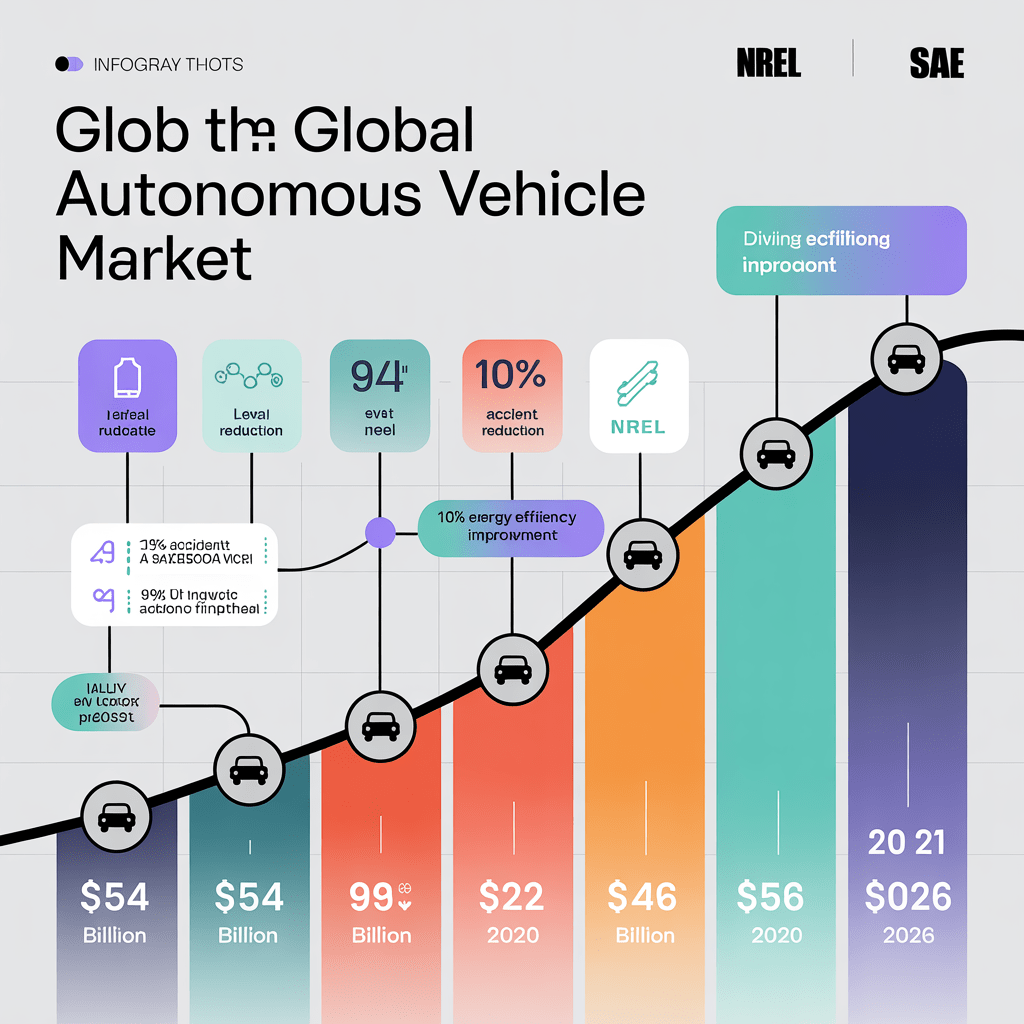
This infographic provides a comprehensive visual overview of the autonomous vehicle industry. It highlights the market’s exponential growth potential, defines the six levels of driving automation, emphasizes the significant safety improvements expected, and showcases advancements in energy efficiency. With data from trusted sources like Allied Market Research, SAE, NHTSA, and NREL, the infographic is designed to inform and captivate professional audiences interested in the future of automotive technology.
The Evolution of Self-Driving Technology: A Brief History
The journey of self-driving technology is a fascinating tale of ambition, innovation, and relentless pursuit of progress. The roots trace back to the 1980s, when the first concepts of autonomous vehicles began to take shape. In 1987, the German Bundeswehr University in Munich developed EUREKA Prometheus, a project that laid the groundwork for modern self-driving systems. Fast forward to the late 2000s, and we see the emergence of Google’s self-driving car project, which has now evolved into Waymo. This shift marked a significant leap from theoretical models to practical applications, showcasing real-world viability.
A pivotal moment occurred in 2004, with DARPA’s Grand Challenge. This competition invited teams to design autonomous vehicles capable of navigating a desert course. No vehicle completed the course that year, but it ignited a spark. By 2005, the subsequent challenge saw five teams succeed, proving that self-driving cars could handle complex environments. These competitions accelerated technological advancements, providing a testing ground for innovations like LIDAR and machine learning algorithms, which continue to be essential components of autonomous systems today.
In my experience, one of the most transformative developments has been the integration of AI and data analytics. Tesla’s approach to using over-the-air updates and real-time data collection has revolutionized how quickly vehicles can learn and improve. This strategy allows for rapid iteration and deployment of new features, increasing the adaptability of the technology. However, it also highlights a key challenge: ensuring the security and privacy of user data.
A common mistake I see is overestimating the readiness of self-driving technology for full autonomy. While companies like Waymo have achieved impressive milestones, the technology still grapples with unpredictable elements, like human behavior and weather conditions. This limitation points to the critical need for regulatory frameworks that ensure safety without stifling innovation. Balancing these aspects will be crucial as we move towards a future where autonomous vehicles are commonplace.
How Autonomous Vehicles Work: Key Technologies and Innovations
Autonomous vehicles are a fascinating blend of software, sensors, and connectivity working in harmony to navigate roads with minimal human intervention. At the heart of these vehicles is a sophisticated system of sensors, including LIDAR, radar, and cameras, which constantly collect data about the vehicle’s surroundings. LIDAR (Light Detection and Ranging) is crucial here. It creates a detailed 3D map of the environment by bouncing laser beams off nearby objects. This technology is essential for detecting obstacles, lane markings, and pedestrians.
Radar complements LIDAR by providing the ability to measure the speed and distance of objects. It’s particularly effective in adverse weather conditions where optical sensors might struggle. Cameras add another layer of detail, capturing visual information such as traffic signals and road signs. Together, these sensors feed data to the vehicle’s onboard computer, which processes the information in real-time to make decisions.
The processing power required to analyze this constant stream of data is immense. Machine learning algorithms play a pivotal role here. They help the vehicle understand complex driving scenarios by learning from vast datasets of previous road experiences. For example, if a pedestrian suddenly steps onto the road, the vehicle’s AI can predict potential paths and take preventive actions, such as braking or steering away.
From a practical standpoint, the integration of these technologies isn’t without its challenges. High costs associated with LIDAR and the complexity of software development are significant hurdles. Furthermore, the need for continuous updates and improvements in AI algorithms to handle unpredictable human behavior on the road cannot be overstated. However, the potential benefits are compelling. Autonomous vehicles promise to reduce accidents caused by human error, increase road efficiency, and offer mobility solutions for those unable to drive. The key takeaway here is that while the road to full autonomy is complex, the technological advancements driving it are undeniably exciting.
The Benefits and Challenges of Self-Driving Cars
Self-driving cars are transforming how we think about transportation. These vehicles promise enhanced safety, improved efficiency, and increased accessibility. The safety aspect is perhaps the most compelling. Human error accounts for nearly 94% of all road accidents, according to the National Highway Traffic Safety Administration. Autonomous vehicles, equipped with sensors and algorithms, can potentially reduce these accidents by reacting faster and eliminating distractions.
Another benefit is the potential for improved traffic flow and efficiency. Autonomous cars can communicate with each other, reducing the start-stop nature of traffic congestion. Imagine a world where cars automatically adjust their speed to maintain optimal traffic flow. This could lead to shorter commutes and less time wasted on the road. Cities like Singapore are already experimenting with this technology, aiming to reduce congestion in urban areas.
But, it’s not all smooth sailing. Cost remains a major hurdle. The technology involved in creating a reliable self-driving car is expensive. From LIDAR sensors to sophisticated software, the price of these vehicles can be prohibitive for many consumers. Moreover, ethical dilemmas pose significant challenges. Programming a car to make split-second decisions in an unavoidable accident scenario raises complex moral questions. Who is responsible for the actions of a self-driving car? These are questions that need answering before widespread adoption.
From a practical standpoint, the key takeaway is that while autonomous vehicles offer promising benefits, we must address these challenges head-on. As the technology evolves, real-world testing and regulatory frameworks will play a crucial role in shaping the future of self-driving cars. Balancing innovation with ethical considerations and affordability will be essential for these vehicles to become a staple in our daily lives.
Regulatory and Ethical Considerations in Autonomous Vehicle Deployment
Regulating autonomous vehicles isn’t just a technical challenge; it’s a complex web of legal and ethical dilemmas. Key considerations include safety standards, data privacy, and liability issues. In my experience, one of the biggest hurdles is establishing who is responsible in the event of an accident. Is it the vehicle manufacturer, the software developer, or the vehicle owner? Each stakeholder might have different levels of control and responsibility, complicating liability claims. The lack of precedent in such cases only muddies the waters further.
Safety standards are another critical area. To ensure public trust, autonomous vehicles must meet stringent safety benchmarks. For example, the National Highway Traffic Safety Administration (NHTSA) in the U.S. has been actively developing guidelines for self-driving technology. However, these standards must continuously evolve alongside technological advancements. A common mistake I see is underestimating how different regional regulations can impact the deployment of autonomous vehicles. What works in California may not fly in Europe or Asia due to varying legal landscapes.
On the ethical side, data privacy concerns loom large. Autonomous vehicles generate massive amounts of data that are crucial for improving algorithms. But this data can also include sensitive information about individuals’ whereabouts and habits. From a practical standpoint, balancing data utility with privacy rights is essential. Companies must ensure robust data protection measures are in place to prevent misuse or unauthorized access.
Pros of deploying autonomous vehicles include improved road safety, as they are designed to reduce human error, which is a leading cause of accidents. They also promise increased mobility for those unable to drive due to age or disability. Moreover, they could lead to more efficient traffic management, reducing congestion and emissions. Cons include the potential for job losses in driving sectors and the ethical implications of decision-making in unavoidable crash scenarios. The key takeaway here is that while the promise of autonomous vehicles is significant, the path to their full deployment is fraught with challenges that require careful navigation.
The Impact of Autonomous Vehicles on Society and the Economy
Autonomous vehicles are more than just futuristic gadgets; they’re poised to reshape both our society and economy in profound ways. Picture this: a bustling city where traffic accidents drop significantly because machines don’t get distracted or tired. According to the National Highway Traffic Safety Administration, 94% of serious crashes are due to human error. Imagine the lives saved and the reduction in medical costs if this risk could be minimized.
From an economic standpoint, the ripple effects of self-driving technology are vast. For instance, trucking companies are eyeing autonomous fleets to reduce labor costs. Currently, the U.S. trucking industry faces a driver shortage, with the American Trucking Associations reporting a gap of over 60,000 drivers. Self-driving trucks could fill this void, potentially cutting down delivery times and costs. However, a shift of this magnitude isn’t without challenges.
On the flip side, job displacement is a significant concern. Autonomous vehicles could endanger the livelihoods of millions of drivers. In my experience, industries often adapt, but the transition can be painful. As automation increases, new jobs in tech maintenance and monitoring might emerge, but they may not match the volume or fit the skillsets of displaced workers.
Moreover, there’s the issue of data privacy. Autonomous vehicles collect enormous amounts of data to function effectively. This data could be invaluable for improving road safety but also raises privacy concerns. Who owns this data, and how securely is it stored? In the real world, regulatory frameworks will need to evolve swiftly to address these issues. The key takeaway here is that while the technology holds great promise, it necessitates thoughtful consideration of its broader implications.
Conclusion: The Road Ahead for Autonomous Vehicles and Self-Driving Technology
Autonomous vehicles are not just a futuristic dream; they’re inching closer to reality with each software update and hardware improvement. In my experience, the biggest leap forward has been in sensor technology, which combines LIDAR, radar, and cameras to create a 360-degree view of a car’s surroundings. This advancement is critical for real-time decision-making, enabling these vehicles to respond swiftly to unexpected obstacles, like a pedestrian darting into the road.
One of the most promising aspects of self-driving technology is its potential to reduce traffic accidents, which are predominantly caused by human error. According to the National Highway Traffic Safety Administration, 94% of serious crashes are due to human mistakes. Autonomous systems, with their precise calculations and constant vigilance, could significantly cut down these numbers. Moreover, self-driving cars could enhance mobility for those unable to drive, such as the elderly or disabled, offering them newfound independence.
However, challenges remain. Safety concerns are at the forefront, with several high-profile incidents where autonomous systems failed, leading to accidents. While these instances are scrutinized and improvements are made, they highlight the need for rigorous testing and failsafe mechanisms. Additionally, the ethical dilemmas these vehicles face, like decision-making in unavoidable accident scenarios, continue to spark debate among developers and ethicists alike.
From a practical standpoint, the regulatory landscape is one of the biggest hurdles. The patchwork of laws across regions makes it difficult for manufacturers to deploy a unified solution. For instance, what’s permissible in one state or country might be banned in another. This inconsistency not only hampers progress but also deters investment. The key takeaway here is that while the road ahead for autonomous vehicles is fraught with obstacles, the potential benefits make it a journey worth pursuing. Ongoing collaboration between tech companies, regulators, and the public will be crucial to navigate these challenges successfully.