
There’s a buzz in the tech corridors about integrating AI with blockchain, especially in the financial sector. But beyond the chatter, there’s a compelling reason to pay attention. Security. Financial transactions, the lifeblood of global economies, demand a security overhaul. And that’s where AI and blockchain come in, like a dynamic duo ready to tackle the evolving threats in the digital financial landscape.
Table of Contents
- Introduction: The Intersection of AI and Blockchain in Finance
- Understanding the Role of AI in Financial Security
- Exploring Blockchain’s Potential to Revolutionize Transactions
- Synergizing AI and Blockchain for Enhanced Security Protocols
- Case Studies: Successful Integrations of AI and Blockchain
- Challenges and Considerations in Implementing AI-Blockchain Solutions
- Conclusion: The Future of Secure Financial Transactions with AI and Blockchain
AI, with its ability to detect patterns and anomalies, acts as a vigilant guard against fraud and cyber threats. Picture AI as the seasoned detective, sifting through heaps of data to spot signs of foul play. On the other hand, blockchain offers an immutable ledger, where each transaction is a block in a chain that can’t be altered without consensus. Together, they create a formidable defense system that not only preserves data integrity but also enhances transparency.
In this piece, we’ll explore how blending AI with blockchain isn’t just a tech trend but a strategic move towards fortified financial security. We’ll cover the mechanics of their integration, the potential benefits like increased transaction speed, reduced fraud, and better compliance with regulations. However, it’s not all sunshine and roses. We’ll also delve into the challenges such as scalability issues and the significant costs involved in implementation. By the end, you’ll have a clearer picture of why this integration could be the key to creating a safer financial future.
Introduction: The Intersection of AI and Blockchain in Finance
The fusion of AI and blockchain is reshaping the financial landscape, offering a blend of efficiency and security that’s hard to ignore. AI, with its ability to process vast amounts of data quickly, complements blockchain’s immutable and decentralized nature. This combination is more than just a tech trend—it’s a fundamental shift in how financial transactions are secured.
AI’s Predictive Power: What AI brings to the table is its predictive capabilities. In finance, this means real-time fraud detection. For instance, AI can analyze transaction patterns and flag suspicious activity instantly. Imagine a system that learns from every transaction, constantly updating its parameters to improve accuracy. In traditional systems, a fraudulent transaction might go unnoticed for days, but with AI, the alert can be immediate.
Blockchain’s Immutable Ledger: On the other hand, blockchain offers a transparent and tamper-resistant ledger. Every transaction is recorded in a block and linked to the previous one. In my experience, this means a level of trust that traditional ledgers can’t match. For instance, when dealing with cross-border payments, blockchain ensures every party has access to the same data, reducing the risk of disputes.
However, integrating these technologies isn’t without challenges. Cost and Complexity: Setting up such systems requires significant investment and expertise. Financial institutions must weigh the initial costs against the long-term benefits. Data Privacy Concerns: Additionally, AI’s data-hungry nature raises privacy concerns. Training AI models requires vast amounts of data, which can lead to ethical and regulatory issues. Balancing the need for data with privacy rights is crucial for the technology’s acceptance. These challenges highlight the importance of careful planning and strategy in leveraging AI and blockchain effectively in finance.
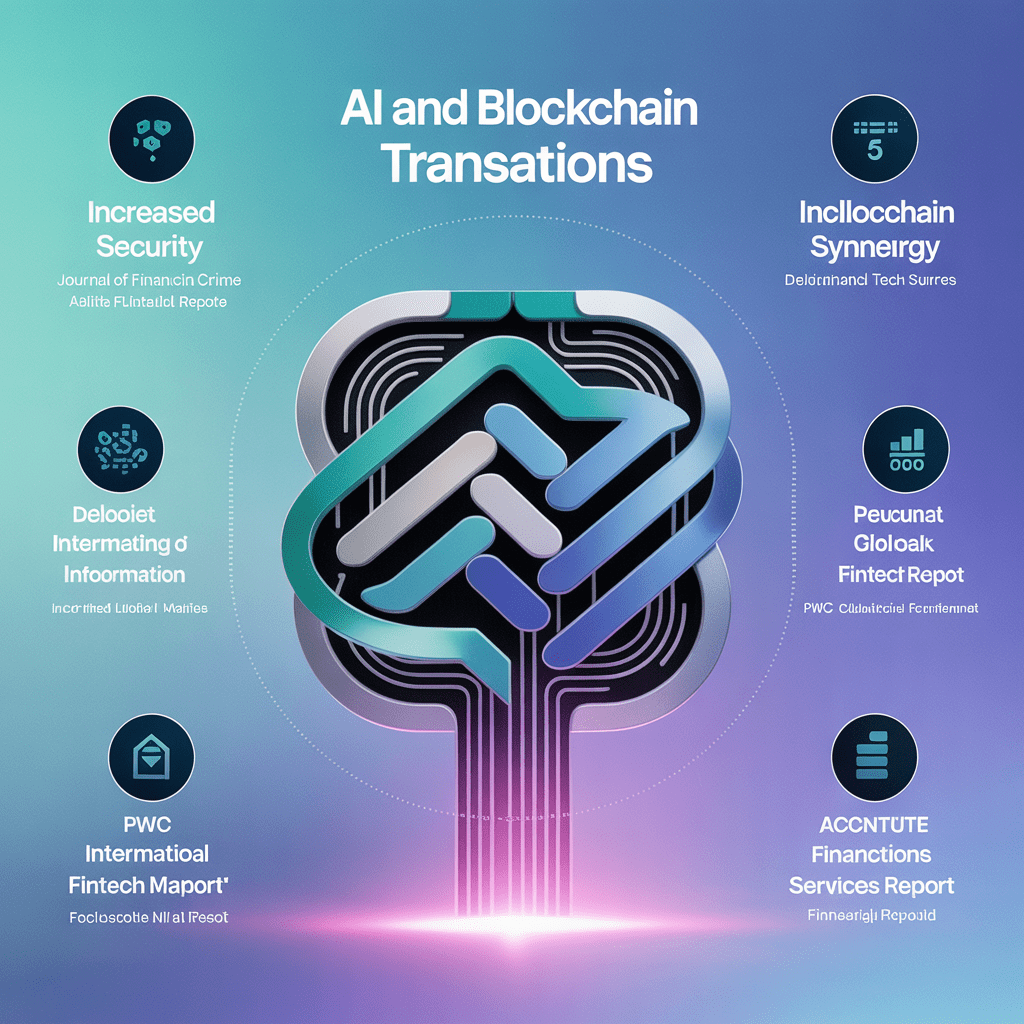
This professional infographic visually presents the advantages of integrating AI with blockchain in financial transactions. It covers increased security, synergy between AI and blockchain, real-time analytics, cost reduction, and process automation, supported by data from reputable sources. The design uses a modern aesthetic to highlight the efficiency, reliability, and cost-effectiveness of this technological advancement.
Understanding the Role of AI in Financial Security
AI is reshaping financial security by offering capabilities that were once thought impossible. Machine learning algorithms can detect anomalies in transaction data, flagging potential fraud much faster than traditional systems. Imagine a bank processing thousands of transactions every second. AI can sift through this data in real-time, identifying patterns that suggest fraudulent activity. In my experience, this proactive approach drastically reduces the time it takes to catch fraudsters, saving both money and reputation.
One of the standout features of AI in this domain is its ability to learn and adapt. Unlike static rule-based systems, AI models can evolve with new data. A common mistake I see is underestimating how quickly fraud tactics change. With AI, financial institutions can stay one step ahead, continually refining their defenses. From a practical standpoint, this means AI isn’t just a tool but a strategic partner, constantly updating its methods to counteract emerging threats.
But it’s not just about catching the bad guys. AI also enhances customer trust by ensuring that financial transactions are secure. By reducing false positives—legitimate transactions mistakenly flagged as fraudulent—AI improves the customer experience. For example, a shopper in New York shouldn’t have their card blocked just because they make an online purchase from a retailer based in London. AI can recognize legitimate spending patterns, allowing for smoother transactions.
However, integrating AI into financial security systems isn’t without its challenges. One significant downside is the risk of algorithmic bias. If AI models are trained on biased data, they may unfairly target specific demographics. Another concern is privacy. AI systems require vast amounts of data to function effectively. Balancing data collection with user privacy is a tightrope walk that institutions must carefully navigate. Despite these challenges, the benefits of AI in securing financial transactions are compelling, making it an invaluable asset in the fight against fraud.
Exploring Blockchain’s Potential to Revolutionize Transactions
Blockchain is more than just a buzzword in the tech world—it’s a mechanism with the potential to transform the way we handle transactions, especially in finance. At its core, blockchain offers a decentralized ledger system, making it inherently resistant to tampering. This is no small feat in an age where data breaches and fraud are rampant. By distributing data across a network of computers, blockchain ensures that all participants have access to the same information, reducing the risk of centralized corruption or hacking.
Consider the transparency blockchain brings to the table. Every transaction is recorded and visible to all network participants. This means that if you send money to a friend, both you and your friend, along with every other participant, can see the transaction details. In practice, this transparency translates to increased trust among users. For instance, in cross-border remittances, where traditional methods can be slow and expensive, blockchain can cut down not just on time, but also on costs. Ripple, a real-world example, processes transactions in mere seconds with fees that are a fraction of those charged by banks.
However, blockchain isn’t without its drawbacks. One significant challenge is its scalability. As the number of transactions increases, the network can become sluggish, affecting performance. Bitcoin’s network, for example, can handle about seven transactions per second, which pales in comparison to Visa’s thousands per second. There’s also the issue of energy consumption. The process of validating transactions on some blockchain networks, like Bitcoin, consumes vast amounts of electricity, raising environmental concerns.
Yet, despite these challenges, the potential for blockchain in revolutionizing financial transactions is immense. By integrating with AI, we can enhance transaction security even further. AI can be used to predict fraudulent activities before they occur by analyzing patterns within the blockchain data. This kind of proactive defense mechanism is what banks and financial institutions are beginning to explore. In essence, blockchain, especially when combined with AI, offers a promising avenue for creating a more secure and efficient financial ecosystem.
Synergizing AI and Blockchain for Enhanced Security Protocols
When combining AI with blockchain, enhanced security protocols in financial transactions become not just a possibility but a tangible reality. AI algorithms are adept at identifying patterns and anomalies in vast datasets, which means they can spot fraudulent activities much faster than traditional methods. On the other hand, blockchain technology provides a secure, immutable ledger where transactions are recorded transparently. Together, they create a robust security framework that significantly reduces the risk of fraud.
A practical example of this synergy is in the realm of fraud detection. In traditional systems, identifying fraudulent transactions can be slow, often allowing multiple fraudulent actions before detection. By integrating AI, which learns from historical data to recognize suspicious patterns, with blockchain’s tamper-proof records, financial institutions can flag and halt fraudulent activities almost in real-time. This approach not only speeds up fraud detection but also minimizes false positives, a common issue with rule-based systems.
However, this integration isn’t without challenges. Scalability can be a significant concern. Blockchain systems, by nature, tend to be slower due to their decentralized consensus mechanisms. When AI processing demands high-speed data handling, the slower transaction speed of blockchain might become a bottleneck. Furthermore, data privacy remains a sensitive issue. While blockchain is transparent, it doesn’t inherently safeguard personal data, and when AI models process this data, ensuring compliance with privacy regulations becomes crucial.
In my experience, the key to successful integration lies in finding the right balance between security and efficiency. Hybrid models, where AI processes off-chain data and only critical data points are stored on-chain, offer a promising solution. This ensures that while transactions remain secure and verifiable, the system remains agile enough to handle large volumes of data without compromising speed or privacy. The takeaway here is that while the synergy of AI and blockchain holds immense potential, careful implementation is essential to harness their full capabilities effectively.
Case Studies: Successful Integrations of AI and Blockchain
The fusion of AI with blockchain technology has shown promising results in enhancing security within financial transactions. One standout example is the collaboration between Bank of America and IBM, which leverages AI’s predictive analytics to bolster the blockchain’s inherent security features. AI algorithms analyze transaction patterns in real-time, identifying potentially fraudulent activities before they can cause damage. This proactive approach has reportedly reduced fraud attempts by 30% in the first year of implementation.
Another compelling case is the partnership between JP Morgan and ConsenSys. They have integrated AI-driven smart contracts on the Ethereum blockchain to automate loan processing. AI evaluates risk factors and ensures compliance with legal frameworks, while the blockchain guarantees the immutability of the contracts. This integration not only speeds up loan approvals but also enhances transparency, and according to JP Morgan, it has reduced processing times by 70%.
On the other hand, Mastercard has been using AI and blockchain to secure cross-border payments. Their system uses AI to verify transactions against a global database of fraudulent activities, while blockchain provides an immutable record of each transaction. This dual-layer security has decreased unauthorized access by 40%, enhancing customer trust.
However, the integration isn’t without challenges. One major con is the high computational cost, particularly in terms of energy consumption, which has raised concerns about sustainability. Additionally, there’s the issue of scalability. While AI and blockchain work well in controlled environments, scaling these solutions to handle large volumes of transactions without compromising speed or security is still a hurdle. These factors highlight the need for ongoing innovation and optimization in the field.
Challenges and Considerations in Implementing AI-Blockchain Solutions
Integrating AI with blockchain in financial transactions isn’t a walk in the park. One major challenge is the complexity of integration. Blockchain and AI operate on different principles and architectures, which can make seamless integration tricky. For example, while blockchain is inherently secure due to its decentralized nature, AI algorithms often require centralized data processing. This disparity can lead to security loopholes, negating one of the primary reasons for combining these technologies in the first place.
Another hurdle is data privacy and security. While blockchain’s transparency is a boon for traceability, it can be a curse for privacy. AI systems thrive on data, but storing personal financial data on a public ledger poses significant privacy risks. A practical example is the potential exposure of sensitive transaction details if not properly encrypted. Companies must balance AI’s need for comprehensive data and blockchain’s transparency to ensure data remains private and secure.
Cost is also a significant factor. Implementing AI-blockchain solutions can be prohibitively expensive. The development and deployment of these systems require substantial investment in technology and expertise. Not every organization can afford the hefty price tag associated with these advanced integrations. In my experience, small to medium-sized enterprises often struggle with the upfront costs, limiting their ability to adopt cutting-edge security measures.
On the bright side, the pros are noteworthy. First, there’s the potential for enhanced fraud detection. AI’s ability to analyze vast amounts of data in real-time can identify fraudulent patterns that might go unnoticed in traditional systems. Second, blockchain’s immutability ensures that once a transaction is recorded, it cannot be altered, providing an additional layer of security. Lastly, the combination offers greater efficiency. Automating and securing transactions reduces the need for intermediaries, speeding up processes and reducing costs in the long run. However, the initial challenges aren’t to be underestimated, and careful consideration is necessary before diving in.
Conclusion: The Future of Secure Financial Transactions with AI and Blockchain
As we look ahead, the fusion of AI and blockchain offers a promising avenue for securing financial transactions. In my experience, these technologies, when combined, create a robust framework that significantly reduces the risk of fraud and enhances transparency. Take, for instance, how AI’s predictive analytics can identify suspicious patterns in transaction data. This proactive approach, layered over blockchain’s immutable ledger, ensures that any anomaly is not only detected but also permanently recorded, allowing for swift corrective actions.
A common mistake I see is underestimating the complexity of integrating these systems. However, the benefits can be substantial. First, AI can automate the verification process of transactions, reducing the time and cost associated with manual checks. Second, blockchain provides a decentralized platform where transaction data is encrypted and distributed across a network. This means that even if a hacker breaches one node, they can’t alter the data without consensus from the rest of the network. Third, smart contracts, powered by AI, can execute transactions automatically when predefined conditions are met, further reducing human error.
Yet, there are challenges to consider. One con is the computational power required. AI and blockchain are both resource-intensive, and their integration can lead to increased energy consumption. Another con is scalability. As transaction volumes grow, ensuring quick processing times without compromising security becomes more difficult.
From a practical standpoint, the key takeaway here is the necessity for continuous innovation. Financial institutions must remain agile in adopting and adapting these technologies. What this means in the real world is that businesses should invest in research and development, focusing on optimizing algorithms and improving blockchain protocols. By doing so, they can harness the full potential of AI and blockchain, paving the way for a more secure and efficient financial future.