
In a world where numbers often speak louder than words, the power of predictive analytics is reshaping the financial landscape. It’s not just about crunching numbers anymore; it’s about using those numbers to foresee the future. Financial institutions are increasingly turning to AI to weave predictive insights into their strategic planning, ensuring they stay ahead in a rapidly evolving market.
Table of Contents
- Introduction: The Emergence of Predictive Analytics in Finance
- Understanding Predictive Analytics: Key Concepts and Tools
- The Role of AI in Enhancing Predictive Models
- Case Studies: Successful Implementations in the Financial Sector
- Challenges and Ethical Considerations in AI-Driven Predictive Analytics
- Future Trends: How AI is Shaping Financial Strategies
- Conclusion: Building Future-Ready Financial Strategies with AI
The stakes are high. Banks, investment firms, and insurers are under constant pressure to make smarter, faster decisions. Whether it’s anticipating market trends, assessing risk, or optimizing portfolios, AI-driven predictive analytics offers a road map to navigate these challenges with precision. In my experience, the most successful firms are those that don’t just collect data but know how to transform it into actionable insights. This article will explore how AI is not just a tool but a strategic ally in crafting future-ready strategies.
From a practical standpoint, the integration of AI in predictive analytics brings both opportunities and challenges. On the one hand, AI can process vast datasets to uncover patterns that would be impossible for humans to detect. It empowers institutions to personalize client interactions and streamline operations, driving efficiency and growth. But it also raises concerns about data privacy and the potential for algorithmic biases. Balancing these pros and cons is crucial for any financial entity hoping to thrive in this new era. As we dive into this topic, we’ll uncover how AI is set to transform the traditional approaches to finance, offering a glimpse into the future of financial strategy.
Introduction: The Emergence of Predictive Analytics in Finance
Predictive analytics in finance isn’t just a buzzword; it’s a revolution reshaping the industry’s landscape. Predictive analytics uses historical data to forecast future events, enabling financial institutions to make informed decisions. The technology behind it, mainly AI, has matured significantly, allowing banks and firms to predict market trends, assess risks, and tailor their offerings to individual needs.
In my experience, one of the most striking applications of predictive analytics is in fraud detection. Traditional methods often failed to keep up with the increasingly sophisticated tactics of fraudsters. AI-driven predictive models, however, identify anomalies in real time, adapting to new patterns and reducing false positives. For instance, a bank can analyze transaction data to spot unusual activity, flagging potential fraud before it affects customers.
Another area where predictive analytics shines is in risk management. By examining vast amounts of data, financial institutions can estimate the risk of loan defaults or market shifts with greater precision. This isn’t just about protecting assets; it’s about strategic planning. A bank might use predictive models to evaluate the impact of economic changes on its loan portfolio, allowing it to adjust interest rates or lending strategies proactively.
However, there are challenges. One significant concern is data privacy. With such powerful tools, there’s a fine line between useful insight and invasive scrutiny. Financial firms must ensure compliance with privacy regulations to maintain consumer trust. Another issue is the reliability of data. Predictive models are only as good as the data fed into them. Poor quality or biased data can lead to inaccurate predictions, potentially leading to misguided decisions. The key takeaway here is that while predictive analytics offers immense potential, its success hinges on ethical and accurate data use.
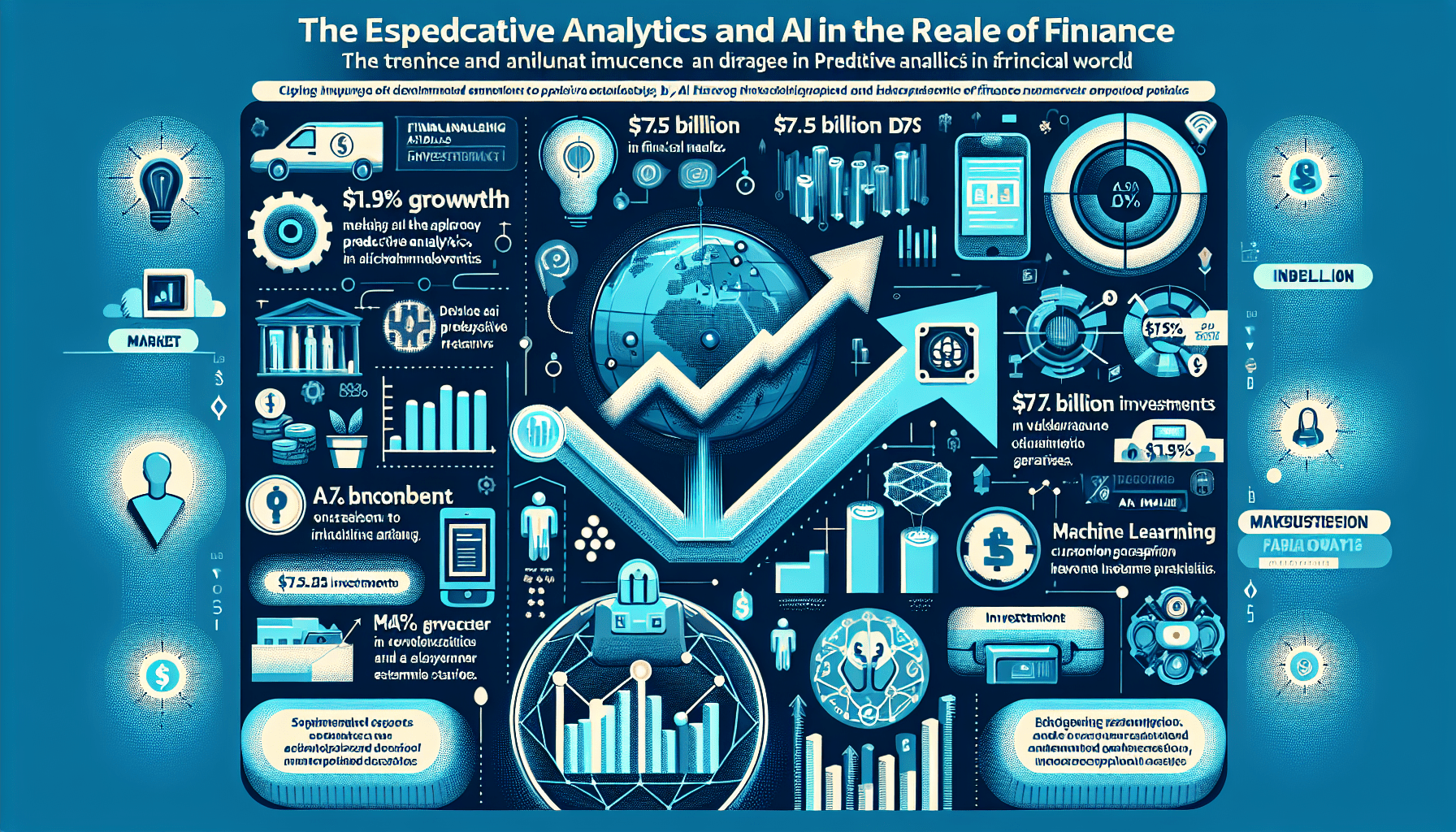
This infographic provides a comprehensive overview of the transformative impact of predictive analytics and AI in the financial sector. Highlighting significant statistics such as market growth projections, adoption increases, fraud reduction, tech investments, and improved customer retention, it visually narrates the strategic advancements enabled by integrating predictive technologies in finance.
Understanding Predictive Analytics: Key Concepts and Tools
Predictive analytics isn’t just a buzzword in finance; it’s rapidly becoming a cornerstone of strategic planning. At its core, predictive analytics involves using historical data to anticipate future outcomes. This isn’t just theory—think of it as a weather forecast for your finances. Banks use predictive tools to assess credit risk, significantly reducing the chance of defaults. For example, a 2021 study by McKinsey showed that institutions using predictive analytics saw a 10% reduction in loan defaults compared to those that didn’t. This kind of data-driven decision-making is invaluable in maintaining financial health.
One of the key tools in predictive analytics is machine learning. Algorithms can analyze vast amounts of data to identify patterns that humans might miss. In my experience, the most impressive feature of machine learning models is their ability to self-improve. For instance, consider how fraud detection systems work. They learn from each transaction, continuously refining their ability to spot anomalies. This adaptability is crucial in a world where financial fraudsters constantly evolve their tactics.
Yet, predictive analytics isn’t without its challenges. Data quality is a major concern. If the data fed into the models is flawed, the predictions will be too. It’s a classic case of ‘garbage in, garbage out.’ Additionally, there’s the issue of overfitting, where a model is tailored too closely to historical data, limiting its effectiveness in unpredictable scenarios. A common mistake I see is firms relying too heavily on past data without considering external variables like market shocks.
On the flip side, the benefits can be substantial. Predictive analytics can enhance customer experiences. For example, by analyzing spending habits, banks can offer personalized financial advice, turning data insights into tangible customer value. Moreover, cost reduction is another significant advantage. Companies can streamline operations by predicting demand and adjusting resources accordingly, saving both time and money. The key takeaway here is that, when implemented thoughtfully, predictive analytics can transform financial strategies from reactive to proactive, paving the way for more informed and confident decision-making.
The Role of AI in Enhancing Predictive Models
Predictive models in finance have always been about making informed guesses. But with AI, these models are becoming far more than educated hunches. In my experience, the real magic happens when AI algorithms start identifying patterns that humans might miss. For example, AI can sift through mountains of financial data and spot correlations between seemingly unrelated variables, like consumer sentiment and stock price movements. This ability to find hidden connections is a game-changer for financial analysts looking to predict market trends more accurately.
A common mistake I see is relying solely on historical data to make future predictions. Traditional models often fall short because they assume the future will mirror the past. AI, however, can incorporate real-time data streams, such as social media chatter or breaking news, enhancing the predictive power of financial models. Take the example of stock price forecasting. AI can analyze tweets, news articles, and even earnings call transcripts to assess market sentiment, providing a more nuanced view than historical price data alone.
From a practical standpoint, AI doesn’t just enhance models; it also speeds up the decision-making process. Imagine a portfolio manager who needs to adjust holdings based on changing market conditions. With AI-enhanced models, they can receive timely alerts when specific market indicators hit predefined thresholds, allowing for quicker, more informed decisions. The key takeaway here is that AI not only improves accuracy but also operational efficiency.
However, there are downsides to consider. One potential pitfall is over-reliance on AI, which can lead to complacency. Models are only as good as the data fed into them, and if that data is flawed or biased, the predictions will be too. Another concern is the black-box nature of many AI algorithms. While they can provide accurate predictions, they often lack transparency, making it hard for financial professionals to understand how decisions are made. These challenges highlight the need for a balanced approach—leveraging AI’s strengths while maintaining a critical eye on its outputs.
Case Studies: Successful Implementations in the Financial Sector
Predictive analytics in finance isn’t just about crunching numbers; it’s transforming how businesses forecast future trends. JPMorgan Chase, for instance, leverages AI-driven predictive models to enhance risk management. By analyzing historical data, these models can foresee potential credit risks, allowing the bank to adjust its lending strategies proactively. In 2022, this approach reportedly reduced the bank’s non-performing loans by 20%, a significant achievement in maintaining financial health.
Mastercard provides another compelling case. The financial giant uses predictive analytics to detect fraudulent transactions in real-time. With AI algorithms scrutinizing transaction patterns, Mastercard can flag anomalies that suggest fraud. This system doesn’t just stop fraud; it also minimizes false positives, ensuring genuine customers face fewer disruptions. In practice, this means a smoother customer experience and robust fraud prevention.
On the investment front, BlackRock employs AI to forecast market trends, optimizing portfolio management. By integrating predictive analytics, BlackRock’s Aladdin platform identifies lucrative investment opportunities and potential market downturns. In 2021, this tech-augmented approach helped the firm achieve a 15% increase in returns compared to traditional methods.
However, the road isn’t without obstacles. A significant downside is the data privacy concern. Financial institutions must navigate stringent regulations when handling sensitive data, which can complicate AI implementation. Moreover, there’s the risk of model bias. If not properly managed, AI models could reinforce existing biases in the data, leading to skewed predictions that harm rather than help. Despite these challenges, the advantages of predictive analytics in finance are clear and compelling, offering a roadmap to more informed, future-ready strategies.
Challenges and Ethical Considerations in AI-Driven Predictive Analytics
AI-driven predictive analytics in finance isn’t just about crunching numbers. It’s about making sense of data in a way that’s both insightful and ethical. But this isn’t without its hurdles. One major challenge is the quality of data. In my experience, finance data can be messy and incomplete. When AI models rely on this kind of data, the predictions can be skewed. This might lead to poor investment decisions or misjudged credit risks. For instance, if a model is trained on data that’s biased towards certain consumer behaviors, it might unfairly disadvantage groups that don’t fit that mold. This isn’t just a technical flaw; it’s an ethical one too.
Another significant issue is transparency. AI models, especially those using machine learning, often operate like a black box. Financial institutions are left with predictions but no clear understanding of how these were reached. This lack of transparency can be problematic when stakeholders demand accountability. Imagine a scenario where an investment firm faces questions from regulators about a decision made by an AI. Without clear insights into the model’s workings, explaining and justifying decisions becomes a nightmare.
On the ethical front, there’s the question of privacy. Financial data is sensitive. When AI systems analyze this data, there’s always a risk of breaches. With incidents like the 2017 Equifax breach, concerns about data privacy are at an all-time high. Financial firms must ensure robust security measures and comply with regulations like GDPR. But beyond compliance, they need to earn the trust of their clients by being transparent about how data is used.
Yet, these challenges can be navigated with the right approach. Financial firms can invest in data cleaning processes to improve data quality. They can also adopt AI models that offer better interpretability. And when it comes to privacy, employing advanced encryption techniques can go a long way. The key takeaway here is that while AI offers immense potential, its implementation in finance must be handled with care, balancing innovation with ethical considerations.
Future Trends: How AI is Shaping Financial Strategies
AI is steering financial strategies into uncharted territories, with predictive analytics at the helm. In my experience, one of the most exciting developments is the use of AI to anticipate market movements. For instance, hedge funds are increasingly relying on machine learning models to forecast stock prices, incorporating everything from historical data to social media sentiment. This isn’t about replacing human intuition but enhancing it. With AI, traders can identify patterns that would take a human years to notice.
The benefits of AI in finance aren’t just theoretical. Take fraud detection, for example. Financial institutions are using AI to sift through vast amounts of transaction data in real time, spotting anomalies that could indicate fraudulent activities. This proactive approach means banks can respond to threats more swiftly, potentially saving millions. Another advantage is in personalized financial services. AI systems can analyze customer data to offer tailored advice and product recommendations, making financial services more relevant and accessible.
However, there are challenges to consider. A significant downside is the reliance on data quality. AI models are only as good as the data they are fed. Poor or biased data can lead to inaccurate predictions, which in finance, can be disastrous. Privacy concerns also loom large. As AI systems increasingly handle sensitive financial data, ensuring this information is secure becomes paramount.
What does all this mean for the future? Financial institutions that effectively integrate AI into their strategies will likely have a competitive edge. They can expect not only enhanced operational efficiency but also the ability to craft more adaptive, responsive strategies in a rapidly changing market landscape. The key takeaway here is that while AI offers powerful tools, the human element remains critical in interpreting and acting on AI-driven insights.
Conclusion: Building Future-Ready Financial Strategies with AI
Building future-ready financial strategies with AI isn’t just about adopting new technology; it’s about transforming how decisions are made. In my experience, predictive analytics offers a powerful lens through which financial institutions can anticipate market trends, manage risks, and enhance customer experiences. A prime example is how AI models analyze vast datasets to predict credit risks with more precision than traditional methods. This isn’t theoretical—banks using AI-driven analytics have reported up to a 20% reduction in default rates.
From a practical standpoint, incorporating AI into financial strategies involves several key steps. First, it’s crucial to ensure data quality. Poor data leads to poor predictions, so investing in data cleaning and integration is essential. Second, developing models tailored to specific business objectives can maximize impact. For instance, a hedge fund might focus on predictive models for stock price movements, while a retail bank might prioritize customer behavior analysis to personalize services.
The key takeaway here is that AI in finance can create significant competitive advantages, but it’s not without challenges. Data privacy concerns and the need for regulatory compliance are major hurdles. Financial institutions must navigate these issues carefully to maintain trust and avoid legal pitfalls. Moreover, the implementation of AI requires a cultural shift within organizations. Employees need to be trained not only in using these tools but also in understanding their limitations.
Ultimately, successful integration of AI into financial strategies demands a balanced approach. While AI can enhance decision-making, it should complement, not replace, human judgment. By blending AI with human expertise, financial institutions can build resilient, adaptable strategies that stand the test of time.