
In the world of investing, the clash between traditional strategies and AI-driven methods isn’t just academic—it’s reshaping portfolios and the future of finance itself. For decades, seasoned investors relied on fundamental analysis, market trends, and a keen understanding of economic indicators to guide their decisions. These methods have stood the test of time because they hinge on human intuition and a deep understanding of market psychology. Yet, as artificial intelligence technology has matured, it’s begun to carve out its own niche in the investment landscape, offering a compelling alternative that promises efficiency and data-driven precision.
Table of Contents
- Introduction: Navigating the World of Investment Strategies
- Understanding Traditional Investment Strategies
- The Rise of AI-Driven Investment Approaches
- Comparative Analysis: Pros and Cons of Each Strategy
- Case Studies: Real-World Applications and Outcomes
- Key Considerations for Choosing Your Investment Strategy
- Conclusion: The Future of Investment in a Technology-Driven World
AI-driven investment strategies capitalize on computing power and vast data sets to make decisions. These algorithms analyze patterns and anomalies that might elude even the most astute human analyst. What’s fascinating is how AI can process data at a speed and scale that humans simply can’t match. This can lead to insights derived from real-time data across global markets, offering new possibilities for risk management and return on investment. But, the real world isn’t just numbers and predictions—it’s also about gut feeling and understanding human behavior, which AI might struggle to replicate.
This article dives into the heart of these two approaches. We’ll look at the advantages of AI, such as its ability to handle large volumes of data and adapt to new information quickly. On the flip side, we’ll also consider the drawbacks, like the potential for over-reliance on technology and the lack of human judgment in unpredictable situations. By contrasting these strategies, you’ll gain a clearer picture of where each shines and where they might fall short. Ultimately, the goal is to equip you with the knowledge to make informed decisions about how you might balance these strategies in your own investment approach.
Introduction: Navigating the World of Investment Strategies
Investing isn’t just about the numbers; it’s a reflection of how we perceive the world around us. Traditional investment strategies, honed over decades, emphasize human intuition and long-term insights. Think of Warren Buffett’s value investing, which hinges on the belief that the market sometimes undervalues competent companies. This strategy relies on patience and a deep understanding of market cycles. Investors look for stocks trading for less than their intrinsic values, betting on their eventual market recognition.
Enter AI-driven strategies, which promise something different. These systems process massive datasets at lightning speeds, identifying patterns that a human might miss. For example, an AI might analyze social media sentiment to predict short-term stock movements. This capability to crunch numbers and learn from vast amounts of data isn’t just about speed; it’s about uncovering insights that are invisible to the naked eye. In my experience, the key takeaway here is that AI can react to market changes almost instantaneously, potentially capturing opportunities or avoiding pitfalls before traditional methods could.
But there’s a flip side. Traditional methods, with their reliance on human judgment, often account for qualitative factors that machines struggle to quantify. The 2008 financial crisis taught us that market emotions, such as fear and greed, play pivotal roles in price movements. While AI can spot trends, it doesn’t yet understand human emotion or regulatory changes as deeply as a seasoned investor might.
From a practical standpoint, combining these strategies could be the sweet spot. Consider a hybrid approach: use AI for data analysis and trend spotting, while relying on human expertise for decision-making. This melds the best of both worlds, leveraging AI’s strengths while mitigating its weaknesses. Ultimately, the real-world application of these methods depends on your investment goals and risk tolerance. Whether you lean towards the tried-and-true or the cutting-edge, understanding the nuances of each strategy is essential for navigating today’s investment landscape.
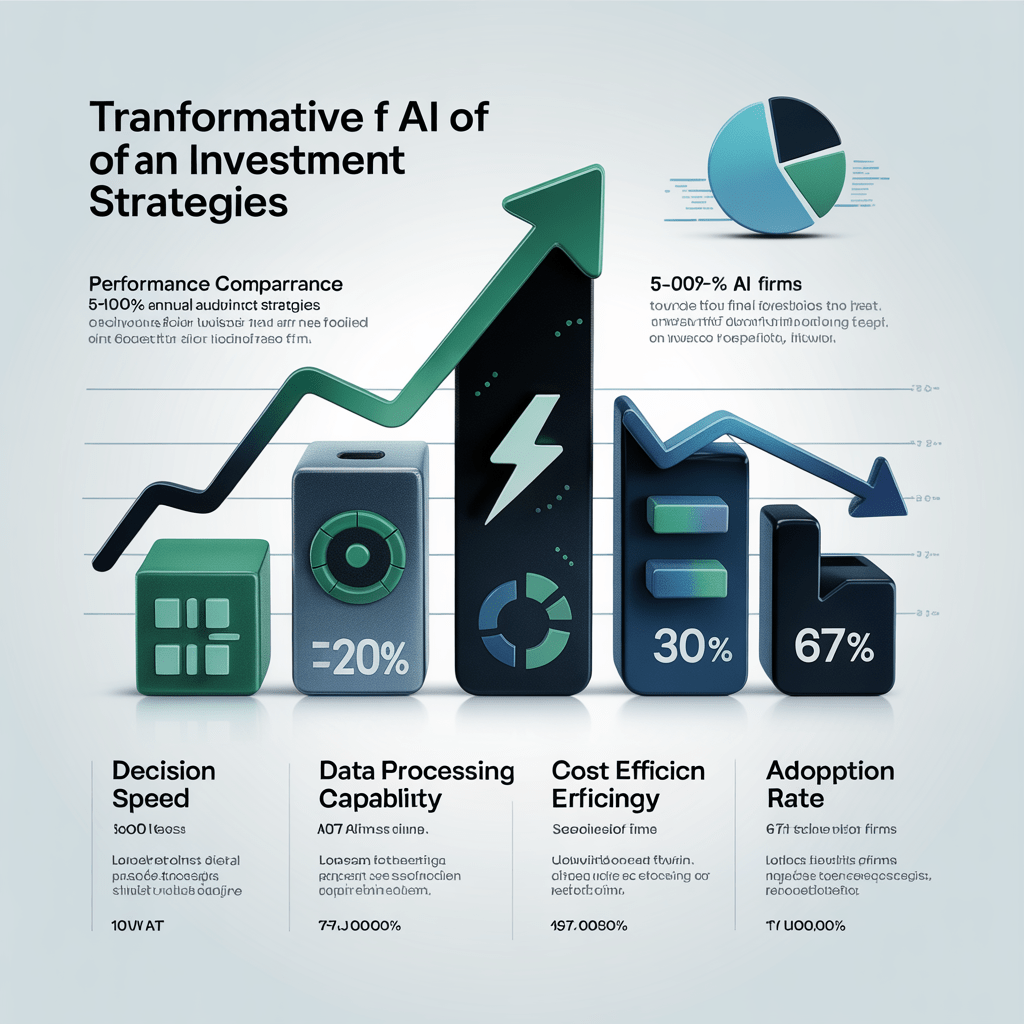
This professional infographic illustrates the transformative impact of AI on investment strategies. It highlights AI-driven performance improvements, decision-making speed, data processing capabilities, cost efficiencies, and current adoption rates in the industry, providing a comprehensive overview for financial professionals and stakeholders.
Understanding Traditional Investment Strategies
When it comes to traditional investment strategies, the hallmark is a structured, time-tested approach. These strategies usually rely on fundamental analysis, where investors evaluate a company’s financial health, market position, and management team. For instance, the Price-to-Earnings (P/E) ratio is a classic tool. A low P/E ratio might suggest a stock is undervalued, offering a potential bargain for the discerning investor.
Traditional methods also emphasize diversification to mitigate risk. By spreading investments across different asset classes—such as stocks, bonds, and real estate—investors can cushion against market volatility. A well-balanced portfolio might include a mix of blue-chip stocks for stability and small-cap stocks for growth potential.
Pros of traditional strategies are clear. First, their long-standing track record offers a sense of security. Investors have trusted these approaches for decades. Second, they provide a solid framework for decision-making, especially for those new to investing. Third, traditional strategies often emphasize risk management through diversification, which can protect against significant losses.
However, there are Cons too. One downside is that traditional strategies can be slow to adapt to market changes. In a rapidly shifting economic landscape, this can mean missed opportunities. Moreover, they require extensive research and analysis, which can be time-consuming and complex. Understanding financial statements and market trends takes considerable effort and expertise.
In my experience, traditional strategies serve well for those who value stability and a methodical approach. But in today’s fast-paced world, complementing them with modern tools might offer a more balanced strategy.
The Rise of AI-Driven Investment Approaches
AI-driven investment strategies are not just the future—they’re very much the present, and their influence is growing. Traditional investment relies heavily on human intuition and experience, but AI systems bring something new to the table: the ability to process vast amounts of data at astonishing speeds. Consider this: a human analyst might spend days combing through financial reports or market trends, while an AI can do the same in seconds, drawing insights from sources as varied as social media sentiment to obscure economic indicators.
Pros of AI-Driven Strategies:
Data Processing Power: AI can analyze millions of data points quickly, leading to insights that might be missed by human analysts. For instance, hedge funds using AI have reportedly outperformed those relying solely on human judgment by tapping into real-time data streams.
Emotionless Execution: Unlike human traders, AI systems don’t suffer from emotional biases. They execute trades based solely on data-driven analysis, which can lead to more consistent returns.
Adaptability: AI systems can be programmed to learn and adapt. They adjust to new data and changing market conditions, potentially providing an edge in volatile markets.
Cons of AI-Driven Strategies:
Overreliance on Data: While AI’s strength lies in data processing, it can be a double-edged sword. If the data is flawed or biased, the AI’s decisions will reflect those inaccuracies.
Lack of Intuition: AI lacks the nuanced understanding that human investors might have, especially when it comes to predicting market sentiment during unprecedented events.
In my experience, the balance between traditional and AI-driven strategies often comes down to finding the right mix. A hybrid approach, where AI augments human decision-making, can offer the best of both worlds. AI can handle the heavy lifting of data analysis, while human experts apply their judgment to interpret the results. The takeaway here is not to abandon human expertise but to enhance it with the power of AI, allowing for more informed and potentially profitable investment decisions.
Comparative Analysis: Pros and Cons of Each Strategy
When comparing traditional and AI-driven investment strategies, each has its unique strengths and weaknesses, shaped by how they approach the market and handle data. Traditional investment strategies rely heavily on human intuition and historical knowledge. Pros include the ability to adapt to unforeseen market changes through human judgment, the depth of experience seasoned investors bring, and the application of well-established financial theories. For example, a veteran investor spotting subtle market trends might adjust a portfolio in ways an algorithm might not.
However, traditional methods can be slow to react due to reliance on human decision-making processes, which can be a disadvantage in fast-moving markets. Additionally, cognitive biases can lead to suboptimal decision-making. A common issue is overconfidence, where investors might underestimate risks, potentially leading to significant losses.
AI-driven investment strategies, on the other hand, offer the advantage of processing massive datasets at speeds no human could match. These systems can identify patterns and correlations in real-time, enabling more precise decision-making. For instance, AI algorithms can analyze social media sentiment alongside market data to predict stock movements more accurately. Another pro is scalability, as AI systems can manage extensive portfolios with minimal human intervention, reducing costs.
Yet, AI strategies aren’t without their flaws. One major con is the dependency on high-quality data; poor data can lead to misguided decisions. There’s also the risk of overfitting, where AI models might perform well on historical data but fail in unpredictable future conditions. Investors should weigh these factors carefully, considering their risk tolerance, investment goals, and the resources available for managing these strategies.
Case Studies: Real-World Applications and Outcomes
In the realm of traditional investment strategies, Warren Buffett’s approach stands out as a hallmark of patience and precision. His focus on value investing, picking stocks that appear undervalued compared to their intrinsic worth, has consistently yielded impressive returns. For example, his company, Berkshire Hathaway, has averaged a compound annual gain of about 20% since 1965, far outpacing the S&P 500. This strategy, rooted in rigorous financial analysis and a deep understanding of market fundamentals, highlights the power of human insight and experience.
On the flip side, AI-driven investment strategies are reshaping how we approach financial markets. Consider Renaissance Technologies, a pioneer in quantitative trading. Their Medallion Fund, heavily reliant on predictive algorithms, has delivered an average annual return of 66% before fees since 1988. Here, the advantage lies in AI’s ability to process vast amounts of data at lightning speed, uncovering patterns and trends that humans might overlook. This capability allows for quick adaptation to market fluctuations, providing a significant edge in volatile conditions.
However, AI-driven strategies aren’t without their pitfalls. A common issue is the risk of overfitting models to historical data, which can lead to erroneous predictions in real-world scenarios. Additionally, these systems can struggle with unstructured data or events outside their training parameters, like geopolitical crises. In contrast, traditional methods, while often slower, can incorporate qualitative factors and human intuition, offering a more nuanced approach during unprecedented times.
The key takeaway here is that both methods have their strengths and weaknesses. Traditional strategies offer stability and are grounded in proven principles, while AI-driven approaches provide speed and adaptability. Investors might find success by blending these strategies, leveraging the strengths of each to mitigate their respective weaknesses. This hybrid approach could harness the best of both worlds, potentially leading to more robust and resilient investment portfolios.
Key Considerations for Choosing Your Investment Strategy
Choosing the right investment strategy can seem daunting, especially when traditional methods are now competing with AI-driven approaches. Each option has its own merits, so it’s crucial to consider your goals, risk tolerance, and investment timeline.
Traditional investment strategies have stood the test of time. They often rely on human expertise and intuition. For instance, a seasoned fund manager might have a keen sense of market trends based on years of experience. Pro: This approach can be more flexible in unpredictable markets, as humans can adapt strategies based on qualitative insights. Pro: Traditional methods usually offer transparency, as decisions are often documented and can be scrutinized. However, a con is that they might miss out on the rapid processing capabilities of AI, which can analyze vast datasets in seconds. Another con is potential biases; human decision-making can be swayed by emotions or past experiences.
On the flip side, AI-driven strategies leverage algorithms and machine learning to make data-driven decisions. A significant pro is their ability to process and analyze large amounts of data quickly, identifying patterns that might be invisible to human analysts. Pro: AI models can run simulations and test various scenarios, which helps in optimizing portfolios under different market conditions. However, these models aren’t foolproof. One con is their reliance on historical data, which might not always predict future outcomes accurately. Additionally, AI systems can be opaque, making it difficult for investors to understand how decisions are made.
In my experience, a hybrid approach often works best. Combining the intuition and flexibility of human decision-makers with the analytical prowess of AI can offer a balanced strategy. For example, using AI to sift through data and identify potential opportunities, while a human assesses the broader economic context, could provide both efficiency and insight. Ultimately, the key takeaway here is to align your strategy with your unique financial goals and risk appetite, ensuring you’re comfortable with the level of control and transparency offered by your chosen method.
Conclusion: The Future of Investment in a Technology-Driven World
In a world where technology is reshaping every sector, the future of investment strategies seems poised for radical change. AI-driven strategies are increasingly popular, not just because of their speed and efficiency, but for their ability to process vast amounts of data that human analysts can’t handle effortlessly. Algorithms can analyze trends, predict market shifts, and even manage portfolios with minimal human intervention. For instance, algorithmic trading platforms can execute trades in milliseconds, an edge that’s crucial in volatile markets.
Pros of AI-Driven Strategies:
Speed and Efficiency: AI can process and analyze data at lightning speed, making decisions faster than any human ever could. This is especially beneficial when dealing with high-frequency trading.
Data-Driven Insights: AI platforms can identify patterns and insights from large datasets that would be impossible for a human to process, providing a significant edge in making informed decisions.
Reduced Emotional Bias: Unlike human traders, AI systems operate without emotional bias, leading to more rational and data-driven investment decisions.
Cons of AI-Driven Strategies:
Lack of Intuition: AI lacks the intuition and gut feeling that experienced investors often rely on, which can sometimes lead to missed opportunities or misinterpretation of market sentiment.
Dependence on Quality Data: The effectiveness of AI is only as good as the data it is trained on. Poor quality or biased data can lead to inaccurate predictions and costly mistakes.
From a practical standpoint, traditional investment strategies still hold their ground. They are based on human judgment, experience, and insights, which can sometimes see beyond what data shows. The key takeaway here is the growing need for a hybrid approach, blending human oversight with AI capabilities. Investors who can skillfully integrate technology into their strategies are likely to stay ahead in this evolving landscape, balancing the precision of AI with the wisdom of human intuition.