
Predictive analytics has become the secret sauce behind many successful business strategies today. With the explosion of data in every field, from finance to healthcare, the ability to predict future trends and behaviors is not just a competitive advantage—it’s a necessity. At the heart of this capability lies machine learning algorithms, the mathematical engines that drive predictions by learning from past data. But not all algorithms are created equal. Choosing the right one can mean the difference between actionable insights and misleading conclusions.
Table of Contents
- Introduction: Understanding the Importance of Predictive Analytics in Today’s World
- What is Machine Learning? A Brief Overview
- Algorithm 1: Linear Regression – The Foundation of Predictive Modeling
- Algorithm 2: Decision Trees – Navigating Through Data with Precision
- Algorithm 3: Neural Networks – Mimicking the Human Brain for Better Predictions
- Algorithm 4: Random Forest – Enhancing Accuracy with Ensemble Learning
- Algorithm 5: Support Vector Machines – Maximizing Margins for Optimal Classifications
- Choosing the Right Algorithm: Factors to Consider
- Conclusion: The Impact of Machine Learning Algorithms on the Future of Predictive Analytics
In my experience, the selection of a machine learning algorithm isn’t just about accuracy; it’s about understanding the problem at hand and the nature of the data. Algorithms can be seen as tools in a toolbox, each with its own specific use case. For instance, some algorithms excel at handling large datasets, while others are better suited for data with many features or complex structures. This article will walk you through the top five machine learning algorithms most commonly used in predictive analytics. We’ll explore their strengths, potential pitfalls, and when you might want to choose one over another.
The key takeaway here is that there’s no one-size-fits-all solution. Each algorithm comes with its own set of pros and cons that can significantly impact the outcome of your predictive models. By understanding these nuances, you can make more informed decisions that align with your specific needs and objectives. Whether you’re a data scientist at a tech giant or a business analyst at a startup, knowing these algorithms inside out will empower you to harness the true potential of your data. Let’s dive into the details and uncover which algorithms could be your best allies in the realm of predictive analytics.
Introduction: Understanding the Importance of Predictive Analytics in Today’s World
Predictive analytics has become a cornerstone of modern decision-making. It’s not just about sifting through historical data; it’s about using this data to forecast future outcomes and trends. This capability is particularly vital in sectors like finance, healthcare, and retail, where anticipating customer behavior or market changes can mean the difference between success and failure. For instance, in the finance sector, predictive analytics helps in assessing credit risk by analyzing past transaction data. Banks can use this information to determine the likelihood of a customer defaulting on a loan, which directly impacts their lending strategies.
In the healthcare industry, predictive analytics plays a crucial role in patient care. By analyzing patterns in patient data, hospitals can predict which patients are at higher risk of developing certain conditions. This proactive approach not only improves patient outcomes but also reduces costs by preventing expensive treatments down the line. An example is the use of predictive models to anticipate which patients might be readmitted within 30 days, allowing healthcare providers to tailor follow-up care and reduce readmission rates.
Retailers use predictive analytics to optimize inventory management and personalize customer experiences. By examining buying patterns, businesses can forecast demand for products and adjust stock levels accordingly, minimizing wastage and maximizing sales. A notable example is how supermarkets use loyalty card data to predict which products will be popular during certain seasons, ensuring they are well-stocked and ready to meet customer demand.
However, applying predictive analytics isn’t without its challenges. Data quality can be a significant hurdle; inaccurate or incomplete data can lead to faulty predictions. Another issue is privacy concerns. As companies gather more data to improve their models, they must navigate the complexities of data protection regulations. Despite these challenges, the benefits of predictive analytics in providing actionable insights and improving decision-making processes are undeniable. In my experience, understanding these nuances is crucial for any organization looking to leverage predictive analytics effectively.
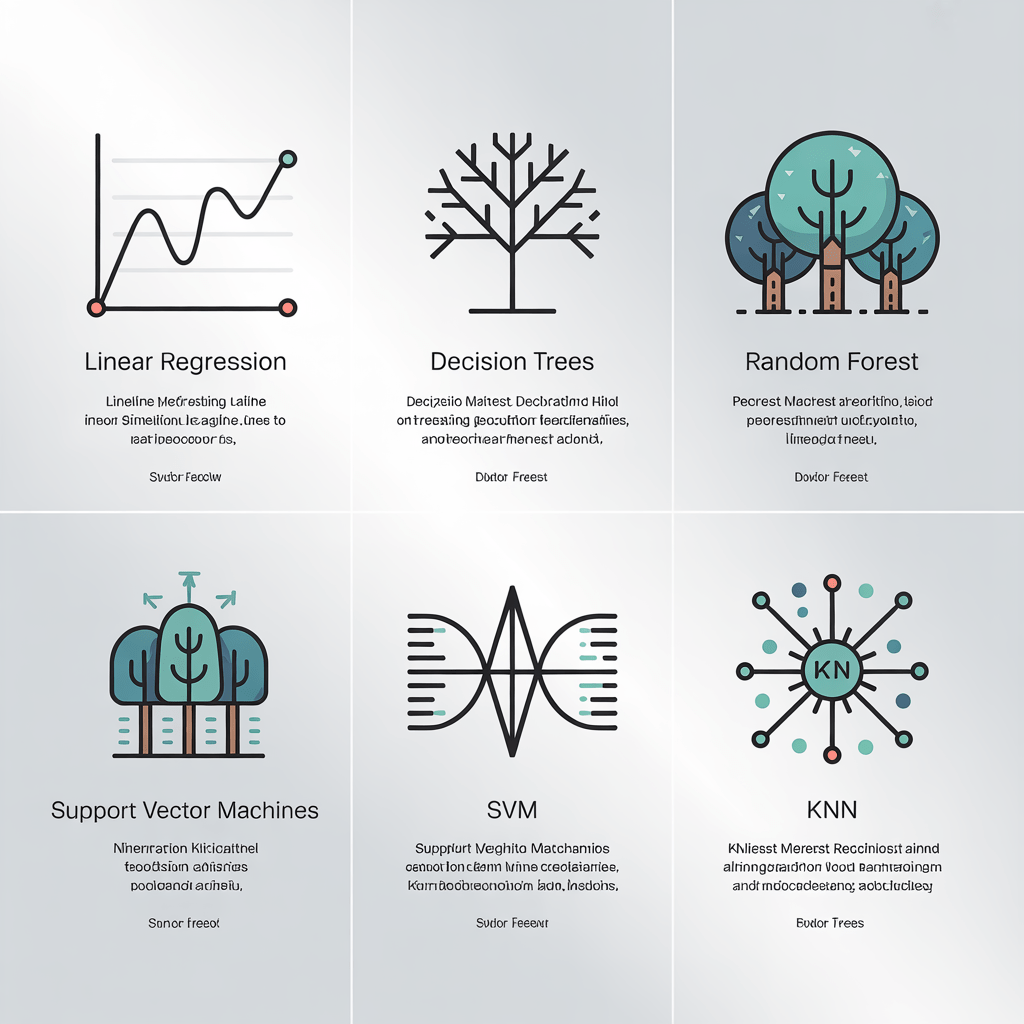
This professional infographic provides a visual guide to understanding popular machine learning algorithms: Linear Regression, Decision Trees, Random Forest, Support Vector Machines (SVM), and K-Nearest Neighbors (KNN). Each algorithm is represented with its unique visual symbol and essence, accompanied by a key fact and the source reference for deeper insights. Perfect for students, educators, and professionals looking to grasp the fundamentals of these algorithms quickly.
What is Machine Learning? A Brief Overview
Machine learning (ML) is the heart of today’s data-driven world, transforming raw data into actionable insights. At its core, ML is about teaching computers to learn patterns from data and make predictions or decisions without being explicitly programmed. This isn’t just sci-fi. It’s happening every day. Consider spam filters in your email. They aren’t just flagging messages based on a list of keywords. Instead, they analyze the patterns in countless emails to determine what’s spam and what’s not.
In my experience, a common mistake people make is thinking ML is a magic wand that can solve any problem with data. But, it’s more like a toolbelt. Each algorithm is suited for specific tasks. For example, linear regression is ideal for predicting numerical values, like forecasting sales based on historical data. On the other hand, decision trees excel at classification tasks, such as determining whether a customer will churn based on their behavior.
What this means in the real world is that selecting the right algorithm is crucial. Using a hammer when you need a wrench won’t work. The key takeaway here is: understand your data and what you want to achieve. ML is powerful, but it’s only as good as the data you feed it and the questions you ask.
However, it’s not all sunshine and roses. ML can be data-hungry, requiring vast amounts of data to make accurate predictions. Plus, it can be a black box. Algorithms might provide answers without clear explanations of how they arrived at them. Despite these challenges, the potential of ML in predictive analytics is undeniable, offering insights that drive smart decision-making across industries.
Algorithm 1: Linear Regression – The Foundation of Predictive Modeling
Linear Regression often feels like the humble beginnings of predictive modeling. It’s the statistical equivalent of learning to ride a bike before tackling a motorcycle. Linear Regression is straightforward yet powerful, especially when dealing with datasets where the relationship between variables is linear. At its core, this algorithm predicts the value of a dependent variable based on one or more independent variables by fitting a linear equation to observed data.
In practice, linear regression shines in scenarios where simplicity is key. Say you’re a real estate agent aiming to predict house prices based on features like square footage and number of bedrooms. Linear regression can provide a clear, interpretable model that helps you understand which factors have the most substantial impact on price. It’s like having a guiding map to navigate through the nuances of data, providing insights that are easy to communicate to stakeholders who might not speak the language of complex algorithms.
Pros:
1. Simplicity and Interpretability: Linear regression models are easy to understand and interpret, making them ideal for a first pass at understanding your data or as a benchmark for more complex models.
2. Efficiency with Large Datasets: When the relationship is indeed linear, these models can be trained quickly, even on large datasets, which is invaluable when time and computational resources are limited.
3. Predictive Performance: For problems where the linearity assumption holds, linear regression can offer surprisingly accurate predictions with minimal parameter tuning.
Cons:
1. Assumption of Linearity: The primary drawback is its assumption that the relationship between variables is linear. This isn’t always the case, and failing to account for non-linear relationships can lead to poor predictions.
2. Sensitivity to Outliers: Linear regression is sensitive to outliers, which can skew results significantly. In datasets with outliers, it’s often necessary to preprocess the data or consider robust methods to mitigate this issue.
From a practical standpoint, linear regression serves as the bedrock upon which more complex algorithms are built. Understanding its nuances is crucial for any data scientist. Despite its limitations, it remains an essential tool in the predictive analytics toolkit, proving that sometimes, the simplest solutions can also be the most effective.
Algorithm 2: Decision Trees – Navigating Through Data with Precision
Decision Trees are like that seasoned detective who sifts through clues to solve a mystery. They analyze data by creating a model that predicts the value of a target variable by learning simple decision rules inferred from data features. Imagine a tree where each node represents a choice between several alternatives, branching out until it reaches a decision or prediction. This structure is straightforward yet powerful in handling both numerical and categorical data.
Pros:
Simplicity and Interpretability: Decision Trees are incredibly easy to understand. In my experience, even those new to machine learning can grasp the logic behind them. Each path from root to leaf can be translated into a set of rules, making it transparent and explainable. For example, a tree predicting loan defaults might show that older applicants with lower debt are less likely to default.
Versatility: These trees shine in classification and regression tasks. They can seamlessly handle missing values and data with a non-linear relationship. For instance, in healthcare, Decision Trees can predict patient diagnoses by considering various symptoms, offering clarity in situations where data is messy or incomplete.
Efficiency with Large Datasets: While they work well with large datasets, they’re particularly effective in scenarios where computational resources are limited. Compared to other algorithms, they require less data preprocessing, which can be a huge time-saver.
Cons:
Overfitting Risk: A common pitfall is their tendency to overfit, especially with a complex tree. They might perform well on training data but poorly on unseen data. Pruning methods can help counteract this, but it’s a balancing act.
Bias Sensitivity: Decision Trees are sensitive to biased data and can propagate any errors found in the data. This means they might favor one outcome unduly if the dataset is skewed. To mitigate this, it’s crucial to ensure a well-balanced dataset.
From a practical standpoint, Decision Trees offer a blend of simplicity and power. The key takeaway is to use them wisely, always keeping an eye on overfitting and data bias. In predictive analytics, they serve as a reliable tool, but like any tool, they must be wielded with care and understanding.
Algorithm 3: Neural Networks – Mimicking the Human Brain for Better Predictions
Neural networks are fascinating. They mimic the structure of the human brain to make sense of complex data. Imagine trying to predict stock prices. Traditional methods might struggle because markets move based on many hidden factors. Neural networks excel in these cases by finding patterns we can’t easily see.
In my experience, one of the best things about neural networks is their ability to learn from vast amounts of data. For instance, companies like Netflix use them to suggest what you might want to watch next, based on viewing history and preferences. This isn’t just about matching genres. It’s about finding subtle connections between what you and millions of others enjoy.
A huge pro of neural networks is their adaptability. They can handle large datasets with many variables, which is crucial in fields like medicine. For example, neural networks can analyze medical images to detect tumors with incredible accuracy. They learn from each new image, continuously improving their diagnostic skills. Another advantage is their ability to model non-linear relationships, which means they can tackle more complicated prediction tasks than linear models.
However, there are downsides. One major con is that they require a lot of data and computational power. Training a neural network can take hours or even days. Another issue is the “black box” problem. While they make accurate predictions, it’s often hard to explain how they reached their conclusions. This can be troubling in critical fields like finance or healthcare, where understanding the reasoning behind a prediction is crucial. Despite these challenges, the potential of neural networks in predictive analytics is vast, and their ability to evolve and learn makes them an invaluable tool in the tech world.
Algorithm 4: Random Forest – Enhancing Accuracy with Ensemble Learning
Random Forest is one of those algorithms that stands out in the machine learning toolbox, primarily because of its ability to improve accuracy through ensemble learning. At its core, Random Forest builds multiple decision trees and merges them together to get a more accurate and stable prediction. Why does this matter? Well, individual decision trees can be prone to overfitting, especially with complex datasets. But when you combine them in a forest, the variance in predictions decreases, and the overall model becomes more robust.
In my experience, Random Forest shines in areas like financial forecasting and medical diagnostics, where predicting outcomes accurately is crucial. For instance, in credit scoring, a Random Forest model can analyze historical data and predict the likelihood of a borrower defaulting. By considering multiple trees, it effectively handles the noise in the data and delivers a reliable prediction.
Pros of using Random Forest:
1. Accuracy: It consistently delivers high accuracy because it reduces overfitting by averaging the results of many decision trees.
2. Handles Missing Data: Random Forest can maintain accuracy even when parts of the data are missing, making it versatile.
3. Feature Importance: It provides insights into which variables are most important for predictions, helping in feature selection.
Cons:
1. Complexity and Computation: Training a Random Forest can be computationally expensive and time-consuming, especially with large datasets.
2. Interpretability: While it’s great for accuracy, it lacks the easy interpretability of simpler models like linear regression, making it harder to explain results to non-technical stakeholders.
From a practical standpoint, if you’re dealing with a dataset where accuracy is key and computational resources are not a constraint, Random Forest is a solid choice. However, it’s essential to balance accuracy with interpretability, especially when results need to be communicated to a broader audience.
Algorithm 5: Support Vector Machines – Maximizing Margins for Optimal Classifications
Support Vector Machines (SVMs) are like the unsung heroes in the world of predictive analytics. They might not be the newest kids on the block, but they’re the workhorses that keep many systems running smoothly. At their core, SVMs aim to find the best boundary—called a hyperplane—that separates different classes in your data. Think of it like drawing a line in the sand to decide which side each point belongs to, but in way more dimensions than we can fathom.
In my experience, the beauty of SVMs lies in their ability to handle high-dimensional data. This is particularly useful in areas like text classification, where each word can be considered a dimension. For instance, in email spam detection, an SVM can efficiently categorize messages by analyzing thousands of features (like the occurrence of specific words). The key takeaway here is the algorithm’s knack for managing complexity without getting bogged down.
Pros:
- Effective in High Dimensions: SVMs excel when the number of features exceeds the number of samples. This is often the case in genomics, where SVMs have been used to classify cancerous cells with remarkable accuracy.
- Robust to Overfitting: With the right kernel function, SVMs can provide a good fit for complex data, minimizing overfitting. This makes them reliable for tasks like image recognition, where precision matters.
- Versatile Kernel Trick: The kernel trick allows SVMs to classify non-linear data by transforming it into a higher-dimensional space. This is a game-changer for datasets that aren’t linearly separable, like those found in stock market predictions.
Cons:
- Computationally Intensive: SVMs can be slow to train, especially with large datasets. This requires significant computational resources, which can be a bottleneck for real-time applications.
- Parameter Tuning: Choosing the right kernel and setting parameters like C (regularization) and gamma can be tricky. Poor choices can lead to suboptimal performance, often requiring extensive trial and error to get right.
From a practical standpoint, while SVMs require careful tuning and can be computationally demanding, their ability to handle complex, high-dimensional data makes them invaluable in predictive analytics. They continue to be a go-to choice for many real-world applications, proving that sometimes, a classic approach is still the best choice.
Choosing the Right Algorithm: Factors to Consider
When it comes to choosing the right machine learning algorithm for predictive analytics, context is king. The success of an algorithm largely depends on how well it aligns with the specific needs of your dataset and the problem at hand. For instance, if you’ve got a dataset with thousands of features, a decision tree might lead to overfitting, while a random forest could offer better generalization. In contrast, linear regression can be a great fit if you’re dealing with a dataset where relationships are linear and straightforward.
A key factor to consider is the size of your dataset. Algorithms like neural networks thrive on large datasets, but with smaller sets, they might just end up memorizing the data rather than learning from it. Take linear regression or logistic regression—these are simpler models and might be more effective with limited data points. They provide a good balance between performance and interpretability without the need for massive computational resources.
Scalability is another crucial aspect. If your project demands real-time predictions, the algorithm’s execution speed matters. For example, k-nearest neighbors (KNN) can be computationally expensive, especially with large feature sets, because it calculates the distance between points each time a prediction is made. On the other hand, algorithms like support vector machines (SVM) or gradient boosting can offer faster predictions once trained, though their training phase might be longer.
Finally, consider the interpretability of the model. In industries like healthcare or finance, understanding how a model makes decisions is critical. Algorithms like decision trees or logistic regression are often favored in these sectors because their decision-making process is more transparent compared to a black-box model like a deep neural network. The key takeaway here is to balance accuracy, interpretability, and computational cost based on your specific needs. By evaluating these factors, you can make a more informed choice that aligns with your goals.
Conclusion: The Impact of Machine Learning Algorithms on the Future of Predictive Analytics
Machine learning algorithms are reshaping the landscape of predictive analytics, offering a transformative impact that’s hard to ignore. In my experience, businesses are leveraging these algorithms to gain insights that were previously out of reach. Take the retail industry, for instance. Retailers use algorithms like Random Forests and Gradient Boosting to predict customer purchasing patterns. By analyzing past transactions and browsing behavior, they can tailor marketing strategies that significantly improve sales.
A common mistake I see, though, is over-relying on these algorithms without considering their limitations. Algorithms such as Support Vector Machines are powerful, yet they demand substantial computational resources and can be less effective with large, noisy datasets. This can be a stumbling block for smaller businesses with limited infrastructure. From a practical standpoint, businesses need to weigh the costs of implementation against potential gains.
The key takeaway here is the balance between accuracy and interpretability. While complex models like Neural Networks can offer high accuracy, they often act as ‘black boxes’, making it tough to interpret the results. This is where simpler models like Linear Regression still hold value. They may not always be the most accurate, but their transparency allows businesses to understand and trust the insights generated.
Looking ahead, the integration of machine learning in predictive analytics will continue to evolve. As algorithms become more sophisticated, we’ll see even richer insights. For example, real-time analytics powered by machine learning can help in making proactive business decisions, reducing risks, and optimizing operations. However, it’s crucial for businesses to remain agile, constantly evaluating and adapting their strategies to harness the full potential of these technological advancements.