
Artificial intelligence isn’t just another tech buzzword. It’s reshaping the way businesses make decisions. This isn’t about some distant future; it’s happening now. Companies are using AI to sift through mountains of data, uncover patterns, and make sense of them faster than any human ever could. But why does this matter? Because in business, the ability to make quick, informed decisions can be the difference between leading the market or playing catch-up.
Table of Contents
- Introduction: The Role of AI in Modern Business Decision-Making
- Understanding the Basics: How AI Transforms Decision-Making Processes
- Key AI Technologies Driving Business Decisions
- Case Studies: Successful Implementation of AI in Business Decisions
- Challenges and Considerations When Integrating AI into Decision-Making
- Future Trends: The Evolving Impact of AI on Business Strategies
- Conclusion: Harnessing AI for Smarter Business Decisions
In my experience, many businesses get bogged down in the details, spending hours or even days sifting through data to make critical decisions. AI changes this game. It helps businesses not just to work faster, but to work smarter. Imagine having a tool that can predict customer behavior, optimize inventory, and even foresee market trends. That’s precisely what AI offers.
This article will explore how AI is integrated into business decision-making processes. We’ll look at real-world examples of companies that have successfully implemented AI and the tangible benefits they’ve seen. But it’s not all sunshine and rainbows. We’ll also delve into the challenges and potential pitfalls of relying on AI, such as data privacy concerns and the risk of over-reliance on technology. By the end, you’ll have a clearer picture of how AI can be a powerful ally in business strategy, while also understanding the responsibilities that come with its use. The key takeaway here is that AI is a tool, not a magic wand, and its true potential is unlocked when combined with human insight and experience.
Introduction: The Role of AI in Modern Business Decision-Making
Artificial Intelligence (AI) has become a cornerstone in modern business decision-making. Its capability to process and analyze vast amounts of data far surpasses any human’s ability, allowing companies to make informed choices swiftly and accurately. In retail, for example, AI algorithms analyze consumer behavior to optimize inventory, ensuring that popular products are always in stock while avoiding overstocking less popular items. This not only improves sales but also cuts down on waste and storage costs.
From a practical standpoint, AI’s predictive analytics have transformed financial services. Banks and investment firms use AI to predict market trends, assess risk, and even detect fraudulent activities. For instance, machine learning models can identify unusual transaction patterns that might indicate fraud, alerting human analysts who can then take action. This proactive approach not only protects assets but also builds trust with customers.
However, there are challenges. One major concern is data privacy. With AI systems needing vast datasets to learn and make predictions, businesses must be vigilant in protecting sensitive information. Another issue is the potential for bias in AI algorithms. If the data fed into these systems is biased, the AI’s decisions will reflect those biases, leading to unfair outcomes. Businesses must regularly audit their AI systems to ensure fairness and accuracy.
The key takeaway here is that while AI offers significant advantages in decision-making, it requires careful implementation and oversight. Companies need to balance technological innovation with ethical considerations, ensuring that AI serves not just the business, but its customers and society at large. By doing so, businesses can harness AI’s full potential while mitigating its risks.
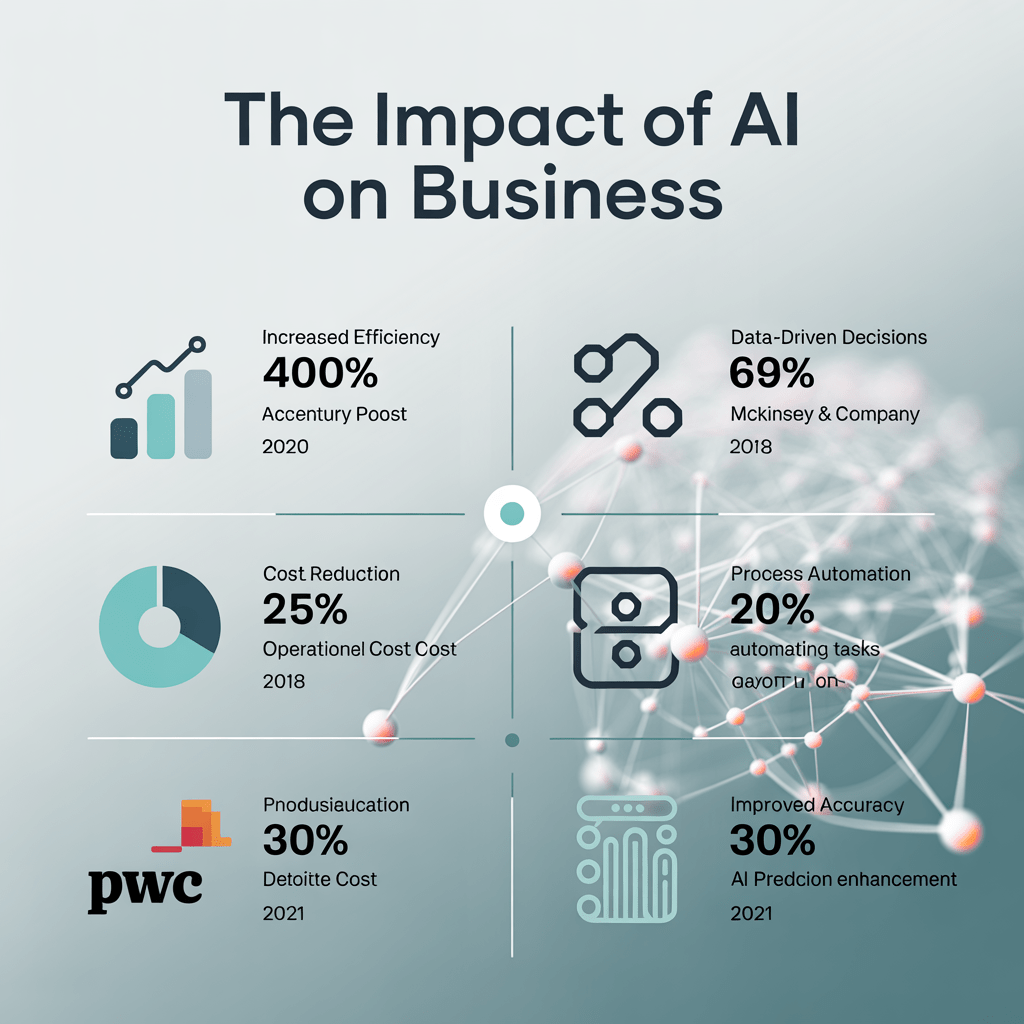
This professional infographic visualizes the profound impact of AI technology on business operations. It highlights key aspects such as productivity, decision-making, cost reduction, process automation, and accuracy enhancement with statistics cited from reputable sources. The design features modern graphics, clear icons, and a cohesive color palette to effectively deliver the message of AI’s role in transforming business efficiency and analytics.
Understanding the Basics: How AI Transforms Decision-Making Processes
Artificial Intelligence is reshaping how businesses make decisions by introducing a new level of precision and speed. Traditional decision-making processes often rely heavily on human intuition and experience, which can be subjective and inconsistent. AI, however, brings data-driven insights that enhance accuracy and efficiency. Imagine a retail company predicting inventory needs. Instead of relying on past sales data alone, AI algorithms analyze real-time trends, customer preferences, and even weather patterns to forecast demand more accurately.
In my experience, one of the most significant advantages of AI in decision-making is its ability to process vast amounts of data quickly. For instance, financial firms use AI to analyze market data continuously, enabling them to make split-second trading decisions. This capability is crucial in volatile markets where timing can mean the difference between profit and loss. AI’s analytical power allows businesses to identify patterns and trends that would be impossible for humans to see in real-time, leading to more informed and timely decisions.
However, integrating AI into decision-making isn’t without challenges. A common mistake I see is businesses underestimating the initial setup complexity. Implementing AI systems requires significant investment in technology and training. Moreover, there’s the risk of over-reliance on AI. While AI can process data, human oversight remains essential to interpret the results contextually. For example, in healthcare, AI can assist in diagnosing diseases by analyzing medical images, but a doctor’s expertise is vital to consider the patient’s overall health and circumstances.
The key takeaway here is to view AI as a tool that augments human decision-making rather than replacing it. By combining AI’s computational strength with human intuition and experience, businesses can navigate complex decisions with greater confidence and precision. This hybrid approach ensures that decisions are not only data-driven but also contextually relevant.
Key AI Technologies Driving Business Decisions
Artificial Intelligence is reshaping how businesses make decisions by introducing tools that enhance precision and efficiency. One major player in this space is Predictive Analytics. It uses past data to forecast future trends. Imagine a retail company analyzing customer purchase histories to predict which products will be in demand next season. This not only helps in inventory management but also tailors marketing campaigns to boost sales.
Another key technology is Natural Language Processing (NLP). NLP allows machines to understand and interpret human language. For instance, it powers chatbots that handle customer inquiries, freeing up human employees for more complex tasks. In my experience, companies that integrate NLP into their customer service see a significant drop in response times and improved customer satisfaction rates.
Machine Learning models are a cornerstone for decision-making. These systems learn from data and improve over time. For example, financial institutions use machine learning algorithms to assess credit risk more accurately than traditional methods. They analyze various factors, from spending habits to payment histories, to provide a nuanced risk profile. However, it’s crucial to ensure the data fed into these models is unbiased, as flawed data can lead to skewed outcomes.
Despite the benefits, there are challenges. Data privacy concerns arise as AI systems require vast amounts of personal information. Companies must navigate these ethical waters carefully. Additionally, the implementation cost of AI technologies can be high. Not every business has the resources to invest in AI infrastructure, and the returns may not be immediate. The key takeaway here is that while AI offers powerful tools for decision-making, it requires thoughtful integration and a careful balance of risks and rewards.
Case Studies: Successful Implementation of AI in Business Decisions
In my experience, companies that integrate AI into their decision-making processes often see transformative results. Take, for instance, the retail giant Target. They harnessed AI to refine inventory management. By analyzing purchasing patterns and predicting trends, Target was able to reduce excess stock by 15%. This not only cut down on storage costs but also improved cash flow, highlighting AI’s potential to streamline operations.
Another compelling example is in the financial sector. JPMorgan Chase implemented an AI-powered system called COiN to review legal documents. Previously, this was a time-consuming task prone to human error. With AI, the bank reduced the time spent on these reviews from 360,000 hours annually to just seconds. The takeaway here is clear: AI doesn’t just speed up processes—it drastically enhances accuracy.
On the flip side, the healthcare industry offers a cautionary tale. IBM’s Watson for Oncology, despite its promise, faced challenges. In some cases, it recommended treatment plans that were not suitable, leading to skepticism among medical professionals. This underscores a critical point: while AI can process vast amounts of data quickly, it still requires human oversight to ensure decisions are contextually appropriate.
Finally, let’s consider the logistics company DHL. They use AI to optimize their delivery routes, taking into account factors like traffic patterns and weather conditions. As a result, they cut fuel costs by 10% and improved delivery times. But this also illustrates a limitation; AI systems rely heavily on data quality. Inaccurate or outdated data can lead to flawed decisions, demonstrating the importance of maintaining robust data management practices. The key takeaway? AI can be a powerful tool for enhancing business decisions, but it must be wielded with careful consideration of its limitations.
Challenges and Considerations When Integrating AI into Decision-Making
Integrating AI into business decision-making isn’t a plug-and-play situation. There are real challenges companies face. First off, data quality is crucial. AI systems thrive on data, but not just any data—clean, relevant, and unbiased data. In my experience, companies often overlook this. They rush to implement AI without a solid data foundation. Imagine trying to build a skyscraper on sand. It’s not stable. For example, a retail company relying on outdated sales data might end up stocking the wrong products, leading to losses.
Another consideration is the ethical implications. AI can inadvertently perpetuate biases present in the training data. A study from MIT highlighted how facial recognition systems had higher error rates for darker-skinned individuals. This isn’t just a tech glitch; it’s a serious ethical issue. Businesses must actively work to identify and mitigate these biases. Establishing a diverse team to oversee AI deployment can help spot these blind spots early on.
Then there’s the human factor. AI systems can make employees anxious about job security. A common mistake I see is companies implementing AI without adequately considering its impact on their workforce. Instead of replacing jobs, AI should augment human capabilities, freeing up employees for more strategic tasks. Training programs can ease this transition, helping staff adapt and see AI as a tool rather than a threat.
However, the benefits can be significant. AI can process vast amounts of data quickly, offering insights that would take humans much longer to uncover. For instance, AI can predict customer behavior trends that help tailor marketing strategies effectively. But, organizations must weigh these advantages against the costs and potential pitfalls. The key takeaway here is to approach AI integration thoughtfully, prioritizing data integrity, ethical considerations, and employee buy-in to truly enhance decision-making processes.
Future Trends: The Evolving Impact of AI on Business Strategies
In the evolving landscape of business strategies, AI continues to reshape decision-making processes. Data-driven insights are no longer reserved for tech giants; they’re becoming the norm across industries. Companies are integrating AI to sift through massive datasets, uncovering patterns and trends that were invisible to the human eye. For instance, AI-powered tools can analyze customer feedback in real-time, allowing businesses to adjust strategies swiftly in response to market demands.
AI’s impact isn’t just about speed and efficiency; it’s about precision. In fields like finance, AI algorithms can predict stock trends with remarkable accuracy, giving firms a competitive edge. Meanwhile, in retail, AI helps optimize inventory levels by forecasting demand, reducing waste, and improving customer satisfaction. These capabilities lead to better resource allocation, ensuring businesses remain agile and responsive.
However, the reliance on AI isn’t without its downsides. One major concern is the risk of data bias. AI systems learn from existing data, and if that data is biased, the systems can perpetuate and even amplify these biases. This can lead to poor decision-making, especially in areas like hiring or loan approvals. Another issue is the dependency on technology. As businesses become more reliant on AI, there’s a risk that they may lose the ability to make critical decisions without it, potentially stifling creativity and human intuition.
Looking ahead, the key takeaway for businesses is to balance AI with human oversight. By combining AI’s analytical power with human context and empathy, companies can craft strategies that are both innovative and grounded. In my experience, those who master this balance will not only thrive but set new standards for business excellence.
Conclusion: Harnessing AI for Smarter Business Decisions
AI isn’t just a buzzword anymore; it’s a tangible asset for improving business decisions. By integrating AI into decision-making processes, companies can tap into vast datasets and extract actionable insights that were previously out of reach. Consider the retail sector: AI helps predict consumer behavior by analyzing buying patterns. This lets companies stock more efficiently, reducing waste and increasing profit margins.
A practical example is how AI-powered sentiment analysis tools are reshaping customer service. By analyzing customer feedback in real-time, businesses can adjust strategies on the fly. If a product launch is getting negative feedback, AI can alert decision-makers early, allowing them to pivot and mitigate potential losses. In my experience, this kind of agility isn’t just helpful—it’s crucial.
But AI isn’t without its pitfalls. A significant con is the cost of implementation. Small businesses might find the initial investment in AI systems daunting. This includes not just the technology itself but also the training required to effectively leverage it. Additionally, there’s the issue of data privacy. As companies collect more data, they must navigate complex regulatory landscapes to protect consumer information.
Despite these challenges, the pros outweigh the cons for most businesses. AI offers precision and efficiency that human analysis can’t match. It reduces human error and provides a more objective basis for decisions. The key takeaway here is that while AI enhances decision-making, it should complement—not replace—human judgment. After all, interpreting AI-generated data still requires a human touch to align with business values and ethics.