
In the world of small business, managing finances can often feel like juggling while riding a unicycle. There’s a lot going on, and one wrong move can send everything crashing down. But what if there was a way to keep your balance and streamline those financial tasks? Enter AI. Artificial Intelligence has moved beyond the realm of sci-fi and into the back offices of businesses, offering efficient solutions to age-old problems.
Table of Contents
- Introduction: The Growing Role of AI in Small Business Finance
- Understanding AI: Key Concepts and Technologies
- Benefits of AI Integration for Small Businesses
- Practical Steps to Implement AI in Financial Operations
- Overcoming Challenges and Barriers to AI Adoption
- Case Studies: Success Stories of AI in Small Business Finance
- Conclusion: Embracing AI for a Competitive Edge in Finance
For small businesses, integrating AI into finance isn’t just about keeping up with trends—it’s about survival and growth. Imagine AI handling routine tasks like bookkeeping and invoicing, freeing up precious time for you to focus on big-picture strategies. In my experience, many small business owners find that AI tools can significantly reduce errors and increase productivity. But, adopting AI is not without its challenges.
This guide will explore the benefits and drawbacks of AI in small business finance. We’ll look at how AI can improve accuracy, provide real-time insights, and enhance customer service. On the flip side, we’ll also discuss the potential cons, such as the upfront costs and the learning curve involved. By the end, you’ll have a clear understanding of whether AI integration is the right move for your business and how to navigate the transition smoothly. The key takeaway here is that while AI offers transformative potential, it’s essential to weigh these factors carefully to make informed decisions that align with your business goals.
Introduction: The Growing Role of AI in Small Business Finance
AI is steadily transforming small business finance. It’s not just about automating the mundane; it’s reshaping how businesses understand and manage their finances. For instance, AI-driven bookkeeping platforms now handle tasks that used to consume hours, such as categorizing expenses and reconciling accounts. What used to be a spreadsheet nightmare now happens in real-time, leaving business owners with more bandwidth to focus on growth.
In my experience, a common mistake is assuming AI is only for tech giants. Yet, small businesses are increasingly finding value in AI tools. Consider cash flow management, a critical area where AI can predict cash shortages before they become an issue. Using historical data, these tools offer insights that were previously accessible only to larger firms with dedicated financial analysts. For instance, AI platforms like Float and Pulse help small business owners visualize their cash flow, allowing for smarter, data-driven decisions.
There are clear advantages to integrating AI in finance for small businesses. First, AI reduces human error. When AI manages entries and calculations, inaccuracies drop significantly. Second, AI tools provide insights that help businesses make proactive decisions rather than reactive ones. Third, AI can enhance customer service by quickly analyzing data to offer personalized financial advice, something that can set a business apart in a competitive market.
However, there are also downsides. One major concern is data privacy. Small businesses need to ensure that the AI platforms they use comply with regulations to protect customer data. Another issue is the initial cost. While AI can save money long-term, the upfront investment can be a hurdle for some small businesses. Balancing these pros and cons is essential for any business considering AI integration in finance.
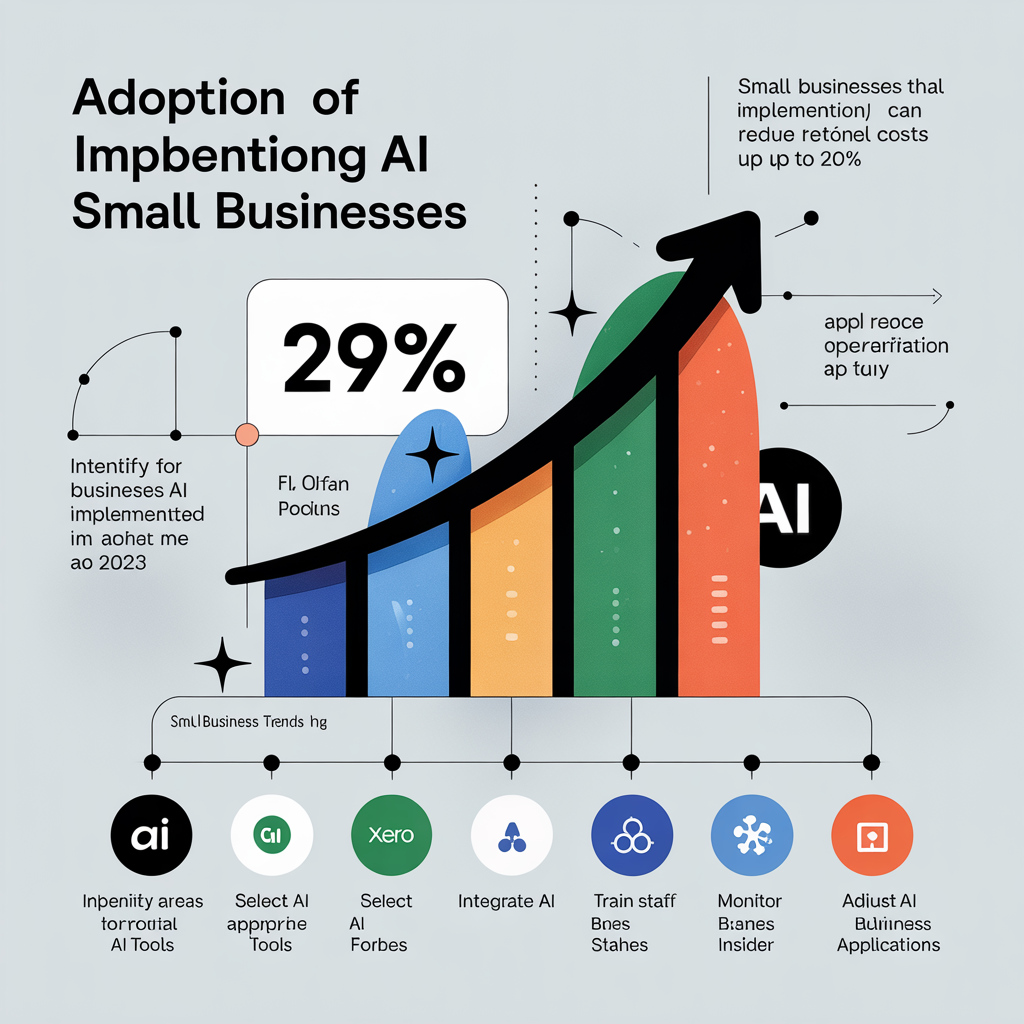
This professional infographic showcases the significant adoption and impact of AI technologies in small businesses as of 2023. With 29% of small businesses implementing AI, there’s a potential 20% reduction in operational costs and a 15% higher revenue growth for those utilizing AI in finance. Displayed are popular AI financial analysis tools such as QuickBooks AI, Xero, and Kabbage Analytics. The infographic also outlines a step-by-step process for integrating AI, ensuring a smooth transition to enhanced business operations, backed by data from credible sources.
Understanding AI: Key Concepts and Technologies
AI isn’t just a buzzword—it’s a transformative force reshaping small business finance. At its core, AI involves creating systems that can perform tasks usually requiring human intelligence. This includes learning from data, recognizing patterns, and making decisions. Machine learning (ML) is a big part of this. Imagine a system that not only processes transactions but also learns from them to predict future cash flow or flag anomalies. For small businesses, this means reducing risks associated with manual errors and improving financial forecasting.
Natural Language Processing (NLP) is another key technology. It allows machines to understand and respond to human language. In practical terms, NLP powers chatbots that can handle customer inquiries. Imagine being able to resolve billing queries 24/7 without human intervention. This is more than just convenience; it frees up your staff to focus on tasks that require a human touch, like building client relationships.
In my experience, small businesses often overlook the value of predictive analytics. This AI-driven tool analyzes historical data to forecast future trends. For instance, if a trend suggests a dip in sales during a specific month, businesses can proactively adjust their strategies. A common mistake I see is underestimating the setup time needed to train these systems. While initial setup can be resource-intensive, the long-term benefits of accurate forecasting can significantly boost profitability.
However, AI integration isn’t without its challenges. Cost is a major concern. Implementing AI solutions can be expensive, especially for small businesses operating on tight budgets. Additionally, there’s the complexity of integrating AI into existing systems. Businesses may face a steep learning curve, requiring investment in training and development. Despite these hurdles, the potential for improved efficiency and decision-making makes AI a compelling investment for those willing to navigate the initial complexity.
Benefits of AI Integration for Small Businesses
Integrating AI into small business finance offers significant advantages. Efficiency gains are perhaps the most immediate benefit. By automating routine tasks like invoice processing or expense tracking, businesses can save both time and money. For instance, AI-powered tools can automatically categorize expenses and even flag unusual transactions for further review. This not only reduces human error but also frees up employees to focus on more strategic activities.
AI can also enhance financial forecasting. Traditional forecasting relies heavily on historical data, which can sometimes miss emerging trends or shifts in market behavior. AI, on the other hand, can analyze vast amounts of data in real-time, including social media trends or emerging market dynamics. This allows businesses to make more informed decisions, reacting to market changes faster than ever before. A small retailer, for example, might use AI to adjust inventory levels based on predicted demand, avoiding both overstock and stockouts.
Customer insights are another area where AI shines. By analyzing customer data, AI can identify spending patterns and preferences that might not be immediately obvious. A coffee shop might discover that its morning rush is driven by nearby office workers who value speed over variety. With this insight, the shop could adjust its menu or service model to better cater to its core customers.
However, the road to AI integration isn’t without its challenges. Data privacy remains a significant concern. Businesses must ensure that customer data is collected and stored securely to prevent breaches. Additionally, implementation costs can be a barrier. While AI tools are becoming more accessible, the initial investment in technology and training can be substantial. Businesses need to weigh these costs against the potential benefits to determine if AI integration is the right move for their specific needs.
Practical Steps to Implement AI in Financial Operations
Overcoming Challenges and Barriers to AI Adoption
Adopting AI in small business finance isn’t just a plug-and-play scenario. Entrepreneurs often face three major hurdles: cost, technical know-how, and employee resistance. These challenges can feel overwhelming, but tackling them head-on can smooth the path to successful AI integration.
Cost is frequently the first obstacle. Small businesses typically operate on tighter budgets, and the initial outlay for AI technology can seem prohibitive. However, there’s a strategic way to address this: start small. Focus on AI tools that automate specific tasks, like invoice processing or expense tracking. By doing this, businesses can reduce labor costs and improve accuracy, which might justify the initial investment. In my experience, many small businesses see a return within the first year, as efficiency gains and error reductions quickly add up.
Technical know-how is another barrier that can’t be ignored. Many small business owners lack the expertise to deploy and manage AI solutions. This is where partnerships come into play. Engaging with AI service providers who offer robust support and training can bridge the knowledge gap. A common mistake I see is businesses trying to go it alone, which often leads to frustration and abandonment of the project. Instead, consider it an opportunity to upskill employees and involve them in the learning process.
Finally, employee resistance can stall AI adoption. Staff may fear job loss or struggle with new technology. To counter this, involve them early in the process. Communicate openly about how AI will enhance their roles, not replace them. For example, automating routine tasks frees up employees to focus on more strategic work, boosting job satisfaction. The key takeaway here is transparency. When employees see AI as a tool that can enhance their work-life, they’re more likely to embrace it.
By addressing these barriers with a clear plan and open communication, small businesses can successfully integrate AI into their financial operations, paving the way for growth and innovation.
Case Studies: Success Stories of AI in Small Business Finance
AI integration in small business finance isn’t just about cutting-edge tech; it’s about real-world impact. Consider Zesty Organics, a family-owned grocery store. They adopted AI-driven inventory management to tackle their perennial issue of overstocking perishable goods. By analyzing purchasing patterns and seasonal trends, AI helped them cut food waste by 30%. This not only saved money but also improved their sustainability credentials—a win-win.
Another compelling example is BrightLens, a boutique eyewear retailer. They implemented AI for personalized marketing. Using machine learning algorithms, BrightLens identified customer preferences and optimized their email campaigns. The result? A 20% increase in open rates and a 15% boost in conversions. The key takeaway here is AI’s ability to transform customer data into actionable insights, driving sales without a hefty marketing budget.
But it’s not just about retailers. GreenLeaf Accounting, a small accounting firm, turned to AI to streamline their operations. They used AI to automate routine tasks like data entry and invoice processing. This freed up their staff to focus on complex client needs, boosting productivity by 40%. However, a common mistake I see is businesses diving into AI without a strategy. GreenLeaf’s success hinged on clearly defined goals and choosing AI tools that aligned with their objectives.
Of course, AI isn’t without its challenges. For instance, TechTots, a small tech startup, struggled with initial integration costs and a steep learning curve. Yet, these hurdles can be overcome with proper planning and training. The real-world payoff often justifies the initial investment, making AI an ally for small businesses navigating financial complexities.
Conclusion: Embracing AI for a Competitive Edge in Finance
In my experience, small businesses that integrate AI into their finance operations often gain a significant edge over competitors. AI can streamline tasks like bookkeeping and forecasting, saving both time and money. For instance, tools like QuickBooks with AI capabilities can automatically categorize expenses and even predict cash flow issues before they arise, allowing businesses to act proactively rather than reactively.
A key takeaway here is the ability of AI to personalize customer experiences. Imagine a small financial advisory firm using AI-driven insights to tailor investment advice based on individual client behavior and preferences. This not only enhances customer satisfaction but also builds loyalty, which is invaluable in a competitive market. According to a recent study by Deloitte, companies using AI report a 20% increase in customer engagement, which directly translates to improved retention rates.
However, there are challenges to consider. One common mistake I see is underestimating the initial investment required for AI integration. While the long-term savings are substantial, the upfront cost can be a hurdle for small businesses. Additionally, there’s a learning curve involved; employees may need time and training to adapt to new systems and processes. It’s crucial to plan for these transitions to avoid disruptions.
From a practical standpoint, embracing AI in finance is not about replacing human expertise but enhancing it. Accountants and financial managers can focus on strategic decision-making while AI handles repetitive tasks. This symbiotic relationship can lead to more informed decisions and, ultimately, a more competitive position in the market. Small businesses that recognize and leverage this synergy will likely thrive in an increasingly data-driven world.