
Reinforcement learning (RL) is like teaching a dog new tricks, but instead of treats, it’s fueled by data and algorithms. At its core, RL is about training models to make sequences of decisions by interacting with an environment. It’s the magic behind self-driving cars learning to navigate roads, robotic arms mastering the art of assembly, and even AI systems improving strategies in complex games like Go and chess. This branch of machine learning, which draws from psychology and neuroscience, is all about learning from experience. It’s not just about knowing what actions to take—but understanding which ones lead to success.
Table of Contents
- Introduction: Understanding the Basics of Reinforcement Learning
- The Core Concepts of Reinforcement Learning
- Key Algorithms in Reinforcement Learning
- Practical Applications and Real-World Examples
- Challenges and Limitations of Reinforcement Learning
- Future Trends in Reinforcement Learning
- Conclusion: The Impact and Potential of Reinforcement Learning
In my experience, one of the most captivating aspects of RL is its ability to adapt. Unlike traditional machine learning models that rely heavily on pre-labeled data, RL models learn by doing. They’re akin to eager learners in a sandbox, experimenting, failing, and refining strategies based on feedback from their environment. The key takeaway here is that RL offers a dynamic approach to problem-solving, making it invaluable in scenarios where static datasets fall short.
This article will explore the nuts and bolts of reinforcement learning, unraveling its inner workings and practical applications. We’ll dive into the fundamental concepts, like agents, environments, and reward signals, and discuss real-world examples that highlight RL’s transformative potential. However, it’s not all rosy. RL comes with its own set of challenges, including high computational demands and the difficulty of defining suitable reward functions. By the end of this discussion, you’ll have a clearer understanding of why reinforcement learning is a cornerstone of modern AI, and how it’s paving the way for smarter, more autonomous systems.
Introduction: Understanding the Basics of Reinforcement Learning
Reinforcement Learning (RL) isn’t just a buzzword in the AI community; it’s a powerful tool that mimics the way we humans learn. Imagine teaching a dog tricks. Each time the dog sits on command, it gets a treat. Over time, the dog learns that sitting leads to rewards. This is essentially how RL works—systems learn by interacting with an environment through trial and error, receiving feedback in the form of rewards or punishments.
In my experience, the beauty of RL lies in its ability to solve complex problems without explicit instructions. Take AlphaGo, for example. It learned to master the ancient game of Go by playing millions of games against itself, improving with each match. This type of learning is not limited to games. In the real world, RL is used in self-driving cars where the vehicle learns to navigate by interpreting feedback from its environment. The key here is exploration and exploitation—the balance between trying new paths and sticking to known routes that yield rewards.
But RL isn’t without its challenges. A common mistake I see is underestimating the amount of data it requires. RL needs massive amounts of data and computational resources to be effective. This can make it prohibitive for smaller projects. Additionally, the trial-and-error nature means RL models can take a long time to train and fine-tune.
Despite these hurdles, RL has some distinct advantages. First, it can adapt to changing environments, making it ideal for dynamic systems like robotics and autonomous vehicles. Second, it reduces the need for manual feature engineering, saving time and resources. Lastly, RL can discover novel solutions to problems, often surprising even its creators with creative strategies. However, it’s worth noting that the unpredictability of its learning paths can sometimes lead to unexpected and undesirable outcomes, requiring constant monitoring and adjustment.
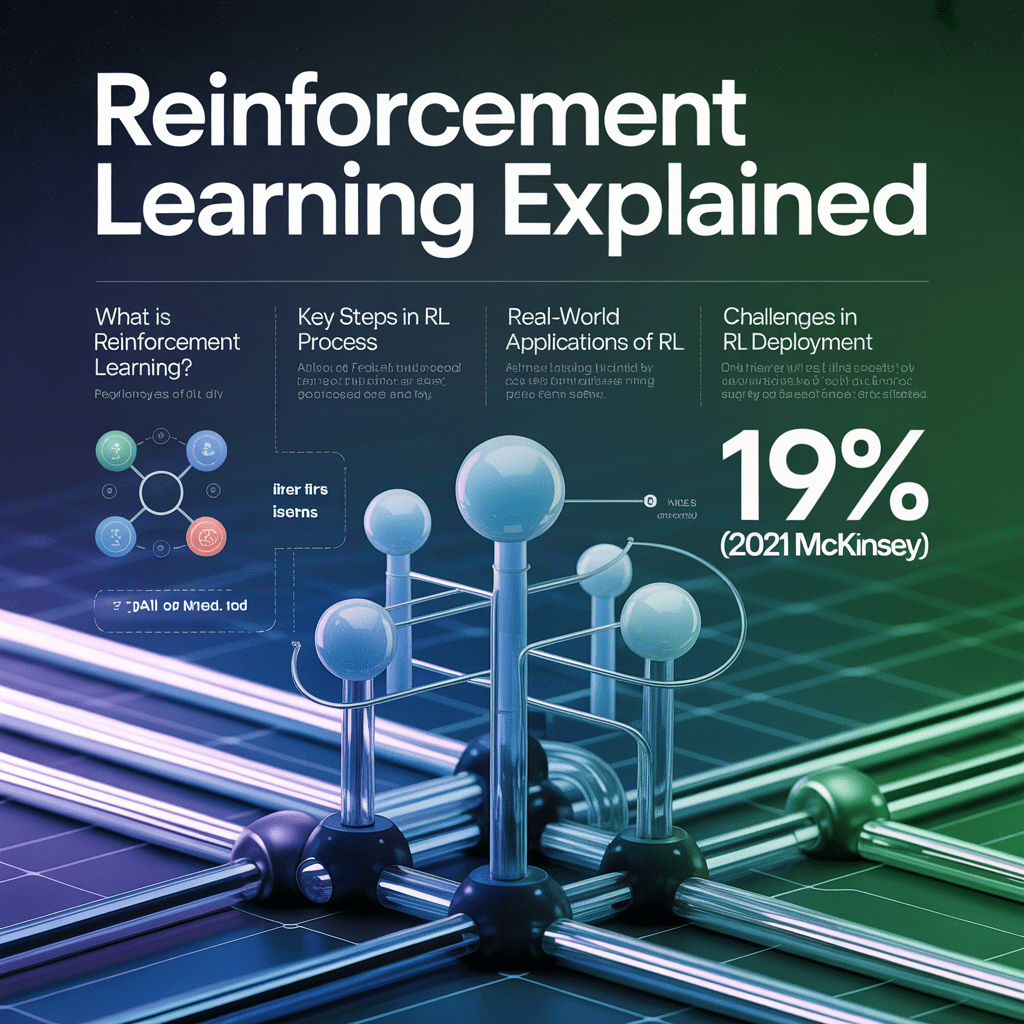
This professional infographic provides a comprehensive overview of Reinforcement Learning (RL). It introduces RL as a machine learning approach focused on decision-making through cumulative reward optimization. The infographic outlines key steps in the RL process, presents real-world applications in gaming, robotics, and autonomous vehicles, and highlights the percentage of AI practitioners using RL based on a 2021 survey. It also addresses challenges in RL deployment such as computational complexity and safety considerations. Icons and graphics enhance understanding and engagement.
The Core Concepts of Reinforcement Learning
Reinforcement Learning (RL) is like teaching a dog new tricks, only the dog is a computer, and the tricks are complex tasks. At its heart, RL involves an agent interacting with an environment. The agent makes decisions based on a policy, receives feedback in the form of rewards, and learns to maximize these rewards through trial and error.
Imagine a robot learning to navigate a maze. The robot, our agent, starts with no idea how to get through. It tries different paths, bumping into walls or reaching dead ends. Each time it hits a wall, it gets a small penalty. When it finally finds the exit, it receives a big reward. Over time, the robot learns which actions lead to rewards and which don’t, refining its path to the exit.
A key concept here is the reward signal. In my experience, defining a good reward signal is pivotal. If the rewards are too sparse or poorly aligned with the goal, the agent might learn inefficiently. Consider an autonomous car learning to drive. If its only reward is reaching the destination, it might ignore important behaviors like obeying traffic lights. Instead, incremental rewards for safe driving actions help shape the agent’s behavior more effectively.
RL also relies on the idea of exploration versus exploitation. A common mistake I see is agents getting stuck exploiting known paths for rewards without exploring new possibilities, which might offer better outcomes. Think of a stock trading bot that only trades a few known stocks. While it might perform well short-term, it could miss discovering more lucrative opportunities in other markets. Balancing exploration and exploitation is crucial for agents to optimize performance over time.
From a practical standpoint, RL isn’t without challenges. Scalability is a significant hurdle. Training agents requires substantial computational resources, particularly for complex environments. Additionally, safety and ethical concerns arise when deploying RL in real-world scenarios, such as self-driving cars, where mistakes can have serious consequences. Ensuring robust, safe learning processes is essential before these systems can be widely adopted. The key takeaway here is that while RL offers a powerful framework for solving complex tasks, careful consideration of reward structures, exploration strategies, and ethical implications is necessary to harness its full potential.
Key Algorithms in Reinforcement Learning
Reinforcement Learning (RL) has been a game-changer in the AI field, thanks to its ability to learn optimal actions through trial and error. At the heart of RL are several key algorithms, each with its unique strengths and challenges.
Q-learning is one of the most foundational algorithms in this realm. It operates by learning the value of actions in given states without requiring a model of the environment. Essentially, it updates a Q-table with estimated rewards for actions, which helps in making decisions over time. Consider a simple grid world where an agent needs to find the shortest path to a goal. With Q-learning, the agent explores various paths, updating its Q-values based on the rewards received, eventually converging on the optimal path. A real-world application can be seen in autonomous vehicles where Q-learning helps navigate complex environments.
Another popular algorithm is Deep Q-Networks (DQN). This extends Q-learning by integrating neural networks to approximate Q-values. DQNs are particularly powerful in large state spaces where traditional Q-tables would be infeasible. For instance, DQNs have been notably successful in playing Atari games, where they outperformed humans in several titles. However, DQNs require a lot of data and computational resources, making them less practical for environments where data is scarce.
Proximal Policy Optimization (PPO) is a more recent algorithm that strikes a balance between ease of use and performance. Unlike Q-learning and DQNs, PPO works by directly optimizing the policy that governs the agent’s actions. One advantage of PPO is its ability to handle continuous action spaces, making it suitable for robotics where actions aren’t just left or right but a spectrum of movements. Yet, PPO requires careful tuning of hyperparameters, which can be a barrier for those without extensive experience.
In practice, choosing the right RL algorithm depends heavily on the problem at hand. Q-learning is great for simpler, discrete problems, while DQN and PPO shine in more complex scenarios, albeit with higher computational demands. The key takeaway here is that understanding these algorithms’ nuances can significantly impact the success of RL implementations in real-world applications.
Practical Applications and Real-World Examples
Reinforcement Learning (RL) is no longer just a theoretical playground. It’s carving out its niche in real-world applications, proving its worth in areas where traditional algorithms fall short. A standout example is autonomous driving. Companies like Tesla and Waymo employ RL to help vehicles make decisions in unpredictable environments. By continuously learning from each situation, these cars improve their ability to navigate safely, adapt to unexpected obstacles, and optimize routes for efficiency.
Another sphere where RL shines is robotics. In my experience, one of the most fascinating applications is in robotic manipulation. Take, for instance, warehouse robots used by Amazon. These bots need to pick items from shelves and pack them efficiently. RL helps them learn how to grasp objects of varying shapes and sizes with minimal human intervention. The key takeaway here is the reduction in operational costs and the increase in throughput, making warehouses more efficient.
Healthcare is also witnessing a transformation thanks to RL. Personalized treatment plans, especially in chronic diseases like diabetes, are being optimized using RL. By analyzing vast amounts of patient data, RL algorithms can suggest tailored interventions, potentially improving patient outcomes. From a practical standpoint, this means doctors can offer more precise medication dosages and lifestyle recommendations.
However, RL isn’t without challenges. One major downside is the high computational cost. Training these models requires significant resources and time, often making it prohibitive for smaller enterprises. Another issue is the need for massive datasets. Without enough varied data, RL models might not generalize well, leading to poor real-world performance. Despite these hurdles, RL’s potential for innovation across industries is undeniable, making it a field worth watching closely.
Challenges and Limitations of Reinforcement Learning
Reinforcement Learning (RL) is like teaching a dog new tricks, but with a twist. You’re not just tossing treats for good behavior; you’re navigating a maze of computational challenges. One major hurdle is sample inefficiency. RL algorithms often require a staggering number of interactions with the environment to learn effectively. Imagine trying to learn chess by playing millions of games. That’s the scale we’re talking about. This inefficiency can be a dealbreaker, especially when data collection is costly or time-consuming.
Another challenge is the exploration-exploitation dilemma. In simple terms, it’s the balance between trying new actions to discover their effects (exploration) and sticking to known actions that yield high rewards (exploitation). In my experience, algorithms get stuck in local optima, exploiting subpar strategies without exploring potentially better ones. For example, a robot learning to walk might stick to awkward moves that prevent it from falling, missing out on smoother strides.
Environment complexity is yet another stumbling block. RL models can struggle with environments that have high dimensionality or dynamic changes. Take autonomous driving. The sheer variability in driving conditions—weather, traffic, pedestrian behavior—can trip up RL systems. In practical terms, simplifying the environment might lead to models that perform well in simulations but fail in the real world.
The key takeaway here is that while RL holds immense potential, its challenges are non-trivial. Tackling these involves smarter algorithms, improved data efficiency, and robust exploration strategies. For practitioners, focusing on tailored solutions for specific applications—like reducing dimensionality or using hybrid models—can help mitigate these limitations. Addressing these challenges head-on is crucial for RL’s success beyond theoretical applications.
Future Trends in Reinforcement Learning
Reinforcement Learning (RL) has been making waves in various sectors, and its future looks promising. The first trend to watch is the integration of RL with other AI technologies, like natural language processing and computer vision. Combining these powerful tools creates more dynamic and robust systems. For instance, autonomous vehicles could use RL in tandem with computer vision to better navigate complex road environments. This synergy not only enhances the capabilities of each technology but also opens doors to applications previously thought unfeasible.
Another exciting development is the rise of multi-agent systems. In these systems, multiple RL agents interact within the same environment, learning not just from the environment but also from each other. This has shown potential in areas like traffic management and resource allocation. A city could, for example, employ multi-agent RL to optimize traffic signals, reducing congestion and improving travel times. However, coordinating these agents to ensure they work harmoniously is a complex challenge, requiring sophisticated algorithms to manage cooperation and competition.
While RL has shown impressive results, it’s not without its hurdles. One significant issue is the high computational cost associated with training RL models. These systems often require vast amounts of data and processing power, making them less accessible for smaller companies or researchers with limited resources. Another challenge is the transferability of models. RL models are typically tailored to specific environments and tasks, and adapting them to new situations can be tricky and resource-intensive.
Despite these challenges, the potential benefits of RL are vast. The key takeaway is that as hardware becomes more powerful and algorithms more refined, the barriers to deploying RL solutions will continue to diminish. This means more industries can leverage RL to tackle complex problems, driving innovation and efficiency across the board.
Conclusion: The Impact and Potential of Reinforcement Learning
Reinforcement learning (RL) is more than just a buzzword in the AI community. It’s a technique that’s reshaping industries by offering solutions that were previously unattainable. From autonomous vehicles to personalized medicine, RL is proving its capability to adapt and optimize in real-time, learning from each interaction to improve outcomes.
Consider the use of RL in autonomous driving. In my experience, traditional algorithms struggle with the unpredictability of real-world environments. However, RL enables vehicles to learn driving strategies directly from data, handling complex scenarios like merging in traffic or navigating crowded city streets. Waymo, for instance, leverages RL to refine its driving models, resulting in safer and more reliable self-driving cars.
In healthcare, RL is making waves by personalizing treatment plans. A common mistake in traditional methods is relying on static data, which doesn’t account for a patient’s unique response to treatment. RL can adapt to these responses, optimizing for the best health outcomes. Take the example of sepsis management. RL algorithms can analyze patient data in real-time, adjusting treatment protocols dynamically to improve survival rates.
But RL isn’t without its challenges. One major con is the computational cost. RL models often require substantial computational resources and time to train, making it less accessible for smaller firms. Moreover, there’s the issue of ethical concerns. In scenarios like finance, where RL is used for algorithmic trading, the lack of human oversight can lead to unintended consequences, such as market manipulation.
Despite these hurdles, the potential of RL is undeniable. As technology advances, we can expect to see even more innovative applications, pushing the boundaries of what’s possible. The key takeaway here is that while RL is still evolving, its impact on various sectors is profound and far-reaching. For those in the tech industry, staying informed and adaptable is crucial as RL continues to develop and integrate into everyday solutions.