
In the world of data science, supervised and unsupervised learning are two foundational techniques that every data enthusiast must understand. Both offer unique approaches to analyzing and interpreting data, yet they serve different purposes and are applied in distinct scenarios. Think of supervised learning as a guided tour through a museum where each piece of art is labeled and explained. In contrast, unsupervised learning is like wandering through an art gallery without any descriptions, relying on your intuition and perception to make sense of what you see.
Table of Contents
- Introduction to Machine Learning: Understanding Supervised and Unsupervised Techniques
- Defining Supervised Learning: Key Concepts and Algorithms
- Exploring Unsupervised Learning: Techniques and Applications
- Comparative Analysis: Supervised vs. Unsupervised Learning
- Real-World Applications: When to Use Each Technique
- Challenges and Limitations of Supervised and Unsupervised Learning
- Conclusion: Choosing the Right Learning Technique for Your Data Science Projects
Supervised learning is all about prediction and precision. It involves training a model on a labeled dataset, where the outcomes are already known. This approach is ideal for tasks like classification and regression, where you need specific answers. For instance, predicting house prices based on historical data or classifying emails as spam or not are classic examples. The beauty of supervised learning lies in its accuracy, but it comes with the caveat of requiring large amounts of labeled data, which can be both time-consuming and expensive to obtain.
On the flip side, unsupervised learning deals with unknowns. It seeks to find hidden patterns or intrinsic structures in data without any predefined labels. Imagine trying to organize a box of assorted LEGO bricks by color or shape without any instructions. Clustering and association are common techniques here, useful for things like customer segmentation or market basket analysis. The flexibility of unsupervised learning is invaluable, particularly when exploring new datasets. However, its outcomes can be less predictable and harder to evaluate, since there’s no clear right or wrong answer.
In this article, we’ll delve into the intricacies of both techniques, weighing their pros and cons, and providing real-world examples to illustrate their applications. By the end, you’ll have a clearer understanding of when to use each method, empowering you to make informed decisions in your data science projects.
Introduction to Machine Learning: Understanding Supervised and Unsupervised Techniques
Machine learning, at its core, is about teaching computers to learn from data. Two primary methods stand out: supervised and unsupervised learning. Each has its own strengths and nuances, and understanding these can significantly impact the success of data science projects.
Supervised learning is akin to teaching a child with a set of flashcards. You provide both the questions and the correct answers, allowing the machine to learn from labeled data. This method is particularly effective for tasks where the outcome is known, like predicting house prices based on historical sales data. Algorithms such as linear regression or decision trees fall under this category. In my experience, supervised learning is invaluable in situations where accuracy is paramount, such as medical diagnosis or financial forecasting. However, the downside lies in its dependence on large quantities of labeled data, which can be both costly and time-consuming to obtain.
On the other hand, unsupervised learning resembles giving a child a puzzle without showing the final picture. Here, the machine explores patterns and relationships in data without predefined labels. Clustering algorithms, like K-means, help segment customers based on purchasing behavior without prior categorization. This method shines in exploratory data analysis, offering insights into data structures that might not be immediately apparent. But the challenge with unsupervised learning is interpretability. The results can be abstract, requiring expert interpretation to make them actionable.
A common mistake I see is choosing the wrong learning technique for the task at hand. From a practical standpoint, if you have a clear outcome in mind and access to labeled data, supervised learning is the way to go. Conversely, if you’re dealing with a new dataset and looking to uncover hidden patterns, unsupervised learning might be more appropriate. The key takeaway here is to match the technique to the specific needs and constraints of your project.
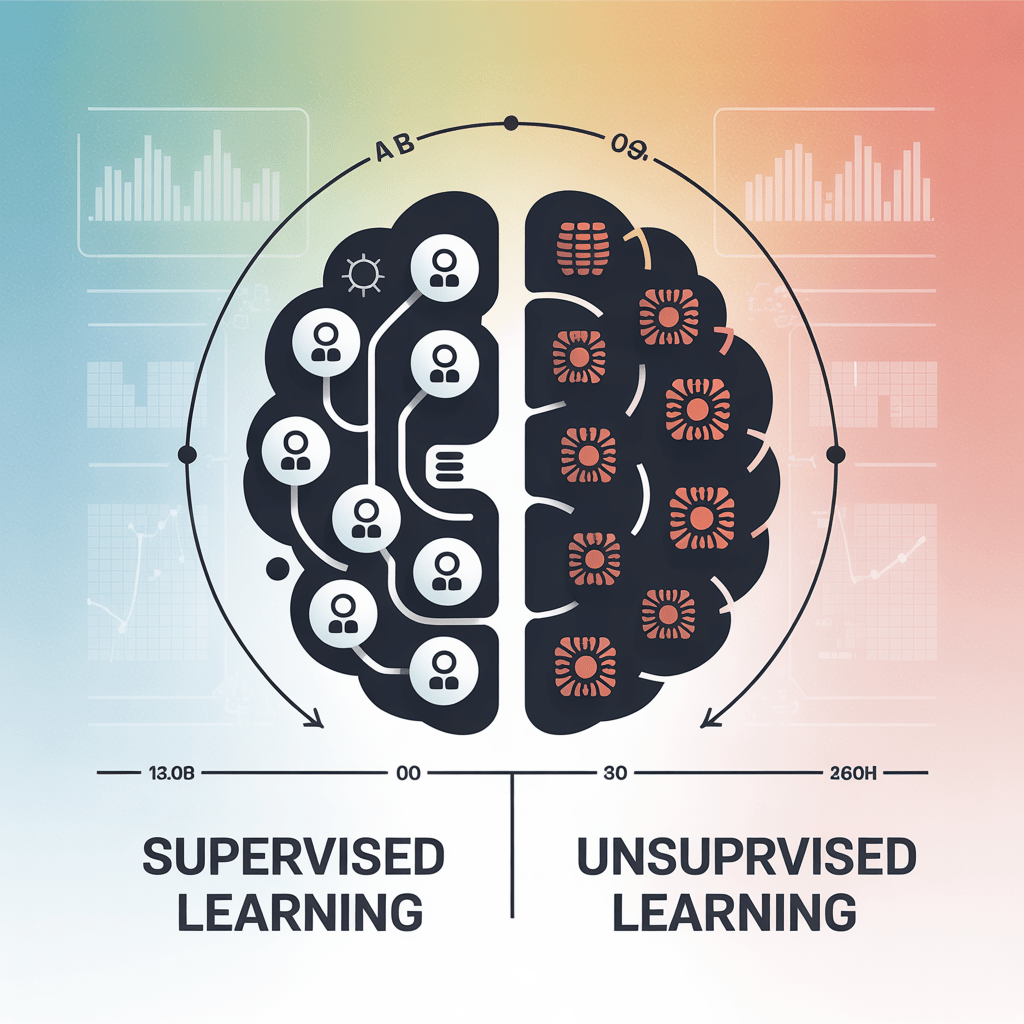
This professional infographic offers a clear comparison between supervised and unsupervised learning. It explains their definitions, common algorithms, primary goals, applications, and data requirements, providing a comprehensive overview ideal for understanding the key differences and applications of each learning type in machine learning.
Defining Supervised Learning: Key Concepts and Algorithms
Supervised learning is like having a teacher by your side while you learn to solve problems. This approach uses labeled data, which means each input has a corresponding output that’s already known. The goal here is to learn a function that maps inputs to the right outputs. Think of it like being handed a set of math problems with answers provided, helping you understand the process of getting from question to solution.
In my experience, the key to successful supervised learning lies in the quality of your labeled data. Algorithms such as Linear Regression and Support Vector Machines (SVM) thrive on robust datasets. Linear Regression, for instance, is often used to predict housing prices based on features like square footage and location. It’s simple yet effective for problems where the relationship between input and output is linear. Meanwhile, SVMs are powerful in handling classification tasks, especially when the data is high-dimensional. They work well in separating classes with a clear margin and are often used in text categorization and image recognition.
A common mistake I see is ignoring the importance of data preprocessing. Supervised learning algorithms are sensitive to noise and irrelevant features. Techniques like normalization and feature selection can significantly improve model performance. For example, cleaning up outliers in a dataset used for predicting stock prices can lead to more reliable models. The key takeaway here is that preprocessing steps are not just optional but crucial for accuracy.
On the downside, supervised learning requires a substantial amount of labeled data, which can be costly and time-consuming to produce. Also, it might not perform well on tasks where the relationship between inputs and outputs is not apparent. Despite these challenges, when applied correctly, supervised learning is a powerful tool in a data scientist’s arsenal, especially when dealing with problems where the rules are known and the data is abundant.
Exploring Unsupervised Learning: Techniques and Applications
Unsupervised learning is like exploring uncharted territories. You’re given data without any labels, and the task is to find structure or patterns that are not apparent at first glance. Clustering and dimensionality reduction are the two main techniques used here.
In clustering, the goal is to group similar data points together. Think of it as sorting through a mixed bag of marbles based on color or size. A classic example is the use of K-Means Clustering in customer segmentation. Retailers can categorize customers into different segments based on purchase behavior, helping tailor marketing strategies. K-Means isn’t without its quirks, though. It assumes clusters are spherical and evenly sized, which isn’t always the case.
Dimensionality reduction, on the other hand, deals with simplifying data without losing its essence. Imagine compressing a high-resolution image without blurring its details. Principal Component Analysis (PCA) is a popular method here. It transforms data into a lower-dimensional form, which is crucial for visualizing complex datasets. For instance, in genomics, PCA is used to reduce the complexity of genetic data, making it easier to identify patterns across genomes. However, the interpretability of the results can be a challenge, as the new dimensions often lack clear physical meaning.
Unsupervised learning shines in scenarios where labeled data is scarce. But it’s not a silver bullet. One downside is that it can be computationally intensive, especially with large datasets. Another is its reliance on domain knowledge to interpret clusters or reduced dimensions meaningfully. In my experience, the most fruitful unsupervised learning projects are those where the initial exploration leads to new insights, guiding further investigation or supervised learning efforts.
Comparative Analysis: Supervised vs. Unsupervised Learning
When comparing supervised and unsupervised learning, the choice often hinges on data availability and the specific outcomes you’re aiming for. Supervised learning involves training a model on a labeled dataset, meaning that each training example is paired with an output label. This setup is akin to having a teacher guide you through the learning process, ensuring you’re on the right track. For example, in email spam filters, supervised learning allows the model to differentiate between spam and non-spam by learning from past emails marked by users.
In contrast, unsupervised learning deals with unlabeled data. It’s more about discovering hidden patterns or intrinsic structures in input data. Imagine trying to learn a language by yourself without any translations. Clustering is a common technique here, like segmenting customers into distinct groups based on purchasing behavior without prior categories. An example is using K-means clustering to identify distinct customer segments for targeted marketing strategies.
Pros of supervised learning include its high accuracy and the ability to handle complex data sets. It’s particularly effective for classification and regression tasks, where precise outcomes are crucial. Another advantage is its ability to generalize well to unseen data if the training set is diverse enough. However, it requires a substantial amount of labeled data, which can be costly and time-consuming to obtain. Additionally, there’s a risk of overfitting, where the model learns the training data too well, failing to perform well on new data.
On the other hand, unsupervised learning is excellent for exploratory data analysis, offering insights into the structure of data without the need for labeled examples. It’s less expensive since it doesn’t require labeled data, making it suitable for large, complex datasets. However, the results can sometimes be less accurate or interpretable compared to supervised methods, as there’s no clear-cut guidance on what the output should be. The lack of labels also means that evaluating the performance of unsupervised models can be more challenging.
Real-World Applications: When to Use Each Technique
When choosing between supervised and unsupervised learning techniques in data science, the decision often hinges on the nature of the task and the available data. Supervised learning is the go-to for scenarios where the outcome is clear and labeled data is abundant. Think of it as teaching a child with flashcards; you provide the question and the answer, and they learn to connect the two. In my experience, this approach shines in areas like image recognition, where models are trained on thousands of labeled images to recognize objects. A classic example is the use of convolutional neural networks (CNNs) in detecting specific objects within pictures, like identifying cats among various animals.
On the other hand, unsupervised learning comes into play when you’re wading through data without clear outcomes. Imagine exploring a new city without a map, relying on landmarks to find your way. This method is invaluable for clustering and anomaly detection, where the data itself reveals patterns. Retailers often use clustering techniques to segment customers based on purchasing behavior. For instance, a company might analyze transaction data to discover distinct shopper profiles, tailoring marketing strategies accordingly.
Pros of supervised learning include high accuracy due to precise training and its ability to handle both classification and regression tasks. Another advantage is its predictability; outcomes are often consistent, making it reliable for decision-making. A third benefit is the efficiency with which it can handle large datasets, provided the labels are accurate. However, it’s not without drawbacks. A significant con is the need for vast amounts of labeled data, which can be expensive and time-consuming to collect. Additionally, supervised models can struggle to generalize new, unseen data without proper training.
Unsupervised learning, while less dependent on labeled data, isn’t flawless either. One major pro is its flexibility in discovering hidden patterns without prior knowledge, which is particularly useful in exploratory data analysis. It also excels in uncovering insights in unstructured data, which is increasingly common in today’s data-rich environments. On the flip side, its cons include less precision as compared to supervised learning; the lack of guidance can lead to mixed accuracy. Furthermore, interpreting the results can be challenging, often requiring a deeper understanding of the data context to draw meaningful conclusions.
Challenges and Limitations of Supervised and Unsupervised Learning
Supervised and unsupervised learning are two pillars of data science, each with their unique challenges and limitations. Let’s dissect them.
In supervised learning, the primary challenge lies in the need for labeled data. Imagine training a model to recognize cats in images. You’d need thousands of pictures, each meticulously labeled as ‘cat’ or ’not cat’. This labeling process is not only costly but also prone to human error, which can lead to poor model performance. Moreover, supervised models often struggle with overfitting. They can become too tailored to the training data, capturing noise instead of the underlying pattern. This is akin to memorizing a textbook without understanding the concepts, leading to poor generalization to new data.
Unsupervised learning, on the other hand, operates without labeled data, which sounds like a dream. But here’s the catch: without labels, the model has no guidance. This can result in ambiguous outputs. For instance, clustering algorithms might group data points in ways that make no intuitive sense. It’s like organizing a library without a catalog; you have stacks of books, but no clear order. Another limitation is the interpretability of results. While unsupervised learning can reveal hidden structures, explaining these structures to stakeholders can be tricky. You might find clusters in customer data, but why those clusters exist might remain a mystery.
From a practical standpoint, both methods require a careful balance. In my experience, combining supervised and unsupervised techniques can mitigate some of these challenges. For instance, using unsupervised learning to pre-process data can enhance the performance of supervised models by reducing dimensionality and highlighting relevant features. The key takeaway here is that understanding the limitations of each approach allows data scientists to craft more effective, robust solutions.
Conclusion: Choosing the Right Learning Technique for Your Data Science Projects
When deciding between supervised and unsupervised learning techniques for your data science project, it’s crucial to understand the strengths and limitations of each approach. Supervised learning is often the go-to when you have a well-defined problem with labeled data. Take, for instance, fraud detection in financial systems. Here, historical transaction data labeled as either ‘fraudulent’ or ‘legitimate’ can train models to classify future transactions accurately. The key advantage is the model’s ability to learn from past examples, making it highly effective for tasks like image classification, where labeled datasets are abundant.
However, supervised learning comes with its challenges. A common issue is the need for large amounts of labeled data, which can be costly and time-consuming to gather. Additionally, there’s the risk of overfitting, where the model performs well on training data but poorly on unseen data. This often requires complex techniques to mitigate, such as cross-validation and regularization.
On the other hand, unsupervised learning shines in exploratory data analysis, where the goal is to find hidden patterns or groupings in data without predefined labels. A classic example is customer segmentation in marketing. Here, unsupervised learning can identify distinct customer groups based on purchasing behavior, informing targeted marketing strategies. The strength of unsupervised learning lies in its ability to work with unlabeled data, making it cost-effective and versatile.
Yet, unsupervised learning isn’t without its drawbacks. The results can be harder to interpret, as the discovered patterns may not align with the project’s objectives. Furthermore, the lack of labels means there’s no straightforward way to measure the model’s accuracy. This often requires domain experts to validate the findings, adding an extra layer of complexity. In my experience, the choice between these techniques should be guided by the nature of your data and the specific goals of your project.