
In the hustle to adopt artificial intelligence (AI) in business, we often find ourselves at a crossroads of opportunity and ethical dilemma. Companies are eager to integrate AI into their operations, streamlining processes and boosting productivity. However, the ethical implications of AI implementation can’t be sidelined. These digital decision-makers, if unchecked, can reinforce biases, infringe on privacy, and even destabilize job markets. So, it’s crucial to pause and think about the moral principles guiding these cutting-edge technologies.
Table of Contents
- Introduction: Understanding the Role of Artificial Intelligence in Modern Business
- The Ethical Landscape: Key Considerations for AI in Business
- Privacy Concerns and Data Security in AI Applications
- Bias and Fairness: Ensuring Equitable AI Solutions
- Accountability and Transparency in AI Systems
- Balancing Innovation and Ethical Responsibility
- Conclusion: Navigating the Future of AI with Ethical Integrity
From a practical standpoint, businesses face a dual challenge: harness AI’s potential while ensuring ethical standards are upheld. Imagine an AI system used in recruitment. On one hand, it promises efficiency, sifting through thousands of applications in seconds. On the other, if not carefully designed, it could perpetuate existing biases, favoring certain demographics over others. The key takeaway here is that AI can both mirror and magnify human prejudices, making ethical oversight not just a checkbox, but a necessity in every AI deployment.
This article will explore the complex landscape of AI ethics in business environments. We’ll delve into the benefits—like increased efficiency, data-driven insights, and enhanced customer experiences—that make AI so appealing. But we won’t shy away from addressing the pitfalls, such as privacy concerns and the potential for job displacement. By examining real-world examples and industry best practices, we aim to shine a light on how businesses can responsibly navigate AI’s ethical challenges. Ultimately, the goal is to equip decision-makers with the knowledge to implement AI in a way that aligns with both their strategic objectives and societal values.
Introduction: Understanding the Role of Artificial Intelligence in Modern Business
Artificial Intelligence (AI) is no longer a futuristic concept; it’s here, reshaping the fabric of modern business. From automating mundane tasks to making complex decisions, AI’s role is increasingly pivotal. Businesses are integrating AI to boost efficiency and cut costs, proving its worth across various sectors. Consider logistics companies using AI-driven algorithms to optimize delivery routes, saving time and fuel.
In my experience, one major pro of AI in business is its ability to process vast amounts of data at lightning speed. For instance, financial institutions use AI to analyze market trends, enabling them to make informed investment decisions. This kind of speed and accuracy was unimaginable a few decades ago. Another advantage is AI’s knack for personalization. E-commerce platforms employ AI to suggest products based on user behavior, significantly enhancing customer satisfaction and retention.
However, the implementation of AI isn’t without challenges. A common mistake I see is the underestimation of the ethical implications. Bias in AI algorithms can lead to unfair treatment of certain groups, which can damage a company’s reputation and lead to legal consequences. From a practical standpoint, there’s also the issue of job displacement. While AI can handle repetitive tasks efficiently, it can also lead to unemployment for workers performing these tasks.
The key takeaway here is balance. Companies must weigh AI’s efficiency gains against potential ethical pitfalls. Real-world impact matters more than theoretical benefits. Businesses should foster transparency and accountability in their AI systems, ensuring they enhance rather than hinder the human element in operations. By doing so, they can harness AI’s potential responsibly and sustainably.
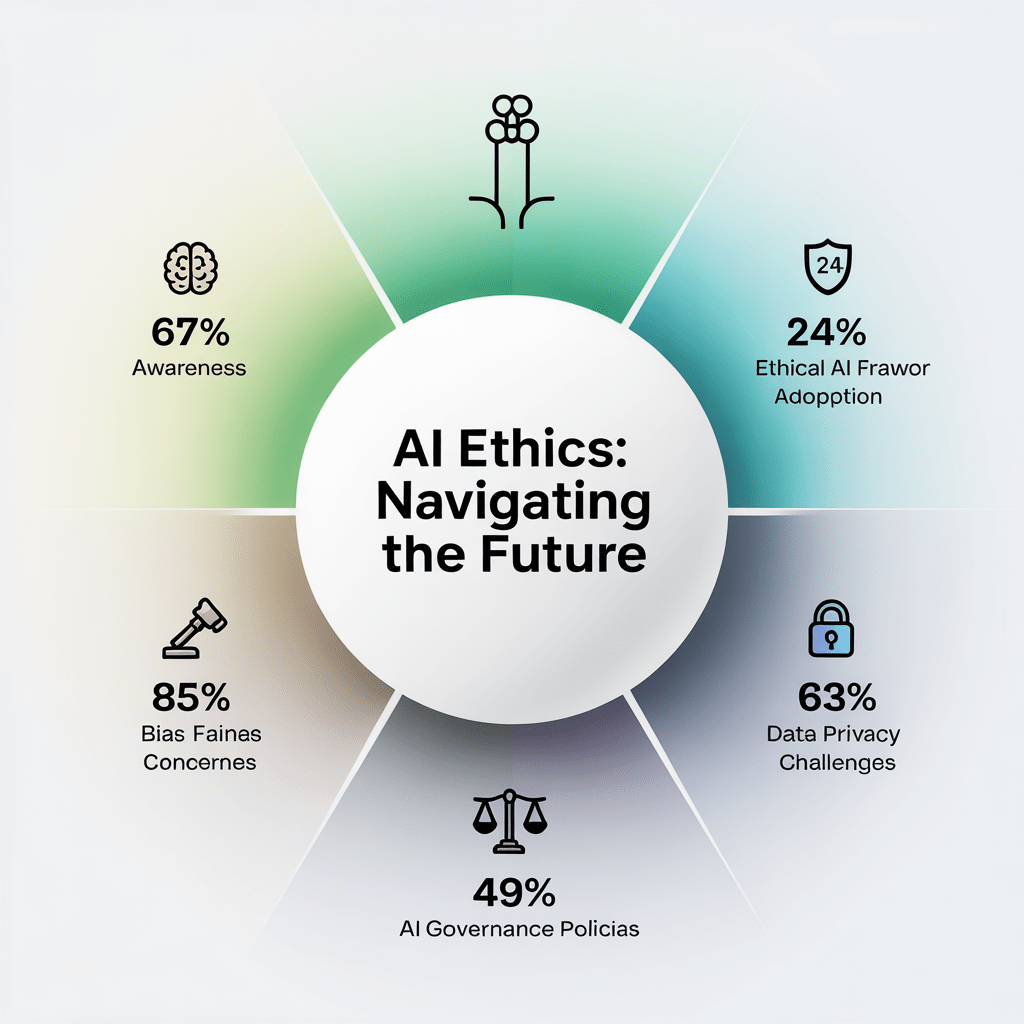
A professional infographic highlighting key statistics related to AI ethics, showcasing executives’ views on its importance, the adoption of ethical AI frameworks, concerns about AI bias and fairness, data privacy challenges, and the establishment of governance policies. The data is sourced from prominent AI research reports and presented with icons and a cohesive color scheme for clarity and visual appeal.
The Ethical Landscape: Key Considerations for AI in Business
The ethical concerns of AI in business aren’t just theoretical musings but tangible issues that impact real-world operations. Privacy is often at the forefront of these discussions. Companies are sitting on troves of data, much of it personal and sensitive. In my experience, businesses face the dilemma of balancing data utility with privacy. For instance, consider how customer data can boost product recommendations. However, misuse or overreach can lead to breaches, damaging both reputation and trust. A notable case involved a large retailer that predicted a teen’s pregnancy before her family knew, which was a PR nightmare.
Bias in AI algorithms is another major ethical pitfall. These systems often learn from historical data, which can carry biases. A common mistake I see is deploying AI without scrutinizing the training data for inherent prejudices. Take facial recognition technology as an example. It has been shown to have higher error rates for people of color, which can lead to discriminatory practices if used in hiring or law enforcement.
On the flip side, AI can significantly enhance decision-making. With its ability to process vast amounts of data, AI can uncover insights that humans might miss. This can lead to more informed strategies and better outcomes in sectors like healthcare, where AI might predict patient deterioration earlier than traditional methods.
However, the lack of transparency in AI decisions remains a conundrum. Black-box algorithms often provide results without clear explanations of how they were derived. This opacity can be problematic, especially in high-stakes decisions like loan approvals or criminal sentencing. Businesses must strive to implement AI systems that prioritize transparency and accountability to maintain trust and ethical integrity. The key takeaway here is that while AI has the potential to transform business, it requires careful, ethical consideration to ensure it serves humanity positively.
Privacy Concerns and Data Security in AI Applications
When businesses incorporate AI, privacy concerns and data security are often at the forefront of discussions. The key issue here is the sheer volume of data AI systems require to function effectively. In my experience, companies underestimate the complexity of securing this data, especially when sensitive consumer information is involved. The stakes are high: a single data breach can compromise millions of personal records, leading to significant legal and financial repercussions.
Consider the case of a major retail company that integrated AI to personalize shopping experiences. While the AI helped boost sales by tailoring recommendations, it also collected vast amounts of consumer data. This included purchase histories, payment details, and even location data. When a security flaw was exploited, it exposed this sensitive information to cybercriminals, resulting in a substantial loss of customer trust and a hefty regulatory fine.
From a practical standpoint, AI systems must be designed with security in mind from the outset. This means implementing robust encryption, regular security audits, and clear data governance policies. Companies should also be transparent with consumers about how their data is used. A common mistake I see is businesses treating transparency as an afterthought rather than a core component of their AI strategy.
However, the cons of prioritizing privacy in AI are also worth noting. For one, there’s the increased cost associated with implementing advanced security measures. Smaller businesses might find it financially burdensome. Additionally, strict data protection regulations can slow down innovation, as companies may become overly cautious and hesitant to experiment with new AI technologies. Balancing data security with innovation is a delicate dance that requires careful consideration and strategic planning.
Bias and Fairness: Ensuring Equitable AI Solutions
Bias in AI systems isn’t just a technical glitch; it’s a reflection of the data they’re fed and the algorithms designed to process it. Ensuring fairness in AI solutions is crucial because these systems increasingly influence decisions in hiring, lending, and even law enforcement. When AI systems are trained on biased data sets, they often produce biased outcomes. For example, if an AI used for hiring is trained on a company’s historical hiring data, it may inadvertently favor the demographic that historically got hired more.
According to a 2019 study by MIT Media Lab, facial recognition systems had error rates as high as 34% for darker-skinned women, compared to less than 1% for lighter-skinned men. These disparities highlight the urgent need for diversity in training data. From a practical standpoint, companies should actively seek out diverse data sets and continuously monitor AI outputs for signs of bias. In my experience, regular audits and involving multidisciplinary teams in the development process can significantly mitigate these biases.
The key takeaway here is that businesses must prioritize transparency and accountability. This means not only understanding the data that feeds into AI systems but also being open about how these tools make decisions. Some companies are implementing “AI ethics boards” tasked with overseeing AI projects and ensuring they adhere to ethical standards. However, the challenge lies in balancing fairness with functionality. Stricter ethical guidelines might slow down development or require more resources, yet the long-term benefits of trust and compliance outweigh these initial hurdles.
On the flip side, over-regulation can stifle innovation. If companies feel overly restricted by ethical constraints, they might avoid developing potentially beneficial AI technologies altogether. Furthermore, there’s the risk of creating a compliance checklist mentality, where businesses focus on ticking boxes rather than genuinely improving their AI processes. This is why an ongoing dialogue between developers, ethicists, and stakeholders is essential to crafting AI solutions that are both equitable and effective.
Accountability and Transparency in AI Systems
Accountability and transparency in AI systems are more than just buzzwords—they’re crucial for building trust and ensuring ethical AI deployment. Accountability means there’s a clear chain of responsibility for decisions made by AI. For instance, if an AI system in a bank wrongly denies a loan, who takes responsibility? Is it the developer, the data scientist, or the bank itself? This isn’t just a technical question; it’s a legal and ethical one. Companies must establish clear accountability frameworks, often involving cross-disciplinary teams to oversee AI implementations.
Transparency in AI involves making AI decisions understandable to humans. It’s not enough for an AI model to make accurate predictions; stakeholders need to know how these decisions are made. Take, for example, facial recognition systems used in law enforcement. If these systems are opaque, there’s a risk of bias and wrongful identification. Transparency can be achieved through explainable AI techniques that clarify decision-making processes, helping to build user trust.
One pro of accountability is that it promotes ethical use by ensuring that companies are held liable for their AI’s actions. Another advantage is that it encourages thorough testing and validation. Knowing they are responsible, stakeholders will likely take more care in the development phase. Additionally, accountability can drive innovation, as teams work to create more robust AI systems. On the con side, assigning accountability can slow down deployment due to increased legal scrutiny. Furthermore, it can lead to a blame game where departments deflect responsibility rather than solve issues collaboratively.
In my experience, businesses that prioritize transparency not only avoid legal pitfalls but also gain a competitive edge. Consumers are increasingly valuing ethical practices, and transparent AI systems can be a selling point. However, achieving full transparency is challenging. Many AI models are inherently complex, and simplifying them without losing essential details is a significant hurdle. Despite these challenges, the key takeaway here is that accountability and transparency are not just ethical imperatives but strategic business advantages that can foster trust and drive long-term success.
Balancing Innovation and Ethical Responsibility
The challenge of balancing innovation with ethical responsibility is a tightrope walk for businesses diving into AI. On one side, you’ve got the burning urge to stay competitive and cutting-edge. On the other, there’s a pressing need to ensure that these technologies don’t trample on ethical boundaries.
Consider one of the biggest tech giants, Google, which has been at the forefront of AI research. While their innovations have transformed industries with smart algorithms and data processing, they’ve faced backlash over data privacy concerns. In 2018, employees protested against Project Maven, a military AI project, raising ethical questions about the role of AI in warfare. This highlights a key issue: innovation can often outpace the ethical frameworks meant to govern it.
From a practical standpoint, businesses should start with a robust ethical guideline before launching any AI initiative. Establishing an ethics board—comprising diverse voices, including ethicists, engineers, and legal experts—can provide a balanced view on the implications of AI projects. For example, Microsoft has an AI ethics committee that evaluates potential projects, ensuring they align with their commitment to privacy and security.
Yet, there are trade-offs to consider. On the plus side, ethical AI practices can build trust with consumers, potentially leading to increased loyalty. They also help avoid legal troubles that can arise from unethical practices. Moreover, incorporating ethics can drive innovation in a more meaningful direction, focusing on societal benefits. However, there are downsides: ethical reviews can slow down the development process, possibly putting companies behind their competitors. Additionally, the cost of implementing thorough ethical oversight can be significant, especially for smaller companies.
In my experience, the key takeaway here is that ethics shouldn’t be viewed as a hindrance but as a foundational element that can guide sustainable innovation. When done right, it ensures that AI serves humanity, not vice versa.
Conclusion: Navigating the Future of AI with Ethical Integrity
In the evolving landscape of artificial intelligence, the ethical compass guiding its application in business is more critical than ever. The potential for AI to transform industries is immense, but with great power comes the risk of ethical pitfalls. Transparency should be the cornerstone of any AI deployment. Businesses need to ensure that their AI systems are not black boxes. For example, when an AI model is used for credit scoring, the logic behind decisions must be clear and understandable to both regulators and consumers. This transparency builds trust and promotes accountability.
Bias and fairness are other critical considerations. AI systems can inadvertently perpetuate existing biases if the data they are trained on is skewed. An infamous case is the AI recruitment tool that favored male candidates over females due to biased training data. To counteract this, companies must implement rigorous data auditing processes. Regular bias checks and diverse training datasets can help mitigate these issues. It’s not just about correcting the models but fostering a culture of inclusivity within the AI development teams.
On the flip side, the benefits of ethical AI are substantial. Efficiency gains from AI can significantly reduce operational costs, as seen in sectors like logistics and customer service, where AI-driven automation streamlines processes. Additionally, AI can enhance decision-making by providing data-driven insights that humans might overlook. However, the trade-off is the potential for job displacement, which requires strategic workforce planning and reskilling initiatives. Privacy concerns also arise, especially when AI systems gather and analyze vast amounts of customer data. Businesses must prioritize data protection to maintain consumer trust.
In my experience, ethical AI implementation is not just a compliance checkbox but a competitive advantage. Companies that lead with ethics prioritize long-term sustainability over short-term gains. The key takeaway here is to embed ethical considerations at every stage of AI development and deployment. By doing so, businesses not only mitigate risks but also pave the way for innovation that genuinely benefits society.