
The digital age has ushered in a wave of change, and at the heart of this transformation is artificial intelligence. Small businesses, often seen as the backbone of the economy, are finding themselves at a crossroads. Embrace AI, or risk being left behind. But what does this mean for growth and sustainability? In my experience, the adoption of AI is not just another trend; it’s a crucial step for long-term survival and competitiveness.
Table of Contents
- Introduction: Understanding the Role of AI in Small Business
- AI-Driven Innovations: Transforming Small Business Operations
- Cost Efficiency and Productivity: How AI Levels the Playing Field
- Enhancing Customer Experience: Personalized Solutions through AI
- Challenges and Considerations: Navigating AI Integration in Small Businesses
- Case Studies: Success Stories of AI Adoption in Small Enterprises
- Conclusion: Embracing AI for Sustainable Growth and Future Opportunities
Consider a local bakery using AI to predict customer preferences based on purchasing history. This isn’t about replacing the artisanal touch with cold algorithms; it’s about enhancing the customer experience. With AI, businesses can tailor offerings, optimize supply chains, and even anticipate shifts in market demand. The key takeaway here is that AI can transform operations from reactive to proactive, a shift that can save both time and resources.
Yet, it’s not all smooth sailing. For many small businesses, the challenges are real. The initial cost of AI implementation can be daunting, and there’s often a steep learning curve involved. Additionally, there’s the risk of over-reliance on technology, which could potentially stifle creativity and human intuition. But despite these hurdles, the potential benefits of AI—like increased efficiency and improved customer satisfaction—are hard to ignore. What this means in the real world is that small businesses willing to navigate these challenges often find themselves better positioned for future growth. And that’s what this article will explore: the balancing act between embracing AI and maintaining the human touch that makes small businesses unique.
Introduction: Understanding the Role of AI in Small Business
AI has quietly slipped into the fabric of small businesses, offering tools that can make a big impact. Automation is one of the major ways AI is helping. Consider a small retail shop using AI to manage inventory. Instead of spending hours tracking stock manually, an AI system can predict demand and reorder products, saving time and reducing waste. This isn’t just efficient; it’s a game-changer for small businesses where every hour and dollar counts.
Another area where AI is making waves is customer service. Chatbots and virtual assistants are now common on websites, handling simple inquiries 24/7. A small online store, for example, can use a chatbot to answer frequently asked questions, freeing up the owner to focus on growing the business. This kind of AI-driven support doesn’t just improve customer satisfaction by providing immediate answers; it also enhances the business’s capacity to serve more customers simultaneously.
On the flip side, implementing AI isn’t without challenges. Cost is a significant barrier for many small businesses. While large companies can afford customized AI solutions, smaller enterprises might find these costs prohibitive. There’s also the issue of data privacy. With AI systems often relying on customer data to function effectively, there’s an increased risk of data breaches. Small business owners need to ensure they have robust security measures in place to protect sensitive information.
From a practical standpoint, the key takeaway is that AI, when used thoughtfully, can level the playing field for small businesses. It allows them to automate mundane tasks and focus on strategic growth. However, it’s crucial to weigh the benefits against the potential risks and costs, ensuring that AI adoption aligns with the business’s overall goals.
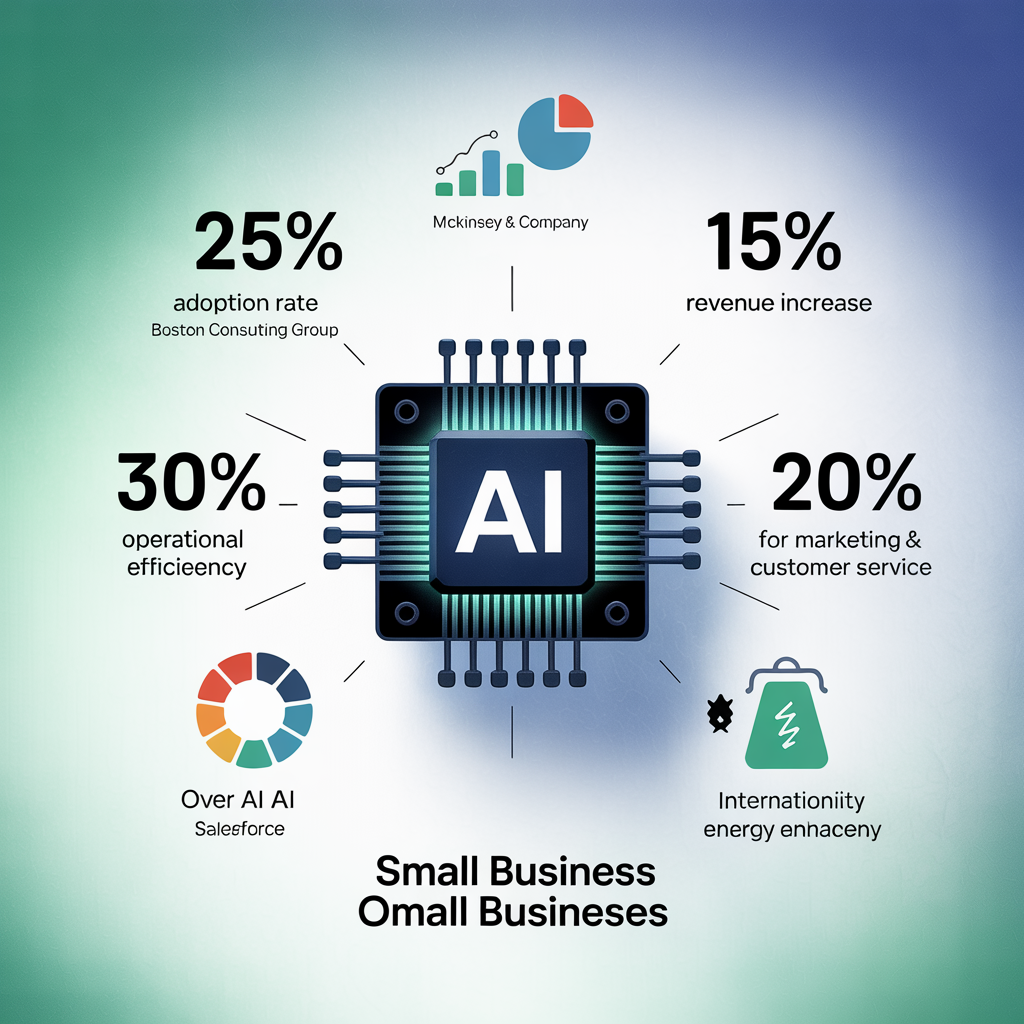
This infographic presents key insights into how small businesses are adopting and benefiting from AI technology. Featuring data from prominent sources such as Boston Consulting Group, McKinsey & Company, Harvard Business Review, Salesforce, and the International Energy Agency, it covers AI adoption rates, revenue impact, operational efficiencies, use in marketing and customer service, and sustainability improvements through AI in energy management. The visual elements, including bar graphs, pie and donut charts, and thematic symbols, emphasize the transformative power of AI across different aspects of small business operations.
AI-Driven Innovations: Transforming Small Business Operations
Small businesses are no strangers to the challenges of staying competitive. Enter AI-driven innovations, which are reshaping their operations in ways that are both subtle and profound. AI tools can streamline processes, improve customer interactions, and even predict future trends, offering small businesses a competitive edge once reserved for larger enterprises.
Consider the example of chatbots. In my experience, these AI-driven customer service tools have become invaluable for small businesses looking to provide 24/7 customer support without the massive overhead. A small online retailer using a chatbot can handle multiple customer inquiries simultaneously, reducing the wait time from hours to seconds. This not only enhances customer satisfaction but also frees up human resources for more complex tasks, like resolving nuanced customer issues or developing new marketing strategies.
Inventory management is another area where AI shines. Small businesses often struggle with balancing inventory—too much ties up capital, while too little means missed sales opportunities. AI-powered inventory systems analyze sales patterns and predict demand, helping businesses maintain optimal stock levels. For instance, a local bookstore might use AI to predict which titles will be popular in the coming months, ensuring they’re ready for customer demands without overstocking.
However, the adoption of AI isn’t without its drawbacks. Integration costs can be a hurdle for small businesses with limited budgets. Initial setup and training require resources that some may find taxing. Additionally, there’s the risk of over-reliance on technology, which can lead to problems if systems fail or are inaccurately configured. This underscores the importance of maintaining a balance between AI tools and human oversight to ensure operations run smoothly and effectively.
The key takeaway here is that while AI presents exciting opportunities for small businesses, it’s crucial to implement these technologies thoughtfully. By doing so, small businesses can harness AI’s potential to not only survive but thrive in an ever-evolving market.
Cost Efficiency and Productivity: How AI Levels the Playing Field
AI is transforming the way small businesses operate, particularly in terms of cost efficiency and productivity. Automation is at the heart of this change. By automating routine tasks, AI allows small businesses to operate more efficiently, reducing the need for a large workforce. For example, chatbots can handle customer service inquiries around the clock, freeing up human employees to tackle more complex issues. This not only lowers labor costs but also enhances customer satisfaction by providing instant responses.
Consider a small e-commerce business using AI-powered inventory management tools. These tools analyze sales trends and predict demand, ensuring that stock levels are optimized. This minimizes the risk of overstocking or understocking, which can be costly. A study by McKinsey found that companies utilizing AI in supply chain management saw a reduction in inventory costs by up to 35%. For small businesses operating on thin margins, this kind of efficiency can be a game-changer.
AI also levels the playing field by providing access to powerful analytics tools that were once reserved for larger enterprises. Small businesses can now use AI to analyze customer data and gain insights into purchasing behavior. This enables them to tailor marketing strategies, potentially increasing conversion rates. For instance, a local coffee shop might use AI to determine the best times to run promotions or introduce new products based on customer foot traffic patterns.
However, there are some drawbacks. Implementing AI can require a significant upfront investment, which may be a hurdle for some small businesses. There’s also a learning curve involved; employees need training to effectively use new AI tools, which can temporarily disrupt operations. In my experience, these challenges can be mitigated with careful planning and by choosing scalable solutions that align with the business’s growth trajectory. The key takeaway here is that while AI adoption involves initial hurdles, the long-term benefits in efficiency and productivity often outweigh these challenges, offering small businesses a competitive edge in today’s market.
Enhancing Customer Experience: Personalized Solutions through AI
In my experience, AI has transformed how small businesses approach customer engagement. Picture this: a boutique clothing store, nestled in a busy neighborhood, competing against online giants. How can it stand out? Through AI-driven personalization. By analyzing customer data, like purchase history and browsing habits, AI helps tailor recommendations that feel almost bespoke. It’s like having a personal shopper who knows your style inside out.
Here’s a practical example: a coffee shop using AI to study customer patterns. By understanding when foot traffic peaks, they can adjust staffing and inventory. But it doesn’t stop there. AI can send personalized offers to customers who haven’t visited in a while, nudging them back through the door with their favorite brew. This isn’t just about convenience; it’s about creating a customer experience that feels intimate and thoughtful.
Pros of implementing AI solutions are significant. First, there’s the increased efficiency. Automating routine tasks like customer inquiries frees up staff to focus on more strategic areas. Second, AI boosts customer retention by providing tailored experiences that build loyalty. Third, it offers valuable insights into customer behavior, guiding better business decisions.
However, there are Cons to consider. One major concern is privacy. Customers are increasingly wary about how their data is used, and businesses must be transparent and secure in their data handling. Another downside is the initial cost. Implementing AI solutions can be expensive, which may deter small businesses with tight budgets. The key takeaway here is finding a balance between leveraging AI for personalization and maintaining trust with customers.
Challenges and Considerations: Navigating AI Integration in Small Businesses
Integrating AI into small businesses isn’t just about plugging in new technology — it’s a complex dance of strategy, adaptation, and sometimes, outright trial and error. One major challenge is the initial cost of implementation. Small businesses often operate on tight budgets, and the upfront investment required for AI tools, infrastructure, and training can be daunting. For instance, a bakery looking to use AI for inventory management might need to invest thousands in software and hardware before seeing any return.
Another consideration is data privacy and security. AI systems thrive on data, but small businesses must navigate the murky waters of data protection regulations. A small accounting firm, for example, might use AI to streamline client data processing but must ensure compliance with data protection laws like GDPR. Failure to do so could lead to hefty fines, which are crippling for smaller entities.
From a practical standpoint, businesses must also weigh the impact on their workforce. Integrating AI might mean retraining employees to work alongside new systems or, in some instances, reducing staff due to automation. Consider a small manufacturing business that uses AI to optimize production lines. This shift might lead to job displacement if roles become redundant, posing ethical and operational dilemmas.
Yet, despite these challenges, the benefits can be significant. AI can enhance efficiency, improve accuracy, and offer insights that drive growth. A local retail shop using AI for customer analytics might discover shopping patterns that lead to better stock management and sales strategies, ultimately boosting profits. The key takeaway here is that while AI offers transformative potential, small businesses must navigate its integration carefully, balancing cost, compliance, and human impact.
Case Studies: Success Stories of AI Adoption in Small Enterprises
In the real world, AI isn’t just a buzzword thrown around in tech circles. It’s a tool that’s changing how small businesses operate from the ground up. Take Aunt May’s Bakery, a quaint little shop in Ohio. They faced a common issue: predicting how many of their beloved pastries to bake each day. Too many left them with waste, while too few meant unhappy customers. By integrating a simple AI tool that analyzed past sales data and local events, they achieved a 20% reduction in waste. Not only did this improve their bottom line, but it also aligned with their goal of becoming more sustainable.
Another example is GreenTech Suppliers, a small business specializing in eco-friendly products. They struggled with inventory management, often running out of stock on popular items. Implementing AI-driven inventory management software helped them anticipate demand accurately. This resulted in a 30% increase in sales within six months. The AI system alerted them to reorder before stockouts occurred, ensuring they could meet customer demands consistently.
However, AI isn’t a magic bullet. Artisan Crafts, a local handmade goods store, learned this the hard way. They adopted an AI tool for customer service, hoping to enhance their online presence. The tool, while efficient, lacked the personal touch their customers were used to. This led to a temporary dip in customer satisfaction scores. The lesson here? While AI can handle repetitive tasks, human interaction still matters in areas requiring empathy and personal connection.
What these stories highlight is the dual nature of AI in small businesses. The pros are clear: increased efficiency, reduced waste, and enhanced decision-making. But there are cons too, such as the potential loss of personal touch and the upfront costs of implementation. The key takeaway is to use AI where it complements human skills, not where it replaces them entirely. This balanced approach can lead to sustainable growth and customer satisfaction.
Conclusion: Embracing AI for Sustainable Growth and Future Opportunities
AI isn’t just a buzzword; it’s a tangible force driving change in small businesses. In my experience, AI’s ability to analyze vast amounts of data quickly is like giving these businesses a crystal ball. They can predict trends, adjust strategies, and optimize operations with precision. For instance, a local bakery using AI to analyze sales data can adjust its inventory in real-time, reducing waste and improving profitability.
A common mistake I see is small businesses underestimating the initial investment and learning curve associated with AI tools. While AI offers significant advantages, like enhanced customer experiences through chatbots or personalized marketing, the upfront costs can be daunting. However, with careful planning and phased implementation, these challenges can be mitigated. For example, starting with a single AI tool, like an automated customer service platform, can provide immediate benefits without overwhelming resources.
From a practical standpoint, the pros of embracing AI include increased efficiency, deeper customer insights, and the ability to scale operations smoothly. Businesses can automate routine tasks, freeing up human resources for more strategic roles. They can also use AI to gather and interpret customer data, offering personalized experiences that foster loyalty. However, there are cons to consider, such as the risk of data breaches and the potential loss of the personal touch that small businesses often pride themselves on.
The key takeaway here is that AI, when implemented thoughtfully, can be a powerful ally for small businesses. It enables sustainable growth by making operations leaner and decision-making smarter. Yet, it requires a strategic approach to balance technological advancement with the human elements that define small business charm. The future isn’t about choosing between AI and human intuition; it’s about integrating them to unlock new opportunities.