
Artificial intelligence is rewriting the script of healthcare and pharmaceuticals, and it’s not just about robots replacing humans or algorithms crunching data. It’s about enhancing human capability, providing deeper insights, and personalizing patient care like never before. From diagnostic tools that predict diseases before they manifest, to personalized medicine tailored to an individual’s genetic makeup, AI’s role is profound and expanding rapidly. Healthcare professionals and pharmaceutical companies are tapping into AI to transform their practices, offering more accurate diagnoses, innovative treatments, and efficient drug development processes.
Table of Contents
- Introduction: Exploring the Impact of AI in Healthcare and Pharmaceuticals
- The Evolution of AI Technology in Medicine
- AI Applications in Diagnostics and Patient Care
- Revolutionizing Drug Discovery and Development with AI
- Ethical Considerations and Challenges in AI-Driven Healthcare
- Case Studies: Success Stories of AI Integration in the Industry
- Conclusion: The Future of AI in Healthcare and Pharmaceuticals
In my experience, the key takeaway is that AI’s potential in healthcare isn’t just about speed or efficiency—it’s about accuracy and personalization. Imagine an AI system that analyzes thousands of patient records to identify a pattern that a human might miss. This isn’t science fiction; it’s happening now. For instance, AI-driven imaging tools are being used to detect early signs of diseases like cancer, often with higher accuracy than human doctors. Moreover, AI’s ability to tailor drug treatments to individual patients based on their unique genetic profile is setting a new standard for personalized medicine.
But it’s not all smooth sailing. There are challenges too, like data privacy concerns and the risk of over-reliance on automated systems. A common mistake I see is assuming AI can replace human judgment entirely. While AI can process vast datasets faster than any human, it lacks the nuanced understanding that comes with years of clinical experience. The balance, then, is in leveraging AI to support, not replace, human expertise. This guide will explore the transformative power of AI in healthcare and pharmaceuticals, the benefits it brings, and the challenges we must navigate to harness its full potential effectively.
Introduction: Exploring the Impact of AI in Healthcare and Pharmaceuticals
AI’s role in healthcare and pharmaceuticals isn’t just about replacing mundane tasks; it’s about redefining how we understand and treat diseases. Consider the use of AI in diagnostics. Algorithms trained on vast datasets can identify patterns that even the most experienced clinicians might miss. For instance, AI systems analyzing radiology images have matched, and sometimes exceeded, human accuracy in detecting conditions like pneumonia and certain cancers. This isn’t just about efficiency—it’s about saving lives by catching diseases earlier.
Another fascinating area is drug discovery. Traditional methods can take years and cost billions. AI accelerates this by analyzing complex data sets to predict how different compounds will interact with biological targets. A practical example is IBM’s Watson, which has been used to identify new drug candidates for diseases like ALS and cancer. In a world where time is often the difference between life and death, AI’s ability to speed up drug discovery is invaluable.
However, it’s not all positive. One significant concern is data privacy. AI systems require vast amounts of personal health data to function effectively, raising questions about how this data is stored and shared. There’s also the risk of bias. If the data used to train AI systems isn’t representative, the outcomes can be skewed, potentially leading to incorrect treatments.
From a practical standpoint, the integration of AI in healthcare also requires significant investment in infrastructure and training. Healthcare professionals need to understand how to interpret AI outputs, not just rely on them. The key takeaway here is that while AI offers incredible potential, its integration into healthcare and pharmaceuticals must be approached with caution and responsibility.
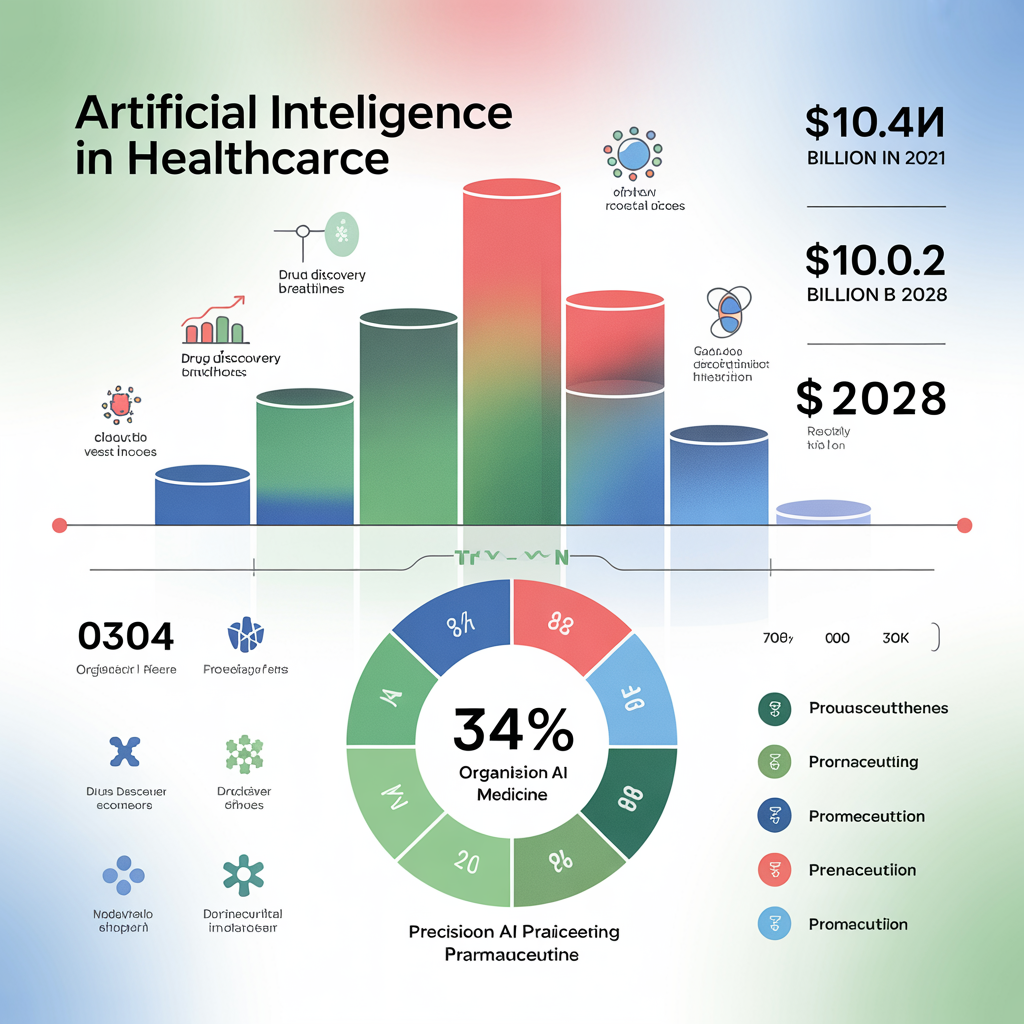
This professional infographic presents the transformative growth and impact of AI in healthcare. It visualizes the forecasted market expansion from $10.4 billion in 2021 to $120.2 billion by 2028. The infographic highlights AI’s potential in reducing drug discovery costs by up to 70% and time by 20% to 30%. It shows that 34% of healthcare organizations use AI for precision medicine. The role of AI in medical imaging is underscored with a projected market worth of $20 billion by 2023. Lastly, it details that 56% of the top biopharma companies are investing in AI technologies, illustrating the widespread adoption and integration of AI in the industry.
The Evolution of AI Technology in Medicine
AI technology in medicine has come a long way from its early days of simple algorithmic tasks. Back then, AI could only handle basic functions like sorting data or pattern recognition. Fast forward to today, and you’re looking at AI systems that can even predict patient outcomes with remarkable accuracy. Take IBM’s Watson, for instance. Initially developed to play Jeopardy!, it’s now diving into cancer research, analyzing vast amounts of medical literature to suggest treatment options faster than any human clinician could.
One standout example of AI’s evolution is in medical imaging. Systems are now able to identify anomalies in X-rays or MRIs faster and sometimes more accurately than seasoned radiologists. This doesn’t just speed up diagnosis—it can fundamentally change the treatment timeline for patients. Google Health’s AI, trained on thousands of eye scans, can detect diabetic retinopathy, a leading cause of blindness. In my experience, this level of precision was unimaginable a decade ago.
While the benefits are clear, there are hurdles too. Implementing AI in healthcare isn’t just about technology. One major pro is the efficiency it brings. AI can process vast datasets in seconds, freeing up human resources for more critical tasks. Another advantage is accuracy in areas like diagnostics, reducing the margin for human error. Additionally, AI provides accessibility to healthcare in remote areas through telemedicine platforms.
But there are cons. Data privacy is a significant concern. With AI systems accessing sensitive patient information, maintaining confidentiality becomes a daunting task. There’s also a risk of bias. AI learns from existing data, which often carries the biases of the society it was generated in. This means AI could inadvertently reinforce existing disparities in healthcare. The key takeaway is that while AI offers enormous potential, it needs careful handling to truly benefit the medical field.
AI Applications in Diagnostics and Patient Care
AI is transforming diagnostics and patient care by offering unprecedented accuracy and efficiency. One of the standout applications is in medical imaging. AI algorithms can analyze X-rays, MRIs, and CT scans faster and often more accurately than human radiologists. For instance, studies have shown that AI can detect lung cancer nodules in scans with a higher sensitivity than experienced radiologists. This doesn’t mean AI will replace doctors anytime soon, but it certainly acts as a powerful assistant, flagging potential issues for further review.
In my experience, one of the most compelling uses of AI in patient care is predictive analytics. By analyzing vast amounts of patient data, AI can predict patient outcomes and identify those at risk of certain conditions. This predictive capability is particularly useful for managing chronic diseases like diabetes or heart failure. For example, AI systems can monitor patient data in real-time, alerting healthcare providers to potential complications before they become critical.
However, the integration of AI in healthcare is not without its challenges. A common mistake I see is over-reliance on AI without proper human oversight. While AI excels in pattern recognition, it lacks the nuanced understanding of human doctors. There’s also the issue of data privacy. With AI systems processing sensitive patient data, ensuring robust security measures is essential to prevent breaches.
The key takeaway here is balance. While AI offers significant advantages in diagnostics and patient care—like improved accuracy, faster processing, and predictive insights—it must be implemented thoughtfully. Healthcare professionals should view AI as a tool to enhance their capabilities, not a replacement. As AI continues to evolve, its role in healthcare will undoubtedly expand, but human oversight will remain crucial to ensure patient safety and ethical standards.
Revolutionizing Drug Discovery and Development with AI
AI is reshaping how we approach drug discovery and development. Traditionally, bringing a new drug to market could take over a decade with costs running into billions. AI is changing this narrative. Take, for instance, the use of machine learning algorithms to sift through massive datasets. These algorithms can identify potential drug candidates much faster than any human team. In my experience, this process alone can shave years off development timelines.
Consider the case of Insilico Medicine. They used AI to identify a novel drug candidate for fibrosis in just 46 days—a task that typically takes months or even years. AI models can analyze complex biological data and predict how new compounds might interact with targets. It’s like having a digital microscope that sees what humans might miss, and it’s proving invaluable in early-stage research.
But it’s not all smooth sailing. One pro of AI in drug development is its ability to reduce costs. By predicting failures earlier in the pipeline, companies can avoid wasting resources on non-viable candidates. Another pro is the enhancement of precision medicine. AI can tailor drugs to genetic profiles, increasing treatment efficacy. Lastly, AI helps in repurposing existing drugs, identifying new uses for old compounds which is a quicker route to market.
On the flip side, there are challenges. A con is the initial investment in AI technologies, which can be steep for smaller firms. There’s also the risk of bias, where AI models trained on biased data produce skewed results. This could lead to ineffective or even harmful treatments. Despite these hurdles, the potential benefits of AI in drug discovery are too significant to ignore. The key takeaway here is that while AI isn’t a magic bullet, it’s a powerful tool that’s accelerating and refining the process of bringing new therapies to patients.
Ethical Considerations and Challenges in AI-Driven Healthcare
AI in healthcare is a double-edged sword. On one hand, it offers groundbreaking possibilities, like early disease detection and personalized treatment plans. On the other, it raises ethical questions that can’t be ignored. Data privacy is one of the biggest concerns. Medical data is incredibly sensitive, and AI systems often need vast amounts of it to function effectively. In my experience, the potential for misuse is a real worry. For instance, if AI systems aren’t properly secured, there’s a risk of data breaches that could expose personal health information.
Another ethical challenge is bias in AI algorithms. AI systems learn from data, and if that data is biased, the AI can perpetuate or even amplify those biases. For example, if an AI system is trained primarily on data from a specific demographic group, it might not perform well for others, leading to disparities in healthcare outcomes. It’s crucial to ensure diverse and representative data sets are used in training these algorithms.
From a practical standpoint, the lack of transparency in AI decision-making processes is also problematic. AI models, especially complex ones like deep learning, are often seen as “black boxes,” making it hard to understand how they reach certain conclusions. This can be particularly concerning in healthcare, where decisions can be life-altering. Patients and practitioners need to trust that AI recommendations are reliable and unbiased.
The key takeaway here is that while AI holds great promise for transforming healthcare, these ethical challenges must be addressed head-on. Robust regulatory frameworks and transparent practices are essential to ensure AI systems are safe, fair, and beneficial. Engaging diverse stakeholders, including ethicists, technologists, and patients, in the development and implementation of AI systems can help mitigate these challenges and harness AI’s full potential responsibly.
Case Studies: Success Stories of AI Integration in the Industry
When it comes to AI in healthcare, the real magic happens when you see it in action, transforming patient care and operational efficiency. Let’s start with a compelling example from the pharmaceutical world. Pfizer, a major player in the industry, has integrated AI into its drug discovery processes. By using machine learning algorithms, Pfizer has managed to significantly cut down the time it takes to identify potential drug candidates. This shift isn’t just about speed; it’s about precision too. AI models can predict how new compounds might behave, allowing researchers to focus their efforts on the most promising leads. This has led to a reduction in the time and cost of bringing new drugs to market.
Another success story comes from Johns Hopkins Hospital, where AI is used to predict patient deterioration and manage resources effectively. By analyzing vast amounts of data from electronic health records, the AI system can identify subtle changes in a patient’s condition that might be missed by human eyes. This early warning allows for timely interventions, potentially saving lives. The system has been credited with reducing the number of emergency transfers to intensive care units, which is not just a metric of efficiency but a testament to improved patient outcomes.
However, the integration of AI in healthcare isn’t without its hurdles. A common issue is the lack of standardization in data, which can lead to inconsistencies in AI outputs. Moreover, there’s a learning curve involved for healthcare professionals to trust and effectively use these systems. Despite these challenges, the potential benefits are hard to ignore. AI can help streamline operations, reduce human error, and ultimately improve patient care.
In my experience, the key takeaway here is that while AI is a powerful tool, its success depends on thoughtful implementation and a willingness to adapt workflows. Organizations that invest in training and infrastructure are more likely to see positive outcomes. The Cleveland Clinic, for instance, has invested heavily in training its staff to work alongside AI tools, leading to more seamless integration and better results.
Conclusion: The Future of AI in Healthcare and Pharmaceuticals
As AI continues to weave itself into the fabric of healthcare and pharmaceuticals, its potential to transform these industries is both exciting and daunting. AI-driven diagnostics are already making a significant impact. For example, Google’s DeepMind has developed an algorithm capable of detecting over 50 eye diseases with accuracy comparable to that of expert ophthalmologists. This kind of precision can lead to earlier interventions and better patient outcomes.
But the story doesn’t end with diagnostics. AI’s ability to personalize treatment plans is another groundbreaking development. Imagine a future where AI systems analyze a patient’s genetic makeup, lifestyle, and even social factors to recommend the most effective treatment plan. This isn’t just science fiction; it’s already happening. IBM Watson is helping oncologists tailor cancer treatments based on a vast database of medical literature and patient records, promising more effective and personalized care.
However, there are challenges to consider. Data privacy remains a significant concern. With patient data being the backbone of AI-driven healthcare solutions, maintaining confidentiality is crucial. Breaches could not only violate patient trust but also lead to severe legal consequences. Additionally, the risk of algorithmic bias is a real issue. If AI systems are trained on datasets that aren’t diverse enough, they can perpetuate existing health disparities, leading to unequal treatment outcomes.
The future of AI in healthcare and pharmaceuticals is undoubtedly bright, but it demands vigilance. For those in the industry, the key takeaway here is to balance innovation with ethical responsibility. Ensuring AI systems are trained on diverse datasets and implementing robust data protection measures will be critical in harnessing AI’s full potential while safeguarding patient rights.