
AI is reshaping the media and entertainment industries, not with a quiet whisper, but with a resounding boom. From how we produce music to crafting digital realities in films, AI is pushing boundaries and redefining creativity. It’s not just about shiny new tech toys; it’s about fundamentally altering how stories are told and consumed. The impact is not just technical—it’s deeply human, sparking new ways of thinking and storytelling that were previously unimaginable.
Table of Contents
- Introduction: Exploring the Impact of AI on Media and Entertainment
- Understanding AI Technologies Transforming the Industry
- AI in Content Creation: Revolutionizing Storytelling and Production
- Enhancing Audience Engagement: AI-Powered Personalization and Recommendations
- The Role of AI in Media Distribution and Marketing
- Ethical Considerations and Challenges of AI in Entertainment
- Conclusion: The Future of AI in Media and Entertainment
In my experience, the real magic of AI in this space is in its ability to enhance creativity rather than replace it. Take, for example, AI-driven tools that assist in scriptwriting. These aren’t about generating plotlines from thin air but providing writers with fresh perspectives and narrative structures they might not have considered otherwise. Then there’s AI in special effects, making it possible to create stunning, lifelike visuals without the astronomical budgets once deemed necessary. What this means in the real world is more accessible, diverse storytelling that can reach new audiences and inspire fresh voices.
But, like any powerful tool, AI comes with its own set of challenges. There’s a growing concern about the authenticity of AI-generated content. Can a machine truly understand the nuances of human emotion and culture? Another issue is the ethical dilemma of replacing human jobs with automated systems. Balancing innovation with ethical considerations will be crucial in navigating this brave new world. This guide will explore these issues in depth, offering insights into how AI is transforming the landscape of media and entertainment, the opportunities it presents, and the challenges we must address to ensure it serves the greater good.
Introduction: Exploring the Impact of AI on Media and Entertainment
AI is reshaping media and entertainment in ways that were hard to picture a decade ago. Automation is at the forefront, changing how content gets produced and distributed. In my experience, one of the most striking changes is seen in video editing. AI tools like Adobe’s Sensei use machine learning to auto-generate edits, which speeds up the process significantly. This means that editors can focus more on creative decisions rather than getting bogged down in tedious tasks.
Another area where AI shines is in content personalization. Streaming platforms like Netflix and Spotify harness AI algorithms to curate content tailored to individual tastes. From a practical standpoint, these algorithms analyze user interactions to suggest new shows or playlists, enhancing viewer engagement and retention. It’s a complex system that learns and evolves, offering a level of personalization that manual curation can’t compete with.
However, this AI-driven landscape isn’t without its drawbacks. One downside is the risk of creating echo chambers. As AI works to provide content that aligns with user preferences, it can inadvertently narrow the diversity of content exposure. This limits users to a bubble of familiar genres and views. Another concern is the ethical implications. AI’s role in deepfakes and synthetic media raises questions about authenticity and misinformation. For instance, AI-generated faces in videos can be seamlessly integrated, making it challenging to discern real from fake.
The key takeaway here is that while AI offers incredible efficiency and personalization, it also presents challenges that need addressing. Balancing innovation with ethical considerations is crucial as AI continues to evolve and integrate into media and entertainment sectors.
This professionally designed infographic explores the transformative role of AI in the media and entertainment industry. Through a combination of impactful data and visually appealing design, it highlights AI’s projected economic impact, efficiency improvements in content production, and enhancements in user engagement and personalization. The infographic provides a comprehensive overview for understanding AI’s significant contributions to the industry.
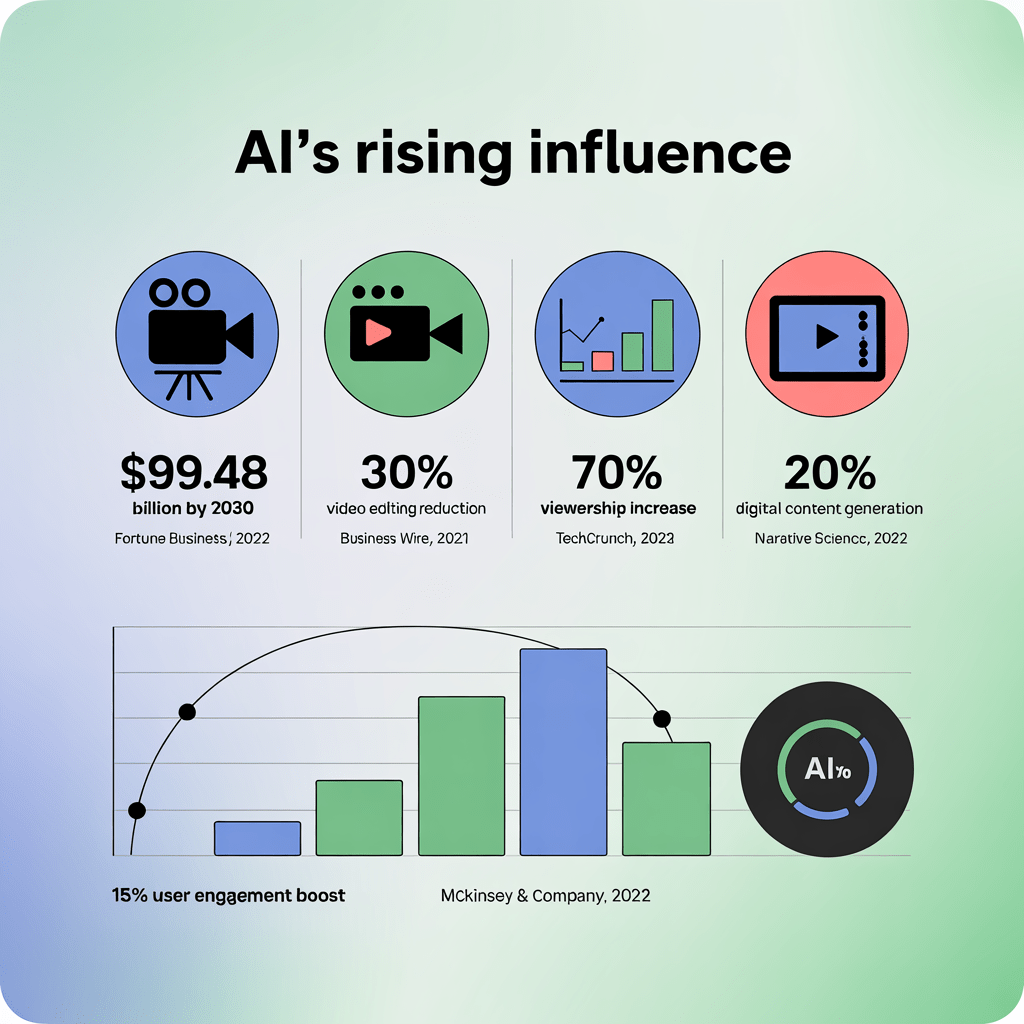
The Role of AI in Media Distribution and Marketing
AI is transforming the way media is distributed and marketed, making processes faster and more efficient. Personalization stands out as one of the most significant advancements. Streaming services like Netflix and Spotify use AI algorithms to analyze user data, crafting personalized recommendations that keep viewers glued to their screens. This isn’t just about suggesting the next movie or song; it’s about understanding and predicting preferences, which keeps user engagement high and churn low.
Another area where AI shines is content distribution optimization. In my experience, AI can pinpoint the best times and platforms to release content for maximum reach and impact. For instance, AI tools analyze social media trends and audience behavior to determine the optimal posting times, ensuring content doesn’t get lost in the digital noise. Warner Bros. used AI to decide when to release ‘Wonder Woman 1984’, balancing between streaming and theatrical releases in the pandemic era, demonstrating AI’s ability to adapt to real-world challenges.
AI-driven analytics also play a crucial role in marketing strategies. By sifting through vast amounts of data, AI can identify which campaigns resonate most with audiences. This allows marketers to fine-tune their strategies, ensuring every dollar spent has a higher chance of return. A common mistake I see is businesses not leveraging these insights fully, often sticking to traditional methods that lack data-backed refinement.
However, there are drawbacks. Data privacy remains a significant concern. As AI collects more data to improve its algorithms, the risk of breaches increases. Companies must balance personalization with privacy, ensuring compliance with regulations like GDPR. Another con is the potential for bias. If AI systems are trained on biased data, they can perpetuate and even amplify these biases in recommendations and marketing strategies. It’s crucial for companies to regularly audit their AI systems to ensure fairness and accuracy.
Ethical Considerations and Challenges of AI in Entertainment
AI in entertainment isn’t just about dazzling visuals or immersive experiences. It intertwines with significant ethical considerations that challenge creators and consumers alike. One pressing issue is bias in algorithms. AI systems are only as good as the data fed into them. If the data reflects societal biases, the outputs will too. Take facial recognition software, for instance. It’s been shown to have higher error rates for minority groups due to underrepresentation in training data. This not only skews representation in media but also risks perpetuating stereotypes.
Another challenge is the loss of human jobs. While AI can automate tasks like video editing or scriptwriting, it threatens creative jobs traditionally held by humans. The Writers Guild of America has raised concerns about AI-generated scripts. Sure, AI can churn out content at breakneck speeds, but can it match the nuance and emotion of a human writer? In my experience, AI lacks the ability to truly grasp cultural context, which is essential in storytelling.
On the flip side, AI offers exciting possibilities. It can enhance creativity by providing tools that artists never dreamed of a decade ago. Consider AI-driven music composition. Artists like Taryn Southern have used AI to co-create music, pushing boundaries in sound innovation. Moreover, AI helps in personalizing content. Streaming services like Netflix use AI to analyze viewing habits, tailoring recommendations to individual tastes. This not only boosts user engagement but also helps niche content find its audience.
But there’s a gray area: privacy concerns. AI’s ability to analyze vast amounts of data poses risks. Personal data used for content recommendations raises issues about user consent and data security. From a practical standpoint, ensuring transparency and user control over data is crucial. The key takeaway here is that while AI in entertainment holds promise, stakeholders must navigate its ethical landscape with caution and responsibility.
Conclusion: The Future of AI in Media and Entertainment
The future of AI in media and entertainment is not just a distant concept—it’s unfolding now. With AI-generated scripts, personalized content recommendations, and deepfake technologies, we’re witnessing a transformation in how content is created, distributed, and consumed. One striking example is Netflix’s algorithm, which analyzes user behavior to suggest tailored content. This has not only increased viewer satisfaction but also boosted Netflix’s viewership metrics significantly.
From a practical standpoint, AI is enabling artists and creators to push boundaries. AI tools like Runway ML are now being used by filmmakers to automate tedious editing processes, allowing them to focus on the creative aspects of storytelling. This democratization of technology means even independent creators can produce content with high production values. However, this ease of access also brings challenges. One con is the potential for oversaturation of content, making it harder for quality work to stand out. Additionally, there’s the ethical dilemma of deepfake technologies, which can be used maliciously to spread misinformation, posing significant risks to societal trust.
On the upside, AI is making waves in accessibility. Services like Descript are revolutionizing podcast production by providing automated transcription and editing tools, making media more accessible to those with hearing impairments. Yet, the reliance on AI raises concerns about job displacement. While AI can handle repetitive tasks, it’s crucial to remember that the nuances of human creativity and judgment are irreplaceable. The key takeaway here is that AI should be viewed as an enabler rather than a replacement.
In my experience, successful integration of AI in this sector hinges on balancing innovation with ethical considerations. Companies need to invest in robust AI governance frameworks to ensure transparency and accountability. The future may be AI-driven, but maintaining human oversight is essential to harnessing its full potential responsibly. Ultimately, the path forward is one of collaboration between human ingenuity and machine efficiency, allowing us to explore new creative horizons while addressing the ethical challenges that arise.