
Machine learning and data science aren’t just buzzwords floating around Silicon Valley. They’re the backbone of how we interpret vast seas of data today. In my experience, the magic lies not just in the algorithms but in how we apply them to solve real-world problems. Whether it’s predicting customer churn or optimizing supply chains, understanding these techniques is crucial for anyone wanting to stay relevant in the tech world.
Table of Contents
- Introduction: Navigating the World of Machine Learning and Data Science
- Understanding the Core Concepts of Machine Learning
- Exploring Essential Data Science Techniques
- Diving into Advanced Machine Learning Algorithms
- Integrating Machine Learning with Big Data
- Practical Applications and Industry Use Cases
- Conclusion: The Future of Machine Learning and Data Science
This guide digs into the nuts and bolts of machine learning and data science, unraveling the complexities without the jargon. We’ll cover key techniques like supervised and unsupervised learning, offering insights into how they differ and when to use each. You’ll also learn about data preprocessing, a vital step that often determines the success of your models. From transforming raw data into something digestible to choosing the right model, every decision shapes your outcomes.
But it’s not just about the how-tos. We’ll explore the ethical considerations and common pitfalls that can derail even the most promising projects. A common mistake I see is people diving headfirst into using the latest algorithm without fully understanding the data they’re working with. The key takeaway here is balance—knowing when to rely on automation and when a human touch is necessary. This guide aims to equip you with the knowledge and confidence to navigate this exciting field effectively.
Introduction: Navigating the World of Machine Learning and Data Science
Machine learning and data science are like the Swiss Army knives of the tech world. They offer a way to tackle diverse problems with precision and adaptability. Machine learning, at its core, is about teaching computers to learn from data. It’s a bit like how humans learn from experience—only faster and on a larger scale. Consider Netflix’s recommendation system; it analyzes your viewing history and predicts what you might like next, refining its accuracy with every click.
In my experience, one common mistake in data science is overlooking the importance of data quality. You could have the most sophisticated algorithms, but if your data is flawed, your insights will be too. Think of data as the fuel for your machine learning engine; poor-quality fuel will lead to a sputtering vehicle. For instance, a retail company might misinterpret customer behavior if their sales data is riddled with errors. The key takeaway here is simple: invest time in cleaning and preprocessing your data.
To put machine learning into action, you need more than just data and algorithms. You need to understand the context of your problem. A predictive model in healthcare, for instance, needs to consider ethical implications and patient privacy. The stakes are higher than, say, predicting movie preferences. From a practical standpoint, always align your technical solutions with business goals. It’s easy to get lost in the weeds of technical feasibility, but remember that the ultimate aim is to drive value.
Pros of machine learning include automation of routine tasks, uncovering hidden patterns, and enabling real-time decision-making. Imagine automating customer support with chatbots that learn from each interaction. Cons, however, include the risk of bias if the training data isn’t representative and the potential for overfitting, where the model performs well on training data but poorly on new data. Balancing these pros and cons is critical for successful implementation.
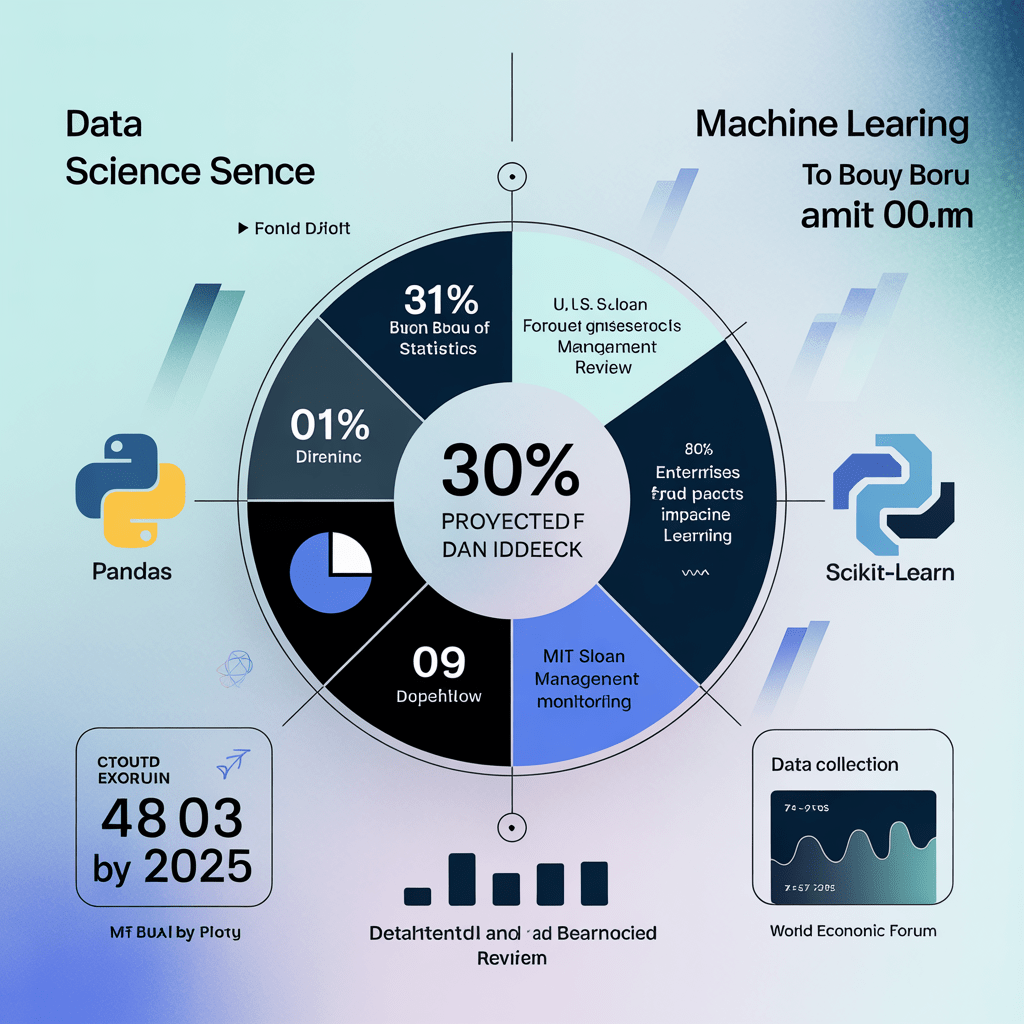
This professional infographic provides a comprehensive overview of critical trends in data science and machine learning. It covers the rapid growth in job demand for data professionals, the positive business impacts of machine learning, the core techniques involved in the data science process, the dominant tools and libraries in the industry, and the expanding scale of data utilization projected for the near future. Vibrant visuals and clear organization are employed to communicate these insights effectively to a professional audience.
Understanding the Core Concepts of Machine Learning
Machine learning can feel like a complex puzzle, but at its heart, it’s about teaching computers to recognize patterns. Imagine a child learning to differentiate between cats and dogs. Initially, they might confuse one for the other, but with time and examples, they start to understand the subtle differences. That’s exactly how a machine learning algorithm works—it learns from data.
In my experience, supervised learning is the most intuitive starting point. Here, you essentially provide the algorithm with labeled data. Think of it as handing over a set of flashcards with the correct answers on the back. This method is powerful for tasks like spam detection in emails. By training on a dataset of known spam and non-spam emails, the algorithm learns to predict the category of new emails. But remember, the quality of your data can make or break the model’s effectiveness.
Then there’s unsupervised learning, which is a bit like asking someone to organize a jumbled box of photos without any instructions. It’s about finding hidden structures in data. A common mistake I see is assuming this approach will always yield clear, actionable insights. In reality, it often requires more nuanced interpretation. Clustering algorithms, like K-means, are popular here, helping in market segmentation by grouping customers with similar purchasing behaviors.
Lastly, reinforcement learning draws from behavioral psychology. Picture training a dog with rewards and penalties. The algorithm learns to make decisions by receiving feedback on its actions. A real-world application is in game AI, where programs learn to play by optimizing strategies through trial and error. The key takeaway here is that while reinforcement learning can be highly effective, it’s computationally expensive and requires careful tuning. A practical standpoint is to start with simpler models before diving into this complex territory.
Exploring Essential Data Science Techniques
Data science is a vast field, but certain techniques stand out as essential tools in any data scientist’s toolkit. Regression analysis is one of these cornerstone techniques. It’s all about understanding relationships between variables. For instance, if you’re predicting house prices, regression helps you quantify how factors like square footage or location influence price. A practical example would be using linear regression to predict future sales based on historical data. In my experience, it’s crucial to remember that while regression can highlight correlations, it doesn’t imply causation. So, always be cautious about drawing direct causal links.
Another indispensable technique is clustering, which involves grouping a set of objects in such a way that objects in the same group are more similar than those in other groups. Take k-means clustering, for example. It’s often used in customer segmentation. By analyzing purchase behavior, businesses can tailor marketing strategies to different customer clusters. However, choosing the right number of clusters can be tricky and requires a good understanding of the problem domain.
Decision trees, on the other hand, are like flowcharts for data decision-making. They’re particularly useful for classification tasks. Imagine you’re working with a large dataset of customer interactions to predict churn. A decision tree can help you identify key decision points that might indicate a customer is likely to leave. Advantages include their interpretability and ability to handle both numerical and categorical data. But beware of overfitting, which can happen if the tree becomes too complex.
In conclusion, mastering these techniques involves more than just understanding the theory. It’s about applying them in real-world scenarios, continuously refining your approach, and learning from each outcome. The key takeaway here is to always tailor these techniques to the specific nuances of your data and problem statement.
Diving into Advanced Machine Learning Algorithms
Advanced machine learning algorithms are like the secret sauce in a data scientist’s toolkit, offering the ability to solve complex problems that simpler models just can’t handle. One standout example is Gradient Boosting Machines (GBM). In my experience, GBM excels at tasks like ranking, classification, and regression. It works by building trees sequentially, each new tree correcting errors made by the previous ones. This iterative process can result in highly accurate models, especially when configured appropriately.
However, GBM’s complexity brings both advantages and challenges. Pros include its ability to handle different types of data with minimal preprocessing and its effectiveness in reducing bias and variance, resulting in high predictive accuracy. It’s also highly flexible, allowing for customization through parameters like learning rate and tree depth. Cons, though, include its tendency to overfit if not properly tuned, and its computational heaviness, which can lead to long training times, especially on large datasets.
Another heavy hitter in the advanced algorithm arena is Support Vector Machines (SVM). SVMs are particularly useful for classification problems, where the data is not linearly separable. They work by transforming data into a higher dimension using a technique called the kernel trick, which can make it easier to separate classes with a hyperplane. In real-world applications, such as image recognition, SVMs have proven their mettle by accurately classifying complex datasets.
But SVMs aren’t without their own set of challenges. Pros include their effectiveness in high-dimensional spaces and their robustness to overfitting, particularly in cases where the number of dimensions exceeds the number of samples. On the downside, SVMs can be less effective on very large datasets due to their high computational cost. And selecting the right kernel function isn’t always straightforward, often requiring domain expertise to avoid poor model performance.
The key takeaway here is that while advanced algorithms like GBM and SVM offer powerful tools for tackling complex problems, they require careful tuning and expertise to harness their full potential. Whether you’re looking to improve accuracy or tackle a specific problem type, understanding these algorithms deeply can be a game-changer in your machine learning journey.
Integrating Machine Learning with Big Data
Integrating machine learning with big data isn’t just a trend; it’s a necessity for businesses aiming to stay competitive. The sheer volume of data generated today—estimated to hit 175 zettabytes by 2025—demands more than traditional data processing methods. Machine learning algorithms are key to sifting through this ocean of information, extracting valuable insights that can drive decision-making and innovation.
A practical example is in predictive maintenance for manufacturing. Machines equipped with sensors generate vast amounts of data every second. Machine learning models, like neural networks, can analyze this data in real-time to predict equipment failures before they happen. This not only saves costs associated with downtime but also extends the life of machinery.
Another domain reaping benefits is personalized marketing. With big data, companies can use machine learning to analyze customer behavior patterns and preferences. Recommendations engines, like those used by Netflix or Amazon, are prime examples. They sift through massive datasets to suggest products or content that align with individual user preferences, significantly boosting user engagement and sales.
However, there are challenges. One major con is data quality. Machine learning models are only as good as the data fed into them. Inaccurate or incomplete data can lead to poor model performance. Another issue is the computational cost. Processing big data with machine learning requires significant computational resources, which can be expensive and environmentally taxing.
In my experience, the key to overcoming these cons is a robust data governance strategy. Ensure data quality through rigorous cleaning processes and invest in efficient, scalable infrastructure. By doing so, businesses can fully harness the synergy between machine learning and big data to foster innovation and maintain a competitive edge.
Practical Applications and Industry Use Cases
Machine learning and data science aren’t just buzzwords—they’re the engines behind some of today’s most innovative solutions. Take healthcare, for instance. Predictive analytics is transforming patient care by foreseeing potential health risks. In hospitals, algorithms analyze patient data, identifying patterns that might signal a future health crisis. For example, by examining electronic health records, a predictive model can flag patients at risk for conditions like diabetes or heart disease, enabling early intervention.
Retail is another sector reaping significant benefits. Inventory management is a perfect example. Retailers use machine learning models to predict product demand with surprising accuracy. By analyzing historical sales data, seasonal trends, and even social media buzz, stores can optimize stock levels, reducing both surplus and shortages. This not only cuts costs but also enhances customer satisfaction as products are available when and where they’re needed.
In the world of finance, fraud detection has seen a revolution. Traditional methods relied heavily on manual reviews and predefined rules, which were slow and often inaccurate. Now, machine learning algorithms can scrutinize thousands of transactions in real time, spotting anomalies that might indicate fraud. These systems adapt and learn from new data, improving their accuracy over time. A practical downside, though, is the potential for false positives, where legitimate transactions are flagged erroneously, causing inconvenience to customers.
While these applications are groundbreaking, they come with challenges. Data privacy is a major concern. As companies collect and analyze vast amounts of data, the risk of breaches grows. Businesses must implement strict data governance policies to protect sensitive information. Another challenge is the resource intensity of deploying these technologies. Developing and maintaining sophisticated models require significant computational power and expertise, which can be a barrier for smaller organizations. Despite these hurdles, the benefits of machine learning and data science continue to drive innovation across industries.
Conclusion: The Future of Machine Learning and Data Science
The future of machine learning and data science is less about the technology itself and more about how we integrate it into our everyday lives. We’ve reached a point where algorithms can outperform humans in many analytical tasks, but the real challenge lies in their application. In my experience, the most successful implementations are those where machine learning complements human intuition. Think of how recommendation systems on streaming platforms suggest not just what you might like based on data, but also introduce you to content outside your usual preferences. This blend of data-driven insights and human curiosity is where the magic happens.
However, as we push forward, ethical considerations become unavoidable. A common mistake I see is the blind trust in algorithms without questioning their biases. For instance, facial recognition software has faced criticism for misidentifying individuals from minority groups at a higher rate than others. The key takeaway here is not to discard these technologies but to refine them. Transparent data practices and diverse data sets are essential for building fair algorithms. Businesses must prioritize ethical AI by auditing their models regularly to ensure fairness and accuracy.
From a practical standpoint, data scientists need to focus on interpretability. The black box nature of many models can be a barrier to their adoption in sectors where understanding the ‘why’ is as crucial as the ‘what’. For instance, healthcare professionals require clear explanations of AI-driven diagnoses to trust and act upon them. Utilizing techniques like LIME or SHAP, which offer insights into feature importance and model predictions, can bridge this gap.
The key to advancing machine learning and data science is collaboration. No single field holds all the answers, and the interdisciplinary approach promises the most significant breakthroughs. By bringing together experts from disparate domains, we not only enhance the models but also ensure their relevance and applicability in solving real-world problems. The future is bright, but only if we navigate it thoughtfully, blending technology with human insight.