
Natural Language Processing, or NLP, isn’t just about teaching machines to understand human language. It’s a field that is reshaping how we interact with technology daily. Imagine talking to your smartphone, and it actually understanding you, not just responding with pre-programmed answers. That’s the potential of NLP. From virtual assistants like Siri and Alexa to real-time translations and sentiment analysis, NLP is quietly but significantly changing the tech landscape.
Table of Contents
- Introduction: Unveiling the World of Natural Language Processing
- The Fundamentals of Natural Language Processing
- Key Techniques in Natural Language Processing
- Understanding Tokenization and Text Preprocessing
- Exploring Machine Learning Models in NLP
- Real-World Applications of Natural Language Processing
- Conclusion: Embarking on Your NLP Journey
Understanding NLP techniques can seem daunting at first. There’s a myriad of algorithms and models, each with its own purpose and complexity. But don’t worry, this guide is here to break down these concepts into bite-sized, digestible parts. We’ll explore the essentials of how machines learn to process language, including methods like tokenization, parsing, and sentiment analysis. Each section will provide a window into how these techniques are applied in real-world scenarios, making the technical jargon feel a bit less intimidating.
The importance of getting a grip on NLP can’t be overstated. For tech enthusiasts, developers, and anyone intrigued by the intersection of language and technology, understanding NLP is crucial. It’s not just about enhancing user experiences; it’s about empowering machines to understand the nuances of human communication. Whether you’re looking to build smarter apps or just curious about how your phone understands your voice commands, this guide will equip you with the foundational knowledge you need. Let’s dive into the world of NLP and see how it’s quietly revolutionizing our digital lives.
Introduction: Unveiling the World of Natural Language Processing
In the realm of technology, Natural Language Processing (NLP) stands as a fascinating bridge between human communication and machine understanding. It’s all about teaching computers to grasp, interpret, and even generate human language in ways that feel natural to us. In my experience, one of the most compelling aspects of NLP is its ability to transform unstructured data into structured insights. Think of the mountains of text data generated every day from emails, social media, and customer reviews. NLP techniques help make sense of this data, turning it into actionable information.
Consider a practical example: sentiment analysis. It’s a technique that businesses use to understand how customers feel about their products or services. By processing thousands of reviews or tweets, NLP can determine if the sentiment is positive, negative, or neutral. This isn’t just number crunching; it’s about context and nuance. For instance, the phrase “I can’t wait to use it again” is positive, but “I can’t use it anymore” is negative. Subtle differences like these highlight the sophistication needed in NLP algorithms.
Another everyday example is machine translation. Services like Google Translate rely heavily on NLP to convert text from one language to another. But it’s not just about word-for-word translation. The system needs to understand idioms, cultural references, and context to provide meaningful translations. Here lies a challenge: while NLP has made significant strides, it’s not perfect. Machines struggle with sarcasm, irony, and the ever-evolving nature of language. This is where human expertise remains crucial.
The key takeaway here is that while NLP is incredibly powerful, it’s not a silver bullet. It can automate and enhance many tasks, but it still requires human oversight and refinement. As NLP continues to evolve, the collaboration between humans and machines will only deepen, offering new possibilities for innovation and understanding.
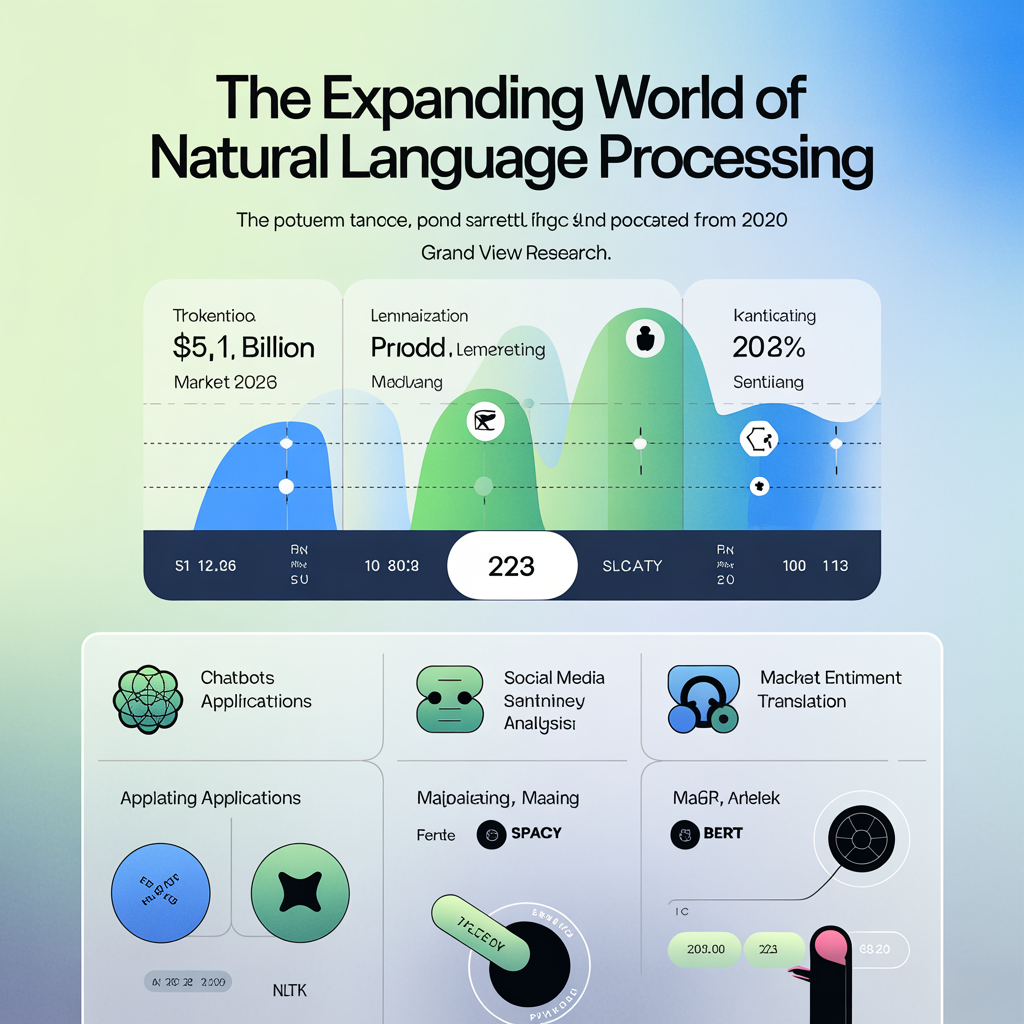
This professional infographic delves into the pivotal elements of the growing Natural Language Processing (NLP) market, projected to reach a valuation of $35.1 billion by 2026, as per Grand View Research. It showcases essential NLP techniques such as Tokenization, Lemmatization, NER, and Sentiment Analysis. The infographic also highlights influential use cases including the role of NLP in chatbots, social media sentiment analysis, and machine translation. Furthermore, it provides insights into popular NLP tools like NLTK, SpaCy, and BERT, making it an informative resource for understanding the current and future landscape of NLP technologies.
The Fundamentals of Natural Language Processing
Natural Language Processing (NLP) is the bridge between human communication and computer understanding. At its core, NLP involves teaching machines to interpret and generate human language, which is not a straightforward task because language is inherently complex and context-dependent. Think of it like teaching a child to understand not just words, but the meaning behind them, considering nuances, idioms, and even sarcasm.
To grasp NLP, it’s essential to understand tokenization. This is the process of splitting text into smaller units called tokens, which could be words, phrases, or characters. For instance, the sentence “I love AI” would be broken down into individual words or tokens: “I,” “love,” and “AI.” Tokenization helps in analyzing the text’s structure and is a fundamental step for further processing.
Next up is part-of-speech tagging—a method to identify the grammatical parts of speech for each token. This means determining if a word functions as a noun, verb, adjective, etc., within the sentence. For example, in “Time flies like an arrow,” “flies” is a verb, while in “Fruit flies like bananas,” “flies” is a noun. This distinction is crucial for machines to understand context correctly.
A critical aspect of NLP is named entity recognition (NER), which involves identifying and classifying key information (entities) in text into predefined categories like names, organizations, dates, and so on. For instance, in “Google was founded on September 4, 1998,” NER helps a machine recognize “Google” as an organization and “September 4, 1998” as a date. This allows systems to extract meaningful data from text, supporting applications like search engines and chatbots. Understanding these fundamental techniques is pivotal for anyone diving into the world of NLP.
Key Techniques in Natural Language Processing
Natural Language Processing (NLP) is a fascinating blend of linguistics, computer science, and AI that aims to make human language comprehensible to machines. At its core, NLP revolves around several key techniques that enable computers to understand, interpret, and respond to human language in meaningful ways. One foundational technique is tokenization, where text is split into smaller units like words or phrases. Think of it as breaking down a sentence into its building blocks. For instance, the sentence “The cat sat on the mat” would be tokenized into individual words. This process is crucial because it lays the groundwork for more complex analysis.
Another critical method is part-of-speech tagging. This technique assigns parts of speech to each word, such as nouns, verbs, and adjectives. In my experience, this helps machines understand the grammatical structure of sentences. For example, in “The quick brown fox jumps over the lazy dog,” identifying “fox” as a noun and “jumps” as a verb helps clarify the sentence’s meaning. This understanding can improve tasks like translation or sentiment analysis.
Named Entity Recognition (NER) is another powerful tool in the NLP arsenal. It zeroes in on specific pieces of information within text, like names, dates, or locations. For example, in the sentence “John visited Paris in July,” NER would highlight “John” as a person, “Paris” as a location, and “July” as a date. This technique is particularly useful in data extraction, allowing businesses to glean valuable insights from vast text datasets.
However, NLP isn’t without its challenges. A significant hurdle is ambiguity. Words can have multiple meanings, and context is key to disambiguating them. For instance, the word “bank” could refer to a financial institution or the side of a river. Another issue is cultural nuances. Language is deeply tied to culture, and subtle differences can drastically alter meaning. Despite these challenges, the advancements in NLP continue to push the boundaries, making machines better at understanding the complexities of human language.
Understanding Tokenization and Text Preprocessing
Tokenization and text preprocessing are foundational steps in natural language processing (NLP). Tokenization, in simple terms, is about breaking text into pieces, or ‘tokens’. These tokens are often words, but they can also be phrases or symbols, depending on the processing needs. Why does this matter? Because algorithms need these smaller units to analyze text more effectively.
In my experience, a common mistake is overlooking the variety in tokenization strategies. For instance, word tokenization splits text at spaces and punctuation. But consider subword tokenization, like Byte Pair Encoding (BPE). This method is powerful because it balances vocabulary size and text representation. It breaks words into smaller subword units, allowing models to handle rare words better. For example, “unhappiness” might split into “un”, “happi”, and “ness”. This approach is especially useful in languages with rich morphology.
Text preprocessing is equally crucial. It’s about cleaning and normalizing text before analysis. Imagine sifting through noisy data with inconsistent casing, punctuation, and stopwords. Preprocessing involves converting text to lowercase, removing unwanted characters, and sometimes stemming or lemmatizing words to their root forms. For example, words like ‘running’ and ‘ran’ might be reduced to ‘run’. This ensures that algorithms aren’t confused by variations of the same word.
However, there are pros and cons to consider. Pros: 1) Better model performance by reducing vocabulary size and computational load. 2) Enhanced consistency in text data for improved analysis. 3) Flexibility in handling different languages and dialects. Cons: 1) Over-preprocessing can strip away context, leading to loss of meaning. 2) It’s resource-intensive initially, requiring thoughtful setup and tuning. The key takeaway here? Proper tokenization and preprocessing lay a strong foundation for any NLP task, ensuring that your models have the cleanest, most meaningful data to work with.
Exploring Machine Learning Models in NLP
Machine Learning Models serve as the backbone of Natural Language Processing (NLP). The most common models you’ll encounter are supervised and unsupervised learning models. Supervised learning models, like the famous Support Vector Machines (SVM) and Logistic Regression, rely on annotated datasets to train and make predictions. These models excel in classification tasks, such as sentiment analysis, where the goal is to categorize text into positive, negative, or neutral sentiments. For instance, SVM can effectively classify emails as spam or not, thanks to its ability to find the optimal boundary between different classes.
On the other hand, unsupervised models don’t need labeled data. Techniques like clustering and topic modeling fall here. Take Latent Dirichlet Allocation (LDA), a popular topic modeling technique. It’s great for discovering underlying themes in text documents. Imagine you have a collection of news articles. LDA can help you identify distinct topics, such as politics, sports, or technology, even if the articles aren’t pre-labeled. The key takeaway here is that while unsupervised models offer flexibility, they often require more interpretation and validation to ensure meaningful results.
Neural Networks, especially deep learning models, have become the gold standard in NLP. Recurrent Neural Networks (RNNs) and their more advanced cousin, the Transformer model, have revolutionized the field. With RNNs, handling sequential data like time series or sentences becomes feasible due to their ability to maintain temporal information. However, RNNs struggle with long-range dependencies, which is where Transformers shine. Attention mechanisms allow these models to weigh the importance of different parts of the input sequence, leading to better performance in tasks like machine translation.
Despite these advances, machine learning models come with challenges. Data dependency is a significant hurdle; these models need vast amounts of quality data. Inadequate or biased data can skew results, leading to poor real-world applicability. Additionally, computational resources can be a bottleneck. Training deep learning models, especially Transformers, requires substantial processing power and memory, making them less accessible for smaller organizations. On the flip side, the benefits include robust performance in understanding and generating human language, and continuous improvement as models are refined and datasets grow.
Real-World Applications of Natural Language Processing
Natural Language Processing (NLP) is quietly woven into our daily lives, often in ways we don’t even notice. From virtual assistants to translation services, NLP is the backbone of many technologies. Take virtual assistants like Siri, Alexa, or Google Assistant. These tools rely heavily on NLP to understand voice commands and perform tasks, from setting reminders to controlling smart home devices. In 2020, it was reported that over half of U.S. adults used voice assistants, underscoring how entrenched this technology has become in our routines.
Another notable application is in the realm of customer service. Chatbots, powered by NLP, are at the front line of customer support for many companies. They handle basic queries efficiently, freeing up human agents for more complex issues. A common mistake some businesses make is underestimating the complexity of human language, leading to poorly designed chatbots. However, when implemented correctly, they not only improve response times but also enhance customer satisfaction. In fact, a study found that chatbots could handle up to 80% of routine customer inquiries, providing significant cost savings.
Sentiment analysis is another powerful use of NLP. Companies use it to gauge public opinion on social media, analyzing tweets or reviews to understand consumer sentiment towards products or services. This real-time feedback can inform marketing strategies or product development. But it’s not without challenges. Sarcasm and context can skew results, which is a limitation that developers are continually working to overcome.
A lesser-known but impactful application is in the medical field. NLP helps in processing clinical notes and research papers, making it easier for healthcare professionals to access patient information and the latest studies. This can lead to more informed treatment plans and improved patient outcomes. However, the sensitive nature of medical data means there’s a constant need for robust privacy measures. The key takeaway here is that while NLP applications are vast and varied, they must be implemented thoughtfully to truly add value.
Conclusion: Embarking on Your NLP Journey
Embarking on your journey with Natural Language Processing (NLP) can be both exciting and daunting. The key takeaway here is that, like any technology, NLP isn’t a monolithic tool but a collection of techniques and algorithms that can be adapted to your specific needs. Whether you’re parsing social media sentiment or building a chatbot, understanding the nuances of NLP can lead to more effective and intelligent applications.
Consider the example of sentiment analysis, a common application of NLP. In practice, sentiment analysis can help companies gauge customer opinions on products by analyzing reviews and social media posts. In my experience, a well-tuned sentiment analysis model can provide insights that are otherwise buried in massive amounts of text data. However, it’s crucial to remember that sentiment analysis is sensitive to context. Sarcasm, for instance, can throw off even the most sophisticated models, leading to misguided interpretations.
From a practical standpoint, one of the primary benefits of NLP is its ability to automate repetitive tasks. For instance, spam detection in emails relies heavily on NLP techniques to filter out unwanted content. This not only saves time but also enhances productivity across various sectors. Another pro is the potential for improved accessibility. NLP powers voice recognition systems, allowing individuals with disabilities to interact with technology more seamlessly. However, a common mistake I see is underestimating the computational resources required for efficient NLP processing. Training models can be resource-intensive, necessitating a careful balance between performance and cost.
Despite its advantages, NLP isn’t without its challenges. One con is the language barrier—models trained in one language often don’t translate well to another without significant retraining. Furthermore, ethical concerns arise regarding data privacy and bias. Models trained on biased datasets can perpetuate stereotypes, leading to unfair outcomes. As you delve deeper into NLP, remain vigilant about these issues. The bottom line is that while NLP offers powerful tools, thoughtful implementation is crucial to harnessing its full potential.