
In the buzzing world of IoT, data doesn’t sleep. Devices talk to each other non-stop, generating streams of information that could easily drown anyone trying to make sense of it all. This is where machine learning steps in as a knight in digital armor, offering the ability to process these torrents of data in real-time, turning chaos into clarity. But why does this matter? Well, the ability to swiftly interpret data streams can mean the difference between a system that simply reacts and one that anticipates and adapts, providing smarter, more efficient outcomes.
Table of Contents
- Introduction: The Intersection of Machine Learning and IoT in Real-Time Data Processing
- Understanding Real-Time Data Stream Processing
- The Role of Machine Learning in Enhancing IoT Data Streams
- Key Machine Learning Techniques for Real-Time Processing
- Challenges and Solutions in Implementing Machine Learning for IoT
- Case Studies: Successful Applications of Machine Learning in IoT
- Conclusion: The Future of Real-Time Data Processing in IoT with Machine Learning
Consider this: a smart city brimming with sensors, each one capturing data on traffic, weather, energy usage, and more. Without real-time processing, this city is like a symphony without a conductor—full of potential but lacking harmony. Machine learning algorithms can sift through this data, identifying patterns and anomalies as they happen. From a practical standpoint, this means traffic lights that adjust to real-time congestion, energy grids that optimize usage dynamically, and even public safety systems that respond instantly to emerging threats.
This article takes you through the nuts and bolts of using machine learning for real-time data stream processing in IoT environments. We’ll explore how it all works, the benefits it brings, and the hurdles that come with it. The key takeaway here is not just understanding the technology but appreciating its impact—how it can transform IoT from a buzzword into a powerhouse of innovation. Whether you’re an engineer, a tech enthusiast, or someone curious about the future of IoT, this exploration offers insights into a world where machines not only learn but also act, making our environments smarter and more responsive.
Introduction: The Intersection of Machine Learning and IoT in Real-Time Data Processing
Machine learning and the Internet of Things (IoT) are like two sides of a coin, each amplifying the other’s potential. When these technologies meet, especially in real-time data processing, they create a powerhouse of possibilities that can transform industries. Machine learning brings the ability to analyze vast amounts of data rapidly, finding patterns and making predictions that humans might miss. On the other hand, IoT provides the data—streams of information collected by sensors and devices in real-time. Together, they unlock new avenues for innovation.
In my experience, one of the most compelling applications of this synergy is in smart cities. Imagine a network of sensors across a city monitoring traffic flow, air quality, and energy usage. Machine learning algorithms process this constant data stream, providing insights that help manage congestion, reduce pollution, and optimize energy consumption. This isn’t just a theoretical exercise; cities like Barcelona and Singapore are already leveraging these technologies to enhance urban living.
But it’s not all smooth sailing. Integrating machine learning with IoT in real-time data processing presents challenges. Scalability is a significant hurdle. As IoT networks grow, the amount of data can be overwhelming, demanding robust infrastructure. In a practical sense, ensuring real-time processing means investing in cutting-edge hardware and software solutions, which can be costly.
Privacy is another concern. With so many devices collecting data, often sensitive, safeguarding this information is crucial. A breach could have severe consequences. Therefore, organizations must implement strong security measures and ensure compliance with data protection regulations. This intersection of machine learning and IoT in real-time data processing is a double-edged sword—offering immense potential but requiring careful navigation to avoid pitfalls.
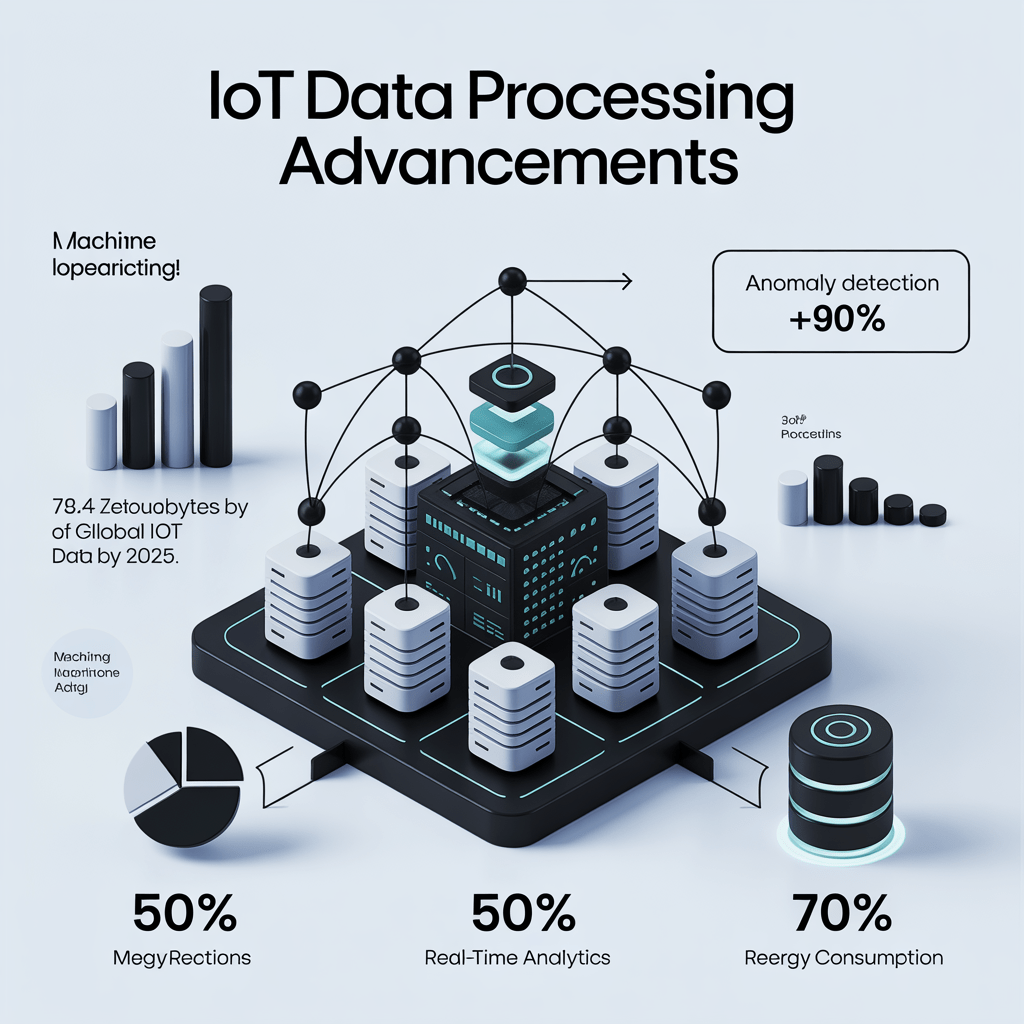
This professional infographic presents significant developments in IoT data processing and analytics. It highlights the substantial reduction in latency through machine learning, the projected increase in global IoT data necessitating real-time solutions, the shift towards real-time analytics for immediate insights, enhanced energy efficiency in IoT networks via edge-optimized models, and improved anomaly detection rates enhancing system reliability and security. Each statistic is drawn from authoritative sources, offering a comprehensive overview of this rapidly evolving technological landscape.
Understanding Real-Time Data Stream Processing
Real-time data stream processing is the backbone of IoT networks. It allows devices to communicate and respond instantly, which is crucial when you think about applications like autonomous vehicles or smart grids. Imagine a self-driving car that needs to avoid a pedestrian. It can’t afford even a second’s delay in processing sensor data. That’s where the magic of real-time processing steps in.
At its core, real-time processing involves ingesting continuous data flows and making immediate, actionable decisions. Contrast this with batch processing, where data is collected over time and analyzed later. For IoT, waiting isn’t an option. Take healthcare, for example. Wearable devices monitoring heart rates need to alert medical professionals of anomalies immediately, not an hour later. This difference can literally save lives.
Machine learning plays a pivotal role here. By applying algorithms to the incoming data, systems can learn and adapt in real-time. Picture a factory using IoT sensors to monitor equipment health. Machine learning models can predict failures before they happen, reducing downtime and saving costs. But it gets tricky. These systems must handle high data volumes and maintain low latency. Achieving this balance requires optimized algorithms and efficient data architecture.
However, it’s not all smooth sailing. One challenge is data inconsistency. IoT devices often produce noisy data, leading to potential errors in real-time decision-making. Another hurdle is scalability. As more devices come online, systems need to scale without losing performance. Despite these challenges, the benefits—like improved operational efficiency and enhanced safety—make real-time data processing indispensable in the IoT landscape.
The Role of Machine Learning in Enhancing IoT Data Streams
Machine learning (ML) plays a vital role in making IoT data streams more effective and insightful. IoT devices generate vast amounts of data every second. The challenge lies in processing this flood of information quickly and accurately. This is where ML steps in, offering the ability to analyze patterns and anomalies in real-time. For instance, in a smart home setting, ML algorithms can sift through data from various sensors to automate tasks, like adjusting the thermostat or turning off lights when a room is empty. This not only enhances convenience but also optimizes energy consumption.
Real-world examples showcase the power of ML in IoT. Consider a smart city infrastructure. Traffic sensors equipped with ML algorithms can predict congestion and adjust traffic light patterns accordingly, reducing travel time and emissions. Similarly, in healthcare, wearable devices continuously monitor vital signs. ML models can detect irregularities that might indicate a health issue, alerting medical professionals instantly. This proactive approach can save lives by catching problems early.
However, implementing machine learning in IoT isn’t without challenges. Pros include enhanced decision-making capabilities, as ML can process and interpret data faster than any human. There’s also the benefit of continuous improvement; ML models learn and adapt over time, getting better at their tasks. Lastly, ML helps automate processes, reducing the need for human intervention and minimizing errors.
On the flip side, there are cons. First, the complexity of deploying ML models in real-time IoT systems can be daunting. It requires significant expertise and resources. Another issue is data privacy. With so much data being processed, ensuring it remains secure and confidential is a major concern. Companies must balance technological advancement with ethical responsibility, ensuring they’re using data ethically and transparently.
Key Machine Learning Techniques for Real-Time Processing
In the realm of real-time data stream processing for IoT, machine learning techniques play a pivotal role in extracting actionable insights. Online learning, a subset of machine learning, stands out here. Unlike traditional models trained on static datasets, online learning updates its parameters continuously as new data arrives. This adaptability is crucial for IoT, where data flows are incessant, and patterns can shift rapidly. A compelling example is in predictive maintenance for industrial machinery. The model continuously learns from sensor data, recognizing wear and tear patterns as they evolve, thus preemptively alerting to potential failures.
Another technique making waves is reinforcement learning. This method involves agents making sequences of decisions by learning from their interactions with the environment. In IoT, this can be particularly useful for optimizing resource allocation in complex networks. Consider a smart grid system where energy consumption needs to be balanced dynamically. Reinforcement learning can help adjust the distribution of power in real-time based on consumption patterns, thus enhancing efficiency and reducing waste.
Anomaly detection is also critical, especially in security-sensitive applications. Machine learning models are trained to identify deviations from the norm, flagging potential threats. For instance, in a smart home system, unexpected activity patterns might indicate a security breach. By leveraging historical data, these models can differentiate between benign anomalies and genuine threats, providing homeowners with timely alerts.
While these techniques offer significant benefits, they come with challenges. Data volume and velocity can overwhelm systems not adequately designed to handle them, leading to latency issues. Additionally, model drift—where the model’s performance degrades over time as it diverges from the current data distribution—can be problematic. Regular model updates and performance monitoring are essential to mitigate these issues and maintain the efficacy of real-time processing systems.
Challenges and Solutions in Implementing Machine Learning for IoT
Implementing machine learning in IoT devices to process real-time data streams isn’t just about plugging in algorithms and calling it a day—it’s a complex dance with a few pitfalls along the way. A significant challenge is the sheer volume and velocity of data generated by IoT devices. With billions of devices globally, each pumping out data continuously, the task of processing and analyzing this information in real time can be overwhelming. Traditional infrastructure often buckles under this pressure, requiring solutions like distributed computing or edge computing to handle the load effectively.
In my experience, data quality issues often trip up machine learning efforts. IoT devices can produce noisy, incomplete, or inconsistent data, which can lead to poor model performance. For example, a smart thermostat might report temperature readings inaccurately due to sensor faults. This means robust data preprocessing and cleaning routines are critical before any machine learning model can be trained effectively. Regular audits and updates to these routines can help maintain data integrity.
Resource constraints pose another hurdle. IoT devices are typically resource-limited, with minimal processing power and battery life. Running complex machine learning models directly on these devices isn’t feasible. Instead, lightweight models or compressed versions of neural networks, such as TensorFlow Lite, can provide a balance between performance and resource usage. This approach allows for some degree of local processing, reducing latency and bandwidth requirements while conserving energy.
On the solution side, cloud integration offers a promising path. Offloading intensive tasks to the cloud can alleviate local resource constraints. However, this introduces latency and potential privacy concerns. A hybrid model, where critical tasks are processed at the edge and others in the cloud, can offer a balanced solution. It’s a strategic blend that maximizes efficiency without sacrificing real-time capabilities or security. The key takeaway is that while challenges abound, careful planning and innovative approaches can make machine learning a powerful tool for IoT data stream processing.
Case Studies: Successful Applications of Machine Learning in IoT
Machine learning has found its footing in IoT by enhancing how we handle real-time data streams. A standout example is its application in smart cities. Take Barcelona, for instance. This city utilizes machine learning algorithms to optimize traffic flow, reducing congestion by up to 30%. It works by processing data from sensors embedded in the roadways and traffic lights. The system learns patterns and adjusts signals in real-time, smoothing commutes for thousands daily.
In the industrial sector, predictive maintenance has become a game-changer. Consider GE Aviation, which uses machine learning to monitor aircraft engine performance. By analyzing the continuous stream of sensor data, they predict failures before they occur, reducing engine downtime by 25%. This not only saves millions of dollars but also enhances safety and efficiency.
Another interesting application is in smart agriculture. John Deere has integrated machine learning into its farming equipment to optimize crop yields. Their tractors equipped with IoT sensors and machine learning capabilities analyze soil conditions, weather patterns, and crop health. This technology has enabled farmers to increase yields by up to 15% while reducing resource use.
However, these benefits come with challenges. One major concern is data privacy. With so much data being collected, securing it against breaches is crucial. Another issue is the complexity of deployment. Implementing such systems requires significant expertise and initial investment, making it daunting for smaller entities. Despite these hurdles, the potential for efficiency and innovation makes the integration of machine learning in IoT a compelling pursuit.
Conclusion: The Future of Real-Time Data Processing in IoT with Machine Learning
Machine learning is transforming real-time data processing in IoT, and it’s doing it in ways that were hard to predict a few years back. The ability to process data streams as they happen means that IoT devices can now provide insights and responses in milliseconds. Take smart cities, for example. Traffic sensors can now use machine learning to optimize traffic flow by analyzing real-time data and adjusting signals accordingly. It’s not just about moving cars faster; it’s about reducing emissions and making cities more livable.
Pros:
Real-Time Decision Making: Machine learning models can predict equipment failures in industrial IoT settings before they happen, saving significant downtime and costs. Companies like GE use machine learning to monitor and predict aircraft engine performance, potentially saving millions.
Improved Efficiency: By automating data processing and decision-making, machine learning reduces the need for human intervention. This automation can lead to more efficient systems that require less oversight, particularly in areas like energy management in smart grids.
Scalability: As IoT deployments grow, the volume of data increases exponentially. Machine learning helps scale data processing capabilities without a linear increase in resources. This is critical for applications like autonomous vehicles, where vast amounts of data need to be processed continuously.
Cons:
Data Privacy Concerns: With great data processing power comes the need for robust privacy measures. IoT devices often handle sensitive data, and machine learning models must be designed with privacy in mind to prevent unauthorized access.
Complexity and Cost: Implementing machine learning in IoT is not a plug-and-play solution. It requires significant investment in infrastructure and talent. Many organizations underestimate this complexity, leading to potential project failures.
In my experience, the key takeaway here is that while machine learning opens up incredible possibilities for IoT, it also demands careful planning and execution. Businesses should not only focus on the technological capabilities but also consider the ethical and logistical implications of deploying these advanced systems. Balancing innovation with responsibility will be crucial as we forge ahead into this new era of interconnected intelligence.